

Brazilian Portuguese Pronunciation: A Complete Guide to Sounds, Stress, and Real Speech
Clearer speech and stronger listening
Brazilian Portuguese pronunciation becomes much easier when you stop treating every letter as a fixed English sound. Portuguese spelling is relatively systematic, but the same letter can still change according to position, stress, neighboring sounds, and regional accent.
This guide focuses on the patterns that make the biggest difference to intelligibility: oral and nasal vowels, word stress, R, S, LH, NH, T and D, final vowels, connected speech, and regional variation.
The objective is not to erase your accent. It is to produce contrasts clearly, understand Brazilians from different regions, and speak without forcing every word through English sound patterns.
rather than memorizing misleading spellings
instead of chasing a single “perfect” accent
because recognition comes before automatic use
especially in R, S, T, D, and final vowels
Twelve pronunciation patterns to learn first
Start with these patterns before trying to master every spelling rule.
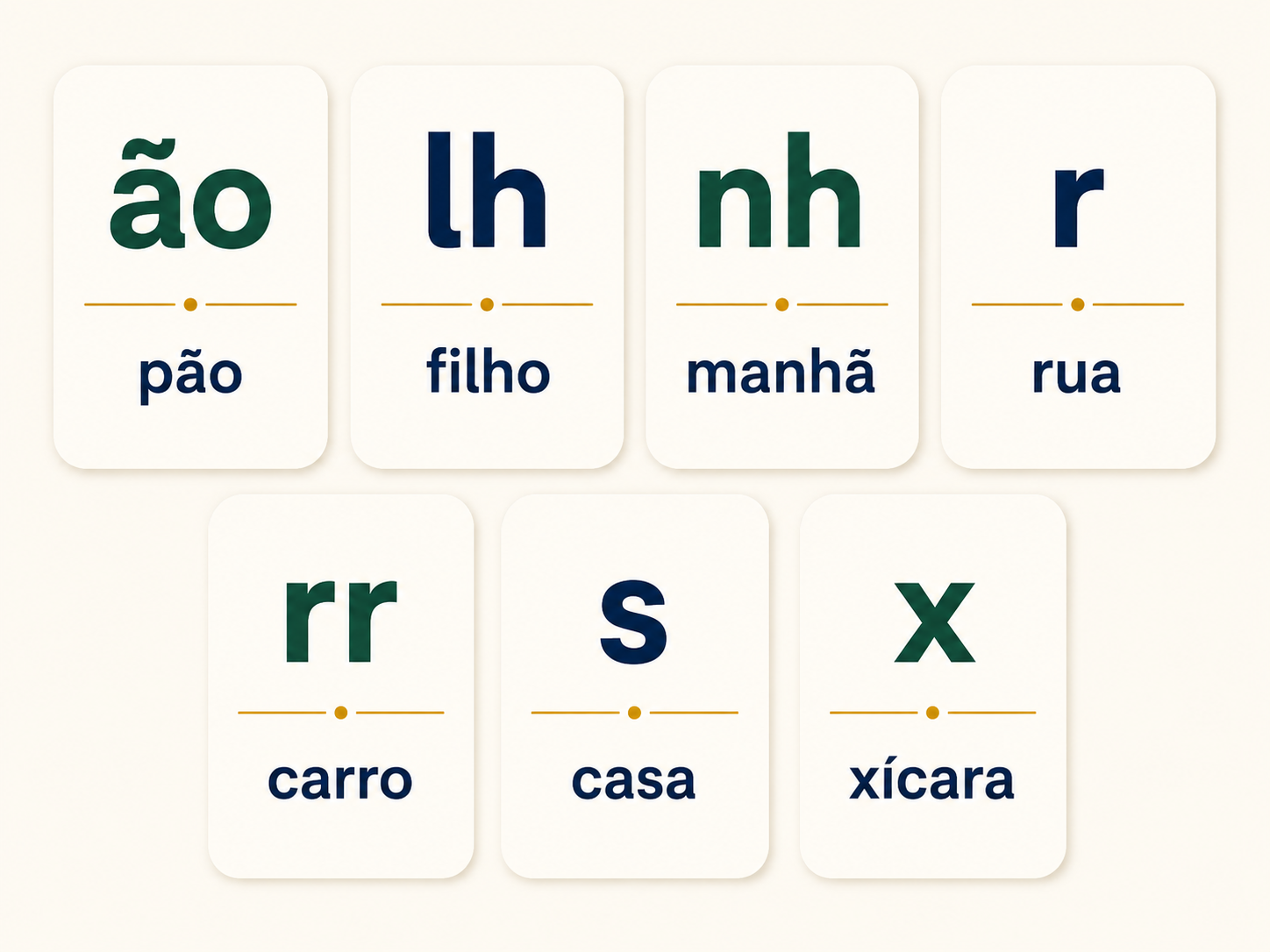
| Pattern | What often happens | Examples |
|---|---|---|
| Final unstressed o | often sounds closer to u | livro, obrigado |
| Final unstressed e | often sounds closer to i | cidade, noite |
| ão | nasal diphthong | não, pão |
| nh | one palatal nasal sound | banheiro |
| lh | one palatal lateral sound | filho |
| j / ge / gi | sound similar to s in measure | já, gente, girafa |
| ch | usually sh | chave |
| single r between vowels | quick tap | caro |
| initial r / rr | strong regional R | rua, carro |
| s between vowels | usually z | casa |
| t / d before i sound | often ch / j-like | tia, dia, cidade |
| x | must often be learned word by word | xícara, táxi, exame |
Why English-style respellings are only approximations
Spellings such as “kah-feh” or “pown” may help a beginner remember a rough sound, but they cannot represent Portuguese vowel quality, nasalization, rhythm, or regional variation accurately. This guide uses plain-language cues together with selected International Phonetic Alphabet symbols when they prevent confusion.
You do not need to memorize the IPA. Treat it as a precise reference when an English comparison is not enough.
Spelling names and codes
The Brazilian Portuguese alphabet
Knowing the letter names is useful when spelling your name, confirming a reservation code, giving an email address, or reading a license plate. The name of a letter does not necessarily tell you how that letter sounds inside a word.
The center of Portuguese pronunciation
Oral vowels: Portuguese has more vowel contrasts than the five letters suggest
The letters e and o can represent open or closed vowels. This distinction can change a word’s identity and cannot be predicted from English spelling habits.
| Spelling | IPA | Examples | Learner cue |
|---|---|---|---|
| a | /a/ | casa, falar | Similar to the vowel in father, but usually shorter. |
| é | /ɛ/ | pé, café | Open e. |
| ê | /e/ | você, mês | Closed e. |
| i | /i/ | vida, aqui | Similar to ee in machine. |
| ó | /ɔ/ | avó, porta | Open o. |
| ô | /o/ | avô, novo | Closed o. |
| u | /u/ | uva, futuro | Similar to oo in rule, but usually shorter. |
Open versus closed O
avó /aˈvɔ/ — grandmother
avô /aˈvo/ — grandfather
Open versus closed E
pé /pɛ/ — foot
você /voˈse/ — you
Final unstressed E and O
In many Brazilian accents, an unstressed final e is raised toward [i], and an unstressed final o is raised toward [u]. This is why cidade may end with an “ee”-like sound and livro may end with an “oo”-like sound.
cidade
Careful spelling: final e
Common pronunciation in many accents: final vowel close to [i]
livro
Careful spelling: final o
Common pronunciation in many accents: final vowel close to [u]
A high-impact contrast
Nasal vowels and nasal diphthongs
A nasal vowel is produced while air flows through both the mouth and nose. In many Portuguese syllables, written m or n signals nasalization rather than a fully released consonant like the final sound in English team.
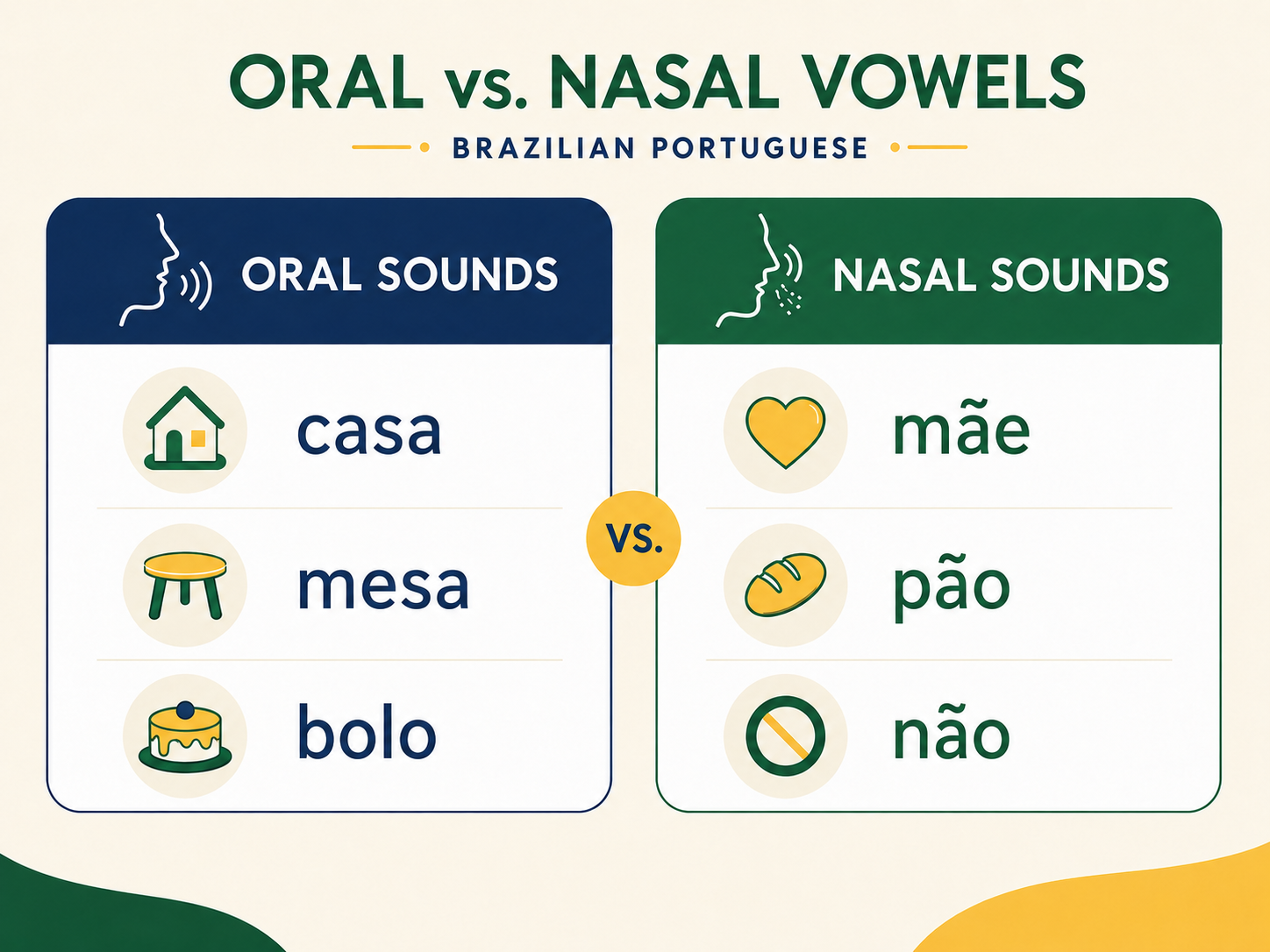
| Pattern | Examples | What to notice |
|---|---|---|
| ã | mãe, manhã | A nasal vowel; do not pronounce a full n after it. |
| ão | pão, não, coração | A nasal diphthong. It is not the same as English ow. |
| em / ens | bem, também, parabéns | Often forms a nasal vowel or diphthong, depending on the word and accent. |
| am at the end of a verb | falam, chegaram | Usually sounds nasal and does not end with a clearly released English m. |
| vowel + m/n before a consonant | campo, mundo, pensar | The vowel becomes nasal; the written m or n may not be released as a full consonant. |
pão
Bread — the vowel is nasal and forms a nasal diphthong.
pau
Stick or wood — an oral diphthong, without nasalization.
This contrast is important enough to have its own guide: pão versus pau in Brazilian Portuguese.
A simple way to practice nasalization
- Say an oral vowel slowly: a.
- Keep the tongue and jaw almost in the same place.
- Allow air to pass through the nose while maintaining the vowel.
- Compare oral and nasal words in short pairs: pau/pão, la/lã.
- Record the pair and check whether the contrast remains clear without exaggeration.
Spelling-to-sound patterns
Brazilian Portuguese consonants that deserve special attention
Many consonants are familiar to English speakers, but their behavior changes according to the following vowel, their position in the syllable, and regional pronunciation.
| Spelling | Common pronunciation | Examples |
|---|---|---|
| c | Before a, o, u: /k/ | casa, coisa, cultura |
| c | Before e, i: /s/ | cedo, cidade |
| ç | Always /s/ and never begins a word | açúcar, França, serviço |
| qu | Usually /k/ before e or i; the u may be silent | que, queijo, quinze |
| g | Before a, o, u: /g/ | gato, agora, seguro |
| g | Before e, i: /ʒ/ | gente, girafa |
| gu | Keeps the hard /g/ before e or i; the u may be silent | guerra, guitarra |
| j | Usually /ʒ/, similar to the sound in measure | já, janeiro, loja |
| ch | Usually /ʃ/, similar to sh | chave, chuva |
| lh | /ʎ/ in careful speech; no exact English equivalent | filho, melhor, trabalho |
| nh | /ɲ/, similar to Spanish ñ | manhã, dinheiro, banheiro |
| h | Silent at the beginning of a word | hotel, hora, hoje |
| initial r / rr / r after n, l, or s | A strong R whose exact sound varies by region | rua, carro, honra, Israel |
| single r between vowels | A quick tap /ɾ/ | caro, barato, arara |
| s between vowels | Usually /z/ | casa, mesa |
| ss | Always /s/ | passar, possível |
| x | Can represent /ʃ/, /ks/, /z/, or /s/ | xícara, táxi, exame, próximo |
| final or syllable-final s | Varies by region and the following sound | mais, mesmo, dois |
| t and d before an i sound | Often become sounds similar to ch and j in many accents | tia, dia, noite, cidade |
| l at the end of a syllable | Often sounds close to /w/ in many Brazilian accents | Brasil, alto, futebol |
LH and NH are single sound units
filho, melhor, trabalho
LH: traditionally represented as /ʎ/. English has no exact equivalent. Avoid pronouncing it as a separate L followed by H.
manhã, dinheiro, banheiro
NH: represented as /ɲ/, similar to Spanish ñ or the middle of English canyon.
Portuguese P, T, and K are usually less aspirated than English
English often releases a strong burst of air at the beginning of stressed words such as pie, tie, and key. Brazilian Portuguese generally uses less aspiration in words such as pai, tá, and casa. Reducing that burst can make your speech sound more Portuguese without requiring a regional accent imitation.
One spelling, several regional sounds
How to pronounce R in Brazilian Portuguese
Brazilian Portuguese does not have one universal R sound. Position gives you a useful starting point, while region determines the exact pronunciation.
Single R between vowels
caro, barato, arara
Usually a quick tap /ɾ/, similar to the sound many North American speakers use in water or better.
R at the beginning
rua, rápido, Roberto
A strong R. Its exact realization varies and may sound h-like, rougher, or more posterior.
RR between vowels
carro, cachorro, correr
Belongs to the strong-R category and contrasts with the tap: caro versus carro.
R after N, L, or S
honra, Israel
Usually behaves like the strong R.
R at the end of a syllable
porta, perto, falar
Highly regional. It may sound h-like, tapped, retroflex, or weak, and it may be reduced in casual infinitives.
The key contrast
caro × carro
Focus first on preserving the contrast between the tap and the strong R, not on copying one city’s exact strong-R quality.
Fricatives
S, Z, X, and CH: predictable patterns and words you must learn individually
S between vowels
casa, mesa, Brasil
Normally voiced like English Z.
SS
passar, possível, assunto
Represents the voiceless S sound.
Z at the end
faz, feliz, arroz
May be devoiced or altered by the following sound and regional accent.
CH
chave, chuva, achar
Usually represents the sound /ʃ/, similar to English SH.
X has several values
xícara, táxi, exame, próximo
It may sound like SH, KS, Z, or S. Many X words must be learned with their pronunciation.
Final S varies regionally
mais, dois, mesmo
Some accents favor S/Z-like realizations; others frequently use SH/ZH-like realizations in syllable-final position.
A famous Brazilian feature
T and D before an I sound
In many Brazilian accents, t and d become sounds similar to English ch and j before an i sound. The trigger is the sound, not simply the fact that the consonant appears between vowels.
Written I
tia, dia
Common in many accents: T is ch-like and D is j-like.
Final unstressed E raised toward I
noite, cidade
In accents with vowel raising and palatalization, the final sequences may sound ch/j-like.
This feature is widespread, but it is not universal across Brazil. A speaker who does not palatalize these consonants is not pronouncing Portuguese incorrectly.
The syllable that organizes the word
Word stress and written accent marks
Correct consonants and vowels can still be difficult to understand when the stress falls on the wrong syllable. Brazilian Portuguese primary stress normally occurs on one of the final three syllables of a word.
| Word shape | Usual tendency | Examples |
|---|---|---|
| Many words ending in -a, -e, -o, -as, -es, -os, -am, -em, or -ens | Often stressed on the next-to-last syllable | casa, nome, falam, jovem |
| Many words ending in -i, -u, -l, -r, or -x | Often stressed on the final syllable | saci, urubu, hotel, falar, Brasil |
| Acute or circumflex accent | Marks the stressed syllable when the word does not follow the usual unaccented pattern | café, fácil, português |
Accent marks are pronunciation information
Acute accent
á, é, í, ó, ú
Marks stress. On é and ó, it also commonly signals an open vowel.
Circumflex
â, ê, ô
Marks stress. Ê and ô normally signal closed vowels; â has a different vowel quality from á.
Tilde
ã, õ
Signals nasalization and participates in forms such as mãe, não, and põe.
Stress can change the word
sábia
wise woman — stress on the first syllable
sabia
knew — stress on the middle syllable
sabiá
thrush — stress on the final syllable
Practice method: clap or tap only the stressed syllable, then repeat the full word without slowing down every syllable.
Why familiar words disappear in conversation
Connected speech, reductions, and word boundaries
Brazilian Portuguese is not normally spoken as a sequence of isolated dictionary forms. Vowels reduce, words connect, and high-frequency expressions develop shorter informal versions.
para → pra
Vou pra casa.
A common informal reduction in speech.
está → tá
Tá tudo bem?
Very frequent in informal conversation.
você → cê
Cê vai hoje?
Common in several regions and informal contexts, but not universal.
Infinitive-final R
falar, comer, sair
The final R may be weak or absent in casual speech, depending on accent and style.
Words link across boundaries
os amigos
The final consonant and following vowel can connect, making the phrase sound less segmented than the spelling suggests.
Function words are often weaker
de, em, para, que
Short grammatical words may be reduced more than the content word carrying the message.
For more written informal language, continue with our guide to Brazilian texting abbreviations and slang. To hear how reductions interact with conversation markers such as né, tipo, então, and aí, see our guide to Brazilian Portuguese filler words.
Beyond individual sounds
Rhythm, sentence stress, and intonation
Pronunciation is not only the production of separate consonants and vowels. Listeners also use rhythm, prominence, and pitch movement to identify focus, attitude, and sentence type.
Do not stress every word equally
Eu PRECISO falar com ela hoje.
The most important information normally receives greater prominence.
Questions may rely on intonation
Você vai amanhã?
The word order can resemble a statement; pitch helps signal the question.
Speak in meaningful groups
Quando eu chegar / eu te aviso.
Thought groups are more natural than equal pauses after every word.
Emotion changes pitch and timing
Que legal!
The same words can sound enthusiastic, ironic, or indifferent depending on delivery.
Our article on questions and intonation in Portuguese explores this connection in more detail.
There is no single Brazilian accent
Regional variation in Brazilian Portuguese pronunciation
Brazilian Portuguese pronunciation varies across regions, cities, social groups, generations, and speaking styles. A pronunciation course should give learners a stable model while also preparing them to understand legitimate variation.
| Feature | What varies | Learning strategy |
|---|---|---|
| Strong R | May sound like [h], [x], [χ], or another regional rhotic. | Recognize several versions; do not treat one city’s R as the only correct form. |
| S at the end of a syllable | May sound like s/z or sh/zh depending on region and neighboring sounds. | Expect Rio-style forms and non-Rio forms. |
| T and D before an i sound | Palatalization is common in many areas but not universal. | Both a ch/j-like pronunciation and a more dental/alveolar pronunciation can be native. |
| Final unstressed e and o | Frequently raised toward i and u, but degree varies. | Learn to hear cidade and livro in more than one accent. |
| Intervocalic and final R | The quick tap and coda R show substantial regional variation. | Prioritize intelligibility and listening flexibility. |
Regional vocabulary and pronunciation often interact. You can continue with our guides to Carioca Portuguese and Mineiro Portuguese. For country-level tendencies—without treating either country as having one uniform accent—read Brazilian Portuguese versus European Portuguese.
Problems that reduce intelligibility
Common Brazilian Portuguese pronunciation mistakes made by English speakers
1. Using the English R everywhere
Portuguese distinguishes a tap from several strong or syllable-final R realizations. An English approximant can blur contrasts.
2. Replacing nasal vowels with vowel + N
Pão is not simply “pow-n.” The nasal quality belongs to the vowel and diphthong.
3. Ignoring open and closed E/O
Pairs such as avó/avô show why one English “eh” or “oh” approximation is not enough.
4. Pronouncing final E and O too fully
In many accents, unstressed final vowels are raised and shorter than English learners expect.
5. Pronouncing LH and NH as separate letters
These spellings normally represent single palatal sounds.
6. Inventing one rule for X
High-frequency words with X should be learned together with audio.
7. Stressing the wrong syllable
Incorrect stress may interfere with recognition even when every segment is individually close.
8. Speaking one word at a time
Over-segmentation makes rhythm unnatural and can make listening practice feel unrelated to real speech.
9. Overaspirating P, T, and K
A large English-style burst of air is not the usual target in Brazilian Portuguese.
10. Treating regional variation as error
A pronunciation may be unfamiliar without being incorrect. Evaluate intelligibility and community usage.
Turn knowledge into automatic speech
A practical Brazilian Portuguese pronunciation routine
A short routine repeated consistently is more useful than reading a long list of rules once.
Minute 1–2: focused listening
Choose one sound contrast and identify it in five short examples.
Minute 3–4: mouth and airflow
Practice the movement slowly without adding a full sentence yet.
Minute 5–7: minimal or near-minimal pairs
Alternate forms such as avó/avô, caro/carro, or pau/pão.
Minute 8–10: shadowing
Repeat a short recording immediately after the speaker, matching stress and rhythm rather than only individual sounds.
Minute 11–13: personal sentences
Use the target sound in sentences related to your real life.
Minute 14–15: record and compare
Listen for one selected feature. Do not try to correct ten things in the same recording.
A weekly learning order
- Day 1: word stress and final vowels.
- Day 2: open and closed E/O.
- Day 3: nasal vowels and ão.
- Day 4: R contrast.
- Day 5: LH, NH, CH, and X.
- Day 6: T/D, syllable-final S, and regional listening.
- Day 7: a short conversation using all targets without stopping after every error.
Continue improving your spoken Brazilian Portuguese
Frequently asked questions about Brazilian Portuguese pronunciation
Is Brazilian Portuguese pronunciation phonetic?
Its spelling-to-sound relationships are relatively systematic compared with English, but it is not one letter equals one sound. Stress, open and closed vowels, X, regional R and S, vowel reduction, and connected speech all require additional knowledge.
Which Brazilian accent should I learn?
Choose a clear model connected to your teacher, goals, or community. At the same time, listen to speakers from several regions so that one unfamiliar R or S does not block comprehension.
Why do T and D sometimes sound like CH and J?
In many Brazilian varieties, T and D are palatalized before an I sound. This may occur before written I and before a final unstressed E that is pronounced close to I. The process is common but not universal.
Why does final O sound like U?
In many Brazilian accents, unstressed final O is raised toward U. This is a regular phonetic pattern, not careless pronunciation.
How do I pronounce ão?
It is a nasal diphthong. Keep the vowel nasal and avoid adding a clearly released English N or M at the end. Audio comparison with au is more useful than an English respelling.
Does every R at the end of a word sound like H?
No. Syllable-final R is one of the most regionally variable features of Brazilian Portuguese. It may be h-like, tapped, retroflex, weakened, or absent in some casual infinitives.
Should I try to sound like a native speaker?
A more useful goal is clear, flexible, confident speech. A foreign accent does not prevent fluency. Prioritize contrasts that affect meaning and listening comprehension.
Can I improve pronunciation without a teacher?
You can make substantial progress through careful listening, recording, comparison, and shadowing. Feedback becomes especially valuable when you cannot identify why a contrast remains unclear or when a form changes during spontaneous conversation.