

50 Brazilian Portuguese Expressions You’ll Actually Hear in Brazil
Real Brazilian Portuguese for real conversations
Brazilian Portuguese expressions can be difficult even when you understand every individual word. That is because the meaning often comes from the whole phrase, the situation, the speaker’s tone, and the level of formality—not from a word-for-word translation.
This guide explains 50 expressions you can genuinely hear in Brazil. For each one, you will find a natural English equivalent, the literal translation, a real example, and a usage note that helps you avoid sounding forced or using the expression in the wrong context.
without duplicated or artificial items
instead of misleading literal translations
so you know when each expression fits
Ten Brazilian expressions to learn first
If you do not want to study all 50 at once, begin with these. They are useful across many everyday situations.
| Expression | Natural meaning |
|---|---|
| Dar um jeito | to find a way; to sort something out; to make it work |
| Quebrar o galho | to help someone out; to do the trick as a temporary solution |
| Pisar na bola | to mess up; to let someone down |
| Dar ruim | to go wrong; to end badly |
| Cair a ficha | to finally realize; for something to sink in |
| Ficar de boa | to relax; to be fine; not to mind |
| Estar de saco cheio | to be fed up; to have had enough |
| Dar o braço a torcer | to concede; to admit that someone else was right |
| Ficar no vácuo | to be ignored; to be left without a reply |
| Matar a saudade | to spend time with someone or something you have missed |
How to use Brazilian expressions without sounding unnatural
- Learn the communicative function, not only the translation. Ask what the speaker is doing: complaining, reassuring, conceding, teasing, or asking for help.
- Pay attention to register. Expressions such as dar ruim and estar de saco cheio are common, but they do not belong in every professional or formal situation. See our guide to formal and informal Brazilian Portuguese.
- Copy the whole pattern. Learning dar um jeito de + infinitive is more useful than memorizing only dar um jeito.
- Listen before you imitate. Regional background, age, and tone can change how slang feels. Read our guides to Carioca slang, Mineiro slang, and Paulista slang.
- Use one or two expressions naturally. Filling every sentence with slang usually sounds less fluent, not more fluent.
Group 1
Getting things done, solving problems, and helping
These expressions appear constantly when Brazilians talk about solving a problem, helping someone, starting a task, or handling a difficult situation.
Dar um jeito
Natural English: to find a way; to sort something out; to make it work
Literal: to give a way
Use dar um jeito when someone finds a solution, makes an arrangement, or manages a problem even when the solution is not obvious yet. It does not necessarily imply anything dishonest or improper.
Portuguese: Não se preocupe. Eu vou dar um jeito de chegar aí antes das oito.
Natural English: Don’t worry. I’ll find a way to get there before eight.
Usage note: A frequent pattern is dar um jeito de + infinitive: dar um jeito de pagar, dar um jeito de falar com ela.
Quebrar o galho
Natural English: to help someone out; to do the trick as a temporary solution
Literal: to break the branch
This expression has two closely related uses. A person can quebrar o seu galho by helping you, and an object can quebrar o galho by working well enough for now.
Portuguese: Meu computador está no conserto, mas este tablet quebra o galho por alguns dias.
Natural English: My computer is being repaired, but this tablet will do the trick for a few days.
Usage note: For personal help: Você consegue quebrar meu galho e buscar a encomenda?
Dar uma força
Natural English: to give someone a hand; to support someone
Literal: to give some strength
Use dar uma força to ask for or offer practical help, encouragement, or support. It usually sounds friendly and less formal than ajudar.
Portuguese: Você pode me dar uma força com essas caixas?
Natural English: Can you give me a hand with these boxes?
Usage note: You may also hear dar aquela força, which adds emphasis but does not change the basic meaning.
Dar conta
Natural English: to manage; to handle; to be able to finish
Literal: to give account
In everyday Brazilian Portuguese, dar conta de often means having enough time, energy, skill, or capacity to handle something.
Portuguese: Hoje eu não vou dar conta de responder todas as mensagens.
Natural English: I won’t be able to answer all the messages today.
Usage note: Do not confuse dar conta de with dar-se conta de, which means to realize.
Colocar a mão na massa
Natural English: to roll up your sleeves; to get hands-on
Literal: to put your hand in the dough
Use this when it is time to stop discussing a task and begin doing the practical work.
Portuguese: A gente já planejou bastante. Agora é hora de colocar a mão na massa.
Natural English: We’ve planned enough. Now it’s time to roll up our sleeves.
Usage note: You will also hear pôr a mão na massa. Both versions are natural.
Mandar ver
Natural English: to go for it; to get on with it; to do something confidently
Literal: to send and see
Mandar ver can encourage someone to begin, continue, or do something with energy and confidence.
Portuguese: Se você já sabe o que quer dizer, manda ver!
Natural English: If you already know what you want to say, go for it!
Usage note: In conversation, the imperative manda ver is especially common.
Pegar no tranco
Natural English: to get going after a slow start; to finally gain momentum
Literal: to start with a push or jolt
Use this when a person, project, class, or process starts slowly but eventually begins working properly or gaining momentum.
Portuguese: A reunião começou meio parada, mas depois pegou no tranco.
Natural English: The meeting started slowly, but then it gained momentum.
Usage note: It can describe both people and situations: Depois do café, eu peguei no tranco.
Segurar a onda
Natural English: to keep it together; to cope; to handle the pressure
Literal: to hold the wave
Segurar a onda means remaining steady during a stressful or difficult situation. Depending on context, it can also mean tolerating a demanding person or circumstance.
Portuguese: A semana foi pesada, mas ela segurou a onda e terminou o projeto.
Natural English: The week was rough, but she kept it together and finished the project.
Usage note: The phrase is supportive, but it can also imply that the situation required real emotional effort.
Dar um tempo
Natural English: to take a break; to pause; to give it some time
Literal: to give some time
Use dar um tempo for a pause in an activity, discussion, or relationship. The intended meaning comes from context.
Portuguese: Vamos dar um tempo nessa conversa e voltar ao assunto amanhã.
Natural English: Let’s take a break from this conversation and return to it tomorrow.
Usage note: In a romantic relationship, dar um tempo commonly means spending some time apart.
Pegar leve
Natural English: to take it easy; to be less harsh; to go easy on someone
Literal: to take lightly
Use this to ask someone to reduce the intensity of criticism, work, exercise, pressure, or punishment.
Portuguese: Pega leve com ele. Foi a primeira vez que ele tentou.
Natural English: Go easy on him. It was his first time trying.
Usage note: The opposite idea is pegar pesado: to be harsh, intense, or demanding.
Group 2
Mistakes, problems, disappointment, and embarrassment
These expressions help you describe situations that went wrong, people who let you down, and moments you would rather forget.
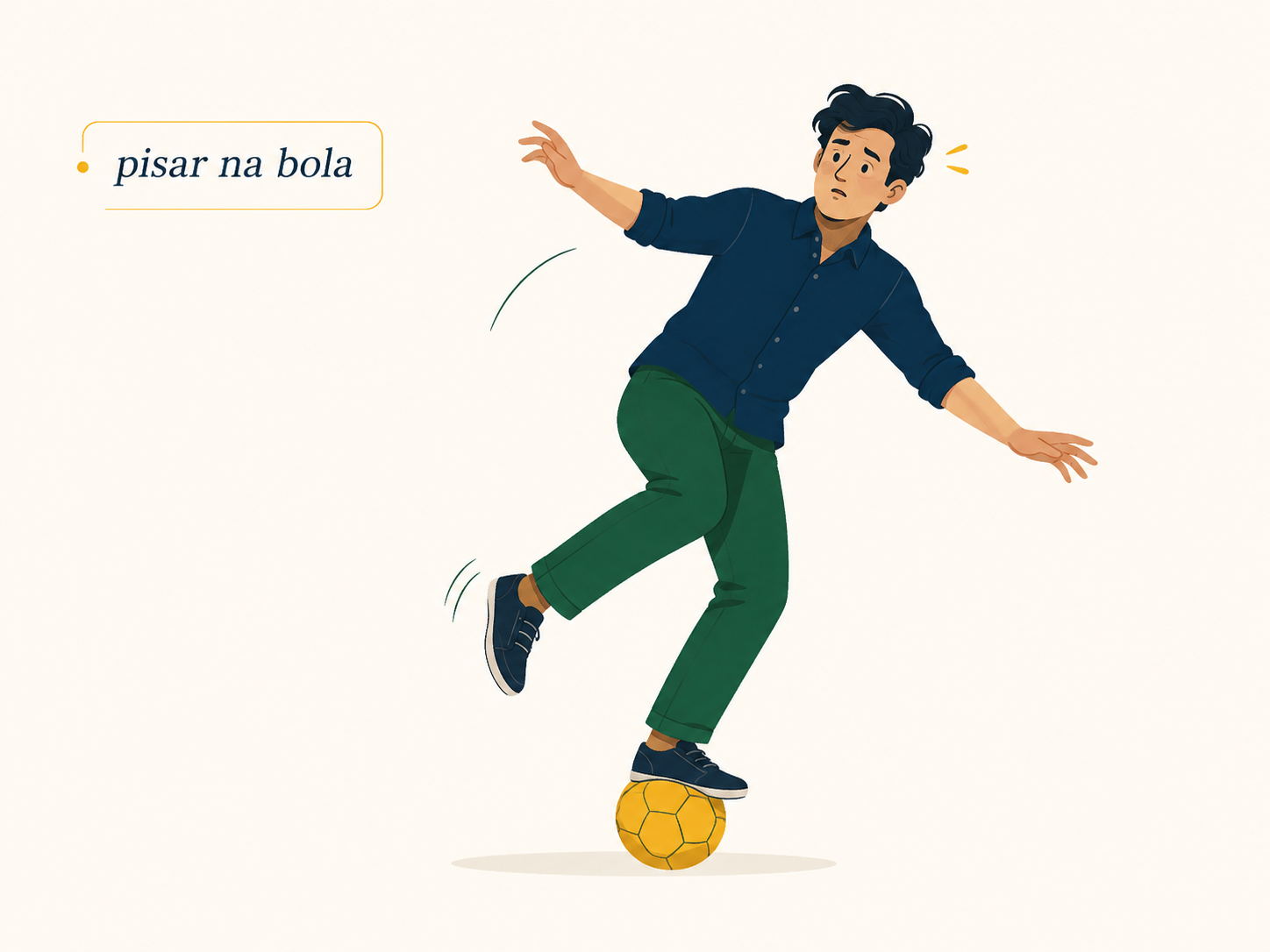
Pisar na bola
Natural English: to mess up; to let someone down
Literal: to step on the ball
Pisar na bola usually describes a mistake that disappoints someone or damages trust, not merely a small technical error.
Portuguese: Eu pisei na bola com você e devia ter avisado antes.
Natural English: I let you down, and I should have told you earlier.
Usage note: It often appears in apologies: Foi mal. Eu pisei na bola.
Dar ruim
Natural English: to go wrong; to end badly
Literal: to give bad
Use dar ruim when a plan, situation, or decision goes badly or creates trouble.
Portuguese: A gente tentou entrar sem reserva, mas deu ruim e não tinha mais mesa.
Natural English: We tried to get in without a reservation, but it didn’t work out and there were no tables left.
Usage note: Avoid it in formal writing. In a neutral context, use dar errado.
Ficar na mão
Natural English: to be let down; to be left stranded; to be left without what you need
Literal: to remain in the hand
Use this when a person, service, device, or plan fails you at the moment you depend on it.
Portuguese: Meu carro quebrou no meio da estrada e eu fiquei na mão.
Natural English: My car broke down in the middle of the road and left me stranded.
Usage note: A person can also deixar alguém na mão: Ele prometeu ajudar, mas me deixou na mão.
Chutar o balde
Natural English: to stop caring; to give up restraint; to throw everything away
Literal: to kick the bucket
In Brazilian Portuguese, chutar o balde is about giving up, rebelling, or deciding you no longer care about the consequences.
Portuguese: Depois de meses naquela rotina, ele chutou o balde e pediu demissão.
Natural English: After months in that routine, he had enough and quit.
Usage note: Important false friend: English kick the bucket means to die. Portuguese chutar o balde does not.
Quebrar a cara
Natural English: to be bitterly disappointed; to learn the hard way
Literal: to break your face
This means discovering that your confidence, expectation, or judgment was wrong, often through an unpleasant experience.
Portuguese: Eu achei que seria fácil resolver tudo sozinho, mas quebrei a cara.
Natural English: I thought it would be easy to handle everything alone, but I learned the hard way.
Usage note: It can sound unsympathetic when used about another person: Eu avisei; agora ele quebrou a cara.
Dar bolo
Natural English: to stand someone up; to fail to show up
Literal: to give cake
Use dar bolo em alguém when a person does not appear for an appointment, date, or agreed meeting.
Portuguese: A gente marcou às sete, mas ele me deu bolo.
Natural English: We agreed to meet at seven, but he stood me up.
Usage note: The person who waited can say: Fiquei esperando e levei um bolo.
Queimar o filme
Natural English: to damage your reputation; to make yourself look bad
Literal: to burn the film
Use this when someone’s behavior harms the way other people see them.
Portuguese: Chegar atrasado em toda reunião está queimando o seu filme com a equipe.
Natural English: Arriving late to every meeting is damaging your reputation with the team.
Usage note: The possessive is common: queimar meu filme, queimar o filme dele.
Pagar mico
Natural English: to embarrass yourself; to make a fool of yourself
Literal: to pay a small monkey
Pagar mico describes an awkward, embarrassing, or socially clumsy moment.
Portuguese: Eu acenei para uma pessoa que nem estava falando comigo e paguei o maior mico.
Natural English: I waved at someone who wasn’t even talking to me and completely embarrassed myself.
Usage note: O maior mico intensifies the embarrassment.
Encher linguiça
Natural English: to pad a text or speech; to fill space without adding substance
Literal: to stuff sausage
Use this when someone adds unnecessary words, examples, or material simply to make something longer.
Portuguese: O relatório tem vinte páginas, mas metade é só para encher linguiça.
Natural English: The report is twenty pages long, but half of it is just filler.
Usage note: It is useful for criticizing essays, meetings, presentations, and long explanations.
Fazer vista grossa
Natural English: to turn a blind eye; to deliberately overlook something
Literal: to make thick eyesight
Use this when someone notices a problem or violation but intentionally chooses not to act.
Portuguese: O gerente fez vista grossa para o atraso porque foi uma situação excepcional.
Natural English: The manager turned a blind eye to the delay because it was an exceptional situation.
Usage note: The expression can describe either compassion or complicity; context determines the judgment.
Group 3
Emotions, reactions, and states of mind
Brazilians use these expressions to talk about surprise, anger, frustration, suspicion, and emotional reactions without sounding like a textbook.
Ficar de cara
Natural English: to be shocked; to be amazed
Literal: to remain with a face
Ficar de cara expresses strong surprise. The surprise can be positive or negative, depending on what follows.
Portuguese: Eu fiquei de cara quando vi quanto a passagem tinha aumentado.
Natural English: I was shocked when I saw how much the ticket price had gone up.
Usage note: A common intensifier is ficar de cara mesmo.
Ficar bolado
Natural English: to be upset; annoyed; worried
Literal: to become shaped into a ball
In much of Brazil, ficar bolado means becoming upset, bothered, suspicious, or worried. The exact shade of meaning depends on region and context.
Portuguese: Ele ficou bolado porque ninguém respondeu à mensagem.
Natural English: He got upset because nobody replied to the message.
Usage note: Do not assume it always means the same emotion. Listen to the situation and the speaker’s tone.
Sair do sério
Natural English: to lose your temper; to lose your cool
Literal: to leave seriousness
Use this when someone becomes angry or loses emotional control after being irritated.
Portuguese: É difícil me fazer sair do sério, mas aquela situação passou do limite.
Natural English: It’s hard to make me lose my temper, but that situation crossed the line.
Usage note: Another common structure is tirar alguém do sério: to drive someone crazy or make them lose their temper.
Estar de saco cheio
Natural English: to be fed up; to have had enough
Literal: to have a full sack
Estar de saco cheio expresses strong irritation or exhaustion with a repeated situation, person, or problem.
Portuguese: Eu estou de saco cheio de receber a mesma ligação todos os dias.
Natural English: I’m fed up with getting the same call every day.
Usage note: It is not obscene, but it is too blunt for many formal or delicate situations.
Estar na fossa
Natural English: to feel very down; to be miserable
Literal: to be in the pit
Use this for a period of sadness or discouragement, especially after a disappointment or breakup. It is everyday language, not a clinical diagnosis.
Portuguese: Ela ficou na fossa por alguns dias depois do término.
Natural English: She felt miserable for a few days after the breakup.
Usage note: Younger speakers may choose newer slang, but the expression remains widely understood.
Cair a ficha
Natural English: to finally realize; for something to sink in
Literal: for the token to drop
Cair a ficha describes the moment when you fully understand or emotionally process something that was not clear before.
Portuguese: Só quando cheguei ao aeroporto caiu a ficha de que eu realmente estava indo embora.
Natural English: It only sank in that I was really leaving when I arrived at the airport.
Usage note: The usual pattern is caiu a ficha or a ficha ainda não caiu.
Ficar com um pé atrás
Natural English: to be wary; to have reservations; to be suspicious
Literal: to keep one foot behind
Use this when you do not fully trust a person, offer, explanation, or situation.
Portuguese: A proposta parece boa, mas eu fiquei com um pé atrás.
Natural English: The offer looks good, but I have some reservations.
Usage note: This is often less direct and less accusatory than saying eu não confio.
Levar na boa
Natural English: to take it well; not to get upset about it
Literal: to take it in a good way
Levar na boa means reacting calmly or without resentment to something that could have caused annoyance.
Portuguese: Eu achei que ela ficaria ofendida, mas ela levou na boa.
Natural English: I thought she would be offended, but she took it well.
Usage note: The expression describes the reaction, not necessarily agreement.
Ficar de boa
Natural English: to relax; to be fine; not to mind
Literal: to remain in a good state
Depending on context, ficar de boa can mean relaxing, staying calm, doing nothing in particular, or being fine with a decision.
Portuguese: Hoje eu vou ficar de boa em casa e assistir a um filme.
Natural English: Today I’m just going to relax at home and watch a movie.
Usage note: Compare: Por mim, de boa means something like That’s fine with me.
Estar por fora
Natural English: to be out of the loop; not to know about something
Literal: to be on the outside
Use this when someone is uninformed, unfamiliar with a topic, or unaware of recent developments.
Portuguese: Eu estou por fora. O que aconteceu entre eles?
Natural English: I’m out of the loop. What happened between them?
Usage note: The opposite is estar por dentro: to be informed or familiar with something.
Group 5
Money, parties, humor, and highly figurative expressions
The final group contains some of the most memorable expressions in Brazilian Portuguese. Their literal translations may sound strange, but their conversational meanings are straightforward once you see them in context.
Fazer uma vaquinha
Natural English: to pool money; to collect contributions
Literal: to make a little cow
Use this when several people contribute money toward a gift, expense, event, or shared goal.
Portuguese: Vamos fazer uma vaquinha para comprar um presente para ela.
Natural English: Let’s all contribute to buy her a gift.
Usage note: The amount does not need to be large. The key idea is a group contribution.
Meter o louco
Natural English: to act recklessly; to play dumb; to behave as if the rules do not apply
Literal image: to play the crazy one
This expression has several informal uses. It may describe acting impulsively, pretending not to understand, avoiding responsibility, or behaving with exaggerated boldness.
Portuguese: Ele meteu o louco e fingiu que não tinha recebido o aviso.
Natural English: He played dumb and pretended he hadn’t received the notice.
Usage note: Because its meaning changes with context, learners should recognize it before trying to use it.
Tirar onda
Natural English: to show off; to tease or make fun of someone
Literal: to take out a wave
Depending on region and context, tirar onda can mean acting impressive or stylish, showing off, joking, or teasing someone.
Portuguese: Ele chegou com o carro novo só para tirar onda.
Natural English: He showed up with the new car just to show off.
Usage note: With a person, tirar onda com alguém may mean teasing or making fun of them.
Botar pra quebrar
Natural English: to go all out; to perform with great energy
Word-for-word: to put [it] to break
Use this to encourage or praise energetic, impressive performance in music, sports, work, dancing, or celebration.
Portuguese: A banda subiu ao palco e botou pra quebrar.
Natural English: The band went onstage and absolutely crushed it.
Usage note: Botar and colocar can overlap in many contexts, but this fixed expression normally uses botar.
Enfiar o pé na jaca
Natural English: to overindulge; to go overboard
Literal: to stick your foot in the jackfruit
Use this when someone excessively eats, drinks, spends, or abandons moderation, especially during a celebration or after a period of restraint.
Portuguese: Eu estava economizando, mas enfiei o pé na jaca durante a viagem.
Natural English: I had been saving money, but I went overboard during the trip.
Usage note: You may also hear meter o pé na jaca.
Arroz de festa
Natural English: someone who is at every party or social event
Literal: party rice
An arroz de festa is a familiar face who seems to appear at every celebration, event, or social gathering.
Portuguese: O Rafael é arroz de festa: está em todos os aniversários.
Natural English: Rafael is at every party: he shows up at every birthday celebration.
Usage note: It can be affectionate, teasing, or mildly critical.
Chá de cadeira
Natural English: a very long wait
Literal: chair tea
Use levar um chá de cadeira when someone is forced to wait far longer than expected.
Portuguese: Eu levei um chá de cadeira de quase duas horas no consultório.
Natural English: I was kept waiting for almost two hours at the doctor’s office.
Usage note: The most common structure is dar/levar um chá de cadeira.
Matar a saudade
Natural English: to spend time with someone or something you have missed
Literal: to kill the feeling of longing
Matar a saudade means easing the feeling of missing a person, place, activity, or experience by reconnecting with it.
Portuguese: Passei o fim de semana com a minha família para matar a saudade.
Natural English: I spent the weekend with my family because I had missed them.
Usage note: It does not mean that the emotional connection disappears; it means satisfying the longing for a while.
Fechar com chave de ouro
Natural English: to end on a high note; to finish in style
Literal: to close with a golden key
Use this when the final part of an event, project, trip, or performance is especially successful or memorable.
Portuguese: Para fechar a viagem com chave de ouro, a gente viu o pôr do sol na praia.
Natural English: To end the trip on a high note, we watched the sunset at the beach.
Usage note: It can describe both carefully planned endings and fortunate final moments.
Bater as botas
Natural English: to die; to kick the bucket
Literal: to bang the boots
Bater as botas is a humorous or euphemistic way to say that someone died. It should not be used in solemn, recent, or emotionally delicate situations.
Portuguese: No filme, o vilão bate as botas antes de revelar o segredo.
Natural English: In the movie, the villain kicks the bucket before revealing the secret.
Usage note: This is the Portuguese expression that corresponds to English kick the bucket, not chutar o balde.
How to remember and practice these expressions
Memorizing a definition is not enough. The goal is to recognize the expression quickly and retrieve it when the situation calls for it.
- Choose five expressions by function.
Learn five ways to discuss problems before moving to expressions about parties or relationships. - Build personal examples.
Replace generic sentences with situations from your own work, family, travel, or study routine. - Practice recognition and production.
First identify the meaning while listening; later try using the expression in a short reply. - Record complete chunks.
Save patterns such as ficar com um pé atrás or dar conta de + infinitive, not isolated words. - Notice the high-frequency verbs inside the expressions.
Many items begin with dar, ficar, bater, levar, or pôr. Review our Brazilian Portuguese verb conjugation guide when the verb forms slow down recognition. - Review spoken form.
Use our Brazilian Portuguese pronunciation guide alongside this list. - Notice digital language.
Read our guide to Brazilian texting slang and abbreviations. - Listen for conversation markers.
Expressions often appear beside Brazilian Portuguese filler words such as né, tipo, então, and aí.
One expression can carry more than one meaning
Context matters. Tirar onda, for example, can involve showing off or teasing someone. Meter o louco can describe reckless behavior or pretending not to understand. A learner’s dictionary gives you a starting point, but natural examples and real interaction teach you which meaning is active in a specific conversation.
Continue learning real Brazilian Portuguese
Frequently asked questions about Brazilian Portuguese expressions
Are all of these expressions used everywhere in Brazil?
Most are widely understood, but frequency and nuance vary by region, generation, social group, and context. The labels in this guide identify expressions with especially strong regional or digital variation.
Are Brazilian expressions the same as slang?
No. Slang is usually strongly informal and may be associated with a generation or group. An expression can be neutral, informal, idiomatic, or fixed without being slang. Fechar com chave de ouro, for example, is figurative but not youth slang.
Can I use these expressions in professional situations?
Some fit professional conversation, while others do not. Neutral expressions such as dar conta, dar um tempo, and fechar com chave de ouro can appear in many work settings. Very informal expressions such as dar ruim, meter o louco, and estar de saco cheio require more caution.
What is the difference between “chutar o balde” and “bater as botas”?
Chutar o balde means giving up restraint, rebelling, or no longer caring about the consequences. Bater as botas means dying. English kick the bucket corresponds to bater as botas, not chutar o balde.
Should beginners memorize all 50 expressions?
No. Start with the ten-expression summary near the top. Learn the meanings, notice them in context, and create personal examples. Add more only after the first group becomes recognizable.
How can I sound natural instead of sounding as if I memorized a list?
Match the expression to the situation, imitate complete phrases from real speech, and avoid using several new expressions at once. Feedback from Brazilian speakers is useful because tone and register cannot always be learned from a definition alone.

Group 4
Conversation, relationships, and social behavior
These expressions are especially useful for understanding how Brazilians describe conversations, conflict, gossip, praise, criticism, and online interaction.
Bater papo
Natural English: to chat; to have a casual conversation
Literal: to hit chat
Bater papo is a relaxed conversation without the seriousness suggested by discutir or ter uma reunião.
Portuguese: A gente ficou horas batendo papo depois da aula.
Natural English: We spent hours chatting after class.
Usage note: Both bater papo and bater um papo are natural.
Back to contents ↑
Puxar o saco
Natural English: to suck up to someone; to flatter someone for personal advantage
Literal: to pull the bag
Use this when praise appears excessive or strategic, especially toward a boss, teacher, or influential person.
Portuguese: Ele vive puxando o saco do chefe para conseguir vantagens.
Natural English: He is always sucking up to the boss to get special treatment.
Usage note: A person who does this is a puxa-saco.
Back to contents ↑
Dar o braço a torcer
Natural English: to concede; to admit that someone else was right
Literal: to let your arm be twisted
Use this when someone reluctantly changes position, admits an error, or acknowledges another person’s point.
Portuguese: Depois de ver os resultados, ele deu o braço a torcer e admitiu que a ideia funcionou.
Natural English: After seeing the results, he conceded and admitted that the idea worked.
Usage note: The expression often implies resistance before the admission.
Back to contents ↑
Ficar de olho
Natural English: to keep an eye on; to watch carefully
Literal: to remain with an eye
Ficar de olho can mean monitoring something, protecting it, or watching for an opportunity.
Portuguese: Você pode ficar de olho na minha mochila enquanto eu vou ao banheiro?
Natural English: Can you keep an eye on my backpack while I go to the restroom?
Usage note: It can also signal interest or intention: Estou de olho naquele curso.
Back to contents ↑
Dar corda
Natural English: to encourage someone to continue; to egg someone on
Literal: to give rope or wind something up
Use this when your attention or reaction encourages a person to keep talking, joking, complaining, or behaving in a certain way.
Portuguese: Não dá corda, senão ele vai contar a história inteira de novo.
Natural English: Don’t encourage him, or he’ll tell the whole story again.
Usage note: The expression may be playful or critical depending on the relationship.
Back to contents ↑
Colocar panos quentes
Natural English: to calm things down; to smooth over a conflict
Literal: to apply warm cloths
Use this when someone tries to reduce tension, soften criticism, or prevent a disagreement from escalating.
Portuguese: Quando a discussão começou, ela tentou colocar panos quentes.
Natural English: When the argument started, she tried to calm things down.
Usage note: It can be positive, but it can also suggest avoiding a problem instead of confronting it.
Back to contents ↑
Não ter papas na língua
Natural English: to speak bluntly; to have no filter
Literal: not to have mush on your tongue
A person who não tem papas na língua says what they think directly, even when it may be uncomfortable.
Portuguese: Minha avó não tem papas na língua e fala exatamente o que pensa.
Natural English: My grandmother has no filter and says exactly what she thinks.
Usage note: It may describe honesty, tactlessness, or both.
Back to contents ↑
Passar pano
Natural English: to excuse, minimize, or defend someone’s bad behavior
Literal: to wipe with a cloth
Passar pano is used when someone overlooks or rationalizes another person’s misconduct instead of holding them responsible.
Portuguese: Não adianta passar pano. O que ele fez foi errado.
Natural English: There’s no point making excuses for him. What he did was wrong.
Usage note: This expression is especially frequent in social media discussions, but it is also used in speech.
Back to contents ↑
Ficar no vácuo
Natural English: to be ignored; to be left without a reply
Literal: to remain in the vacuum
Use this when a message, question, greeting, or attempt at interaction receives no response.
Portuguese: Eu mandei duas mensagens e fiquei no vácuo.
Natural English: I sent two messages and got no reply.
Usage note: You can also say deixar alguém no vácuo: to ignore someone.
Back to contents ↑
Pôr lenha na fogueira
Natural English: to add fuel to the fire; to intensify a conflict
Literal: to put firewood on the fire
Use this when a comment or action makes an already tense situation worse.
Portuguese: O comentário dele só colocou mais lenha na fogueira.
Natural English: His comment only added more fuel to the fire.
Usage note: You may hear both pôr lenha na fogueira and colocar lenha na fogueira.
Back to contents ↑