

Brazilian Portuguese Verb Conjugation: A Practical Guide for Real Conversation
A practical system for speaking Brazilian Portuguese
Brazilian Portuguese verb conjugation looks intimidating when you first see a page full of endings. The good news is that you do not need to memorize every tense before you can communicate.
The most useful approach is to understand the recurring patterns, learn the pronouns Brazilians actually use, prioritize a small group of high-frequency irregular verbs, and connect every form to a real sentence.
This guide gives you that system. It covers the core conjugations you need for conversation, explains what changes in natural Brazilian usage, and shows which forms to learn first.
instead of memorizing six textbook rows
such as vou falar and a gente vai
especially the two main past tenses
not in alphabetical order
Foundation
How Portuguese verb conjugation works
A Portuguese verb changes to communicate three main kinds of information:
eu falo, ela fala, nós falamos
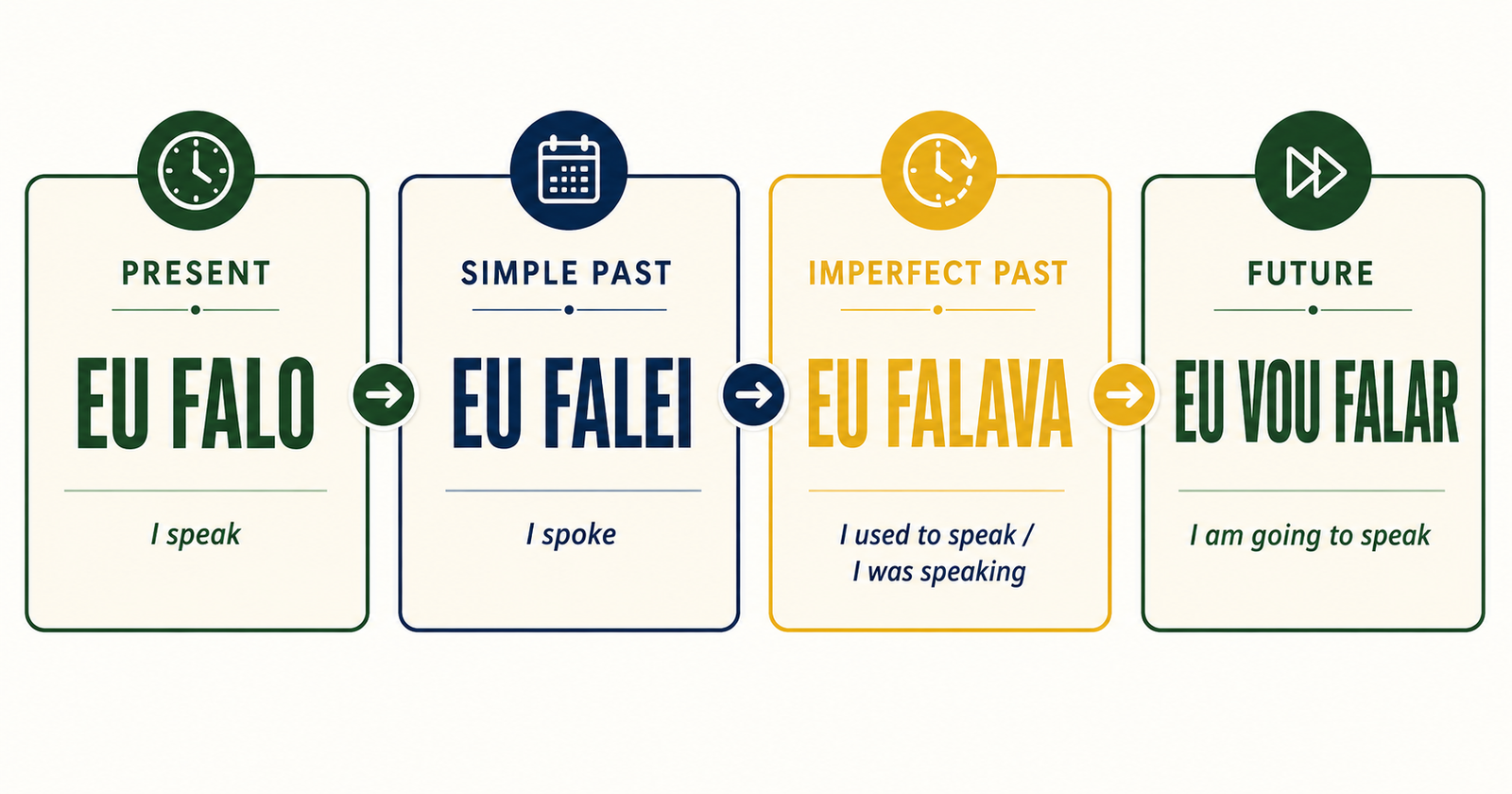
falo, falei, falava, vou falar
as a fact, wish, possibility, condition, request, or command
The dictionary form is the infinitive: falar (to speak), comer (to eat), and abrir (to open). To conjugate a regular verb, you normally identify its stem and replace the infinitive ending with a new ending.
fal-ar → fal-o, fal-a, fal-amos, fal-am
Stem: fal-
Infinitive ending: -ar
Conjugated endings: -o, -a, -amos, -am
Regular verbs follow a predictable pattern. Irregular verbs change the stem, the ending, or both. Even irregular verbs, however, often repeat patterns across related forms, so they are not a collection of random exceptions.
Brazilian usage
Subject pronouns Brazilians actually use
Traditional conjugation charts often include tu and vós in every table. A practical nationwide Brazilian Portuguese chart is more efficient when it begins with four core patterns:
| Subject | Meaning | Verb form used | Example with falar |
|---|---|---|---|
| Eu | I | 1st person singular | falo |
| Você / ele / ela / a gente | you / he / she / we | 3rd person singular | fala |
| Nós | we | 1st person plural | falamos |
| Vocês / eles / elas | you all / they | 3rd person plural | falam |
Why a gente uses a singular verb
A gente usually means “we” in everyday Brazilian Portuguese, but grammatically it takes the third-person singular form:
A gente fala português na aula.
We speak Portuguese in class.
A gente vai sair mais tarde.
We are going out later.
What about tu?
Tu is common in several parts of Brazil, but the agreement heard after it varies by region and community. You may hear the standard second-person form, such as tu falas, and you may also hear tu fala in natural regional speech. Learners should recognize both patterns and follow the usage of the community they communicate with.
Do Brazilians omit subject pronouns?
They can. When the context is clear, falo português already identifies the speaker as eu. However, forms such as fala can refer to você, ele, ela, or a gente, so speakers often keep the subject when clarity matters.
Patterns
The three regular verb groups: -AR, -ER, and -IR
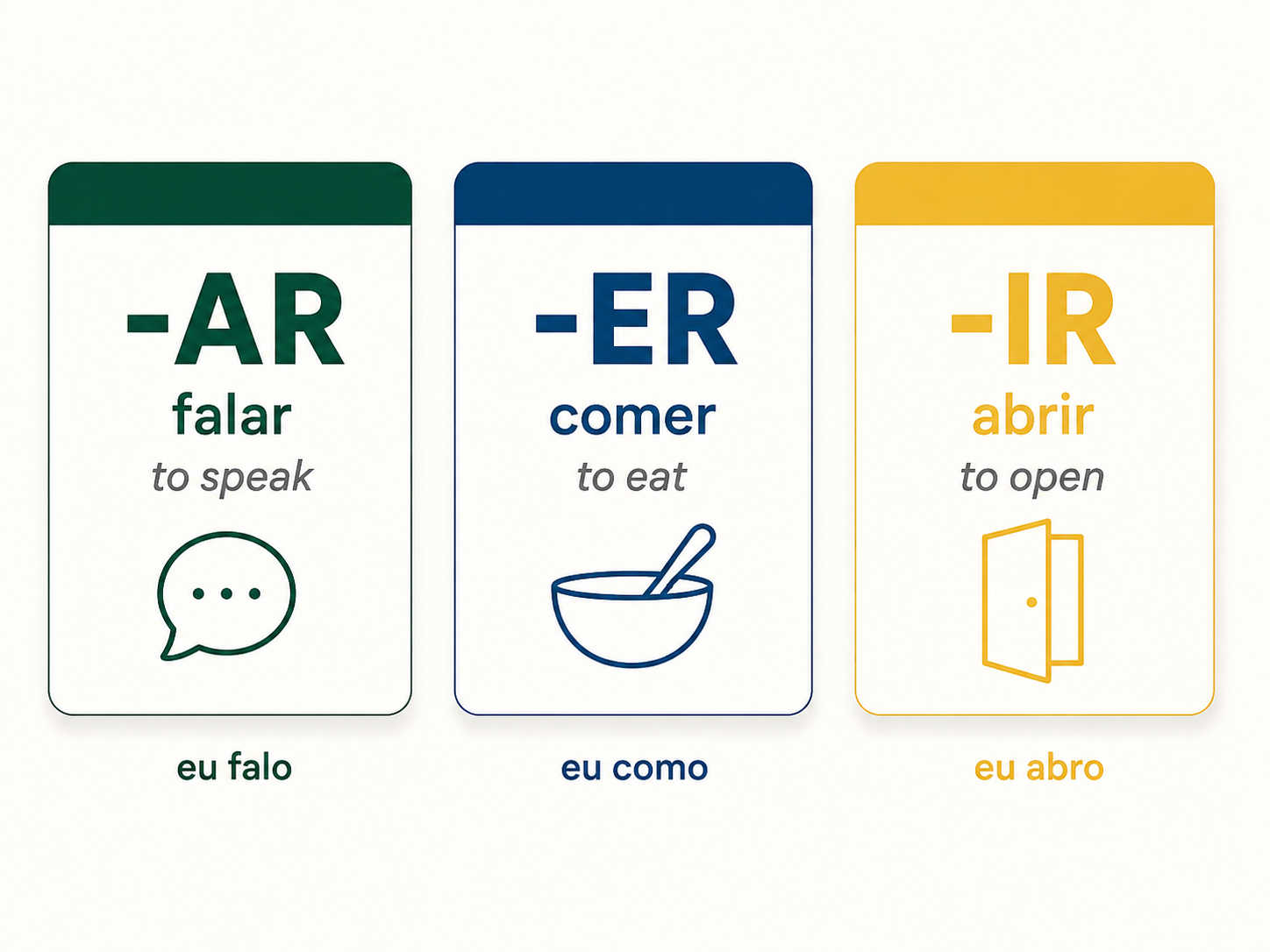
-AR verbs
falar, trabalhar, estudar, morar, viajar
-ER verbs
comer, beber, vender, aprender, escrever
-IR verbs
abrir, partir, decidir, assistir, dividir
An important extra verb
Pôr ends in -or, but historically belongs to the second conjugation and has its own irregular pattern.
The infinitive ending tells you which regular endings to use. Once you know the pattern for one verb in a group, you can apply it to hundreds of other regular verbs.
Core tense 1
Present tense: presente do indicativo
The present indicative is used for habits, facts, preferences, recurring actions, and some actions happening around the present moment.
| Subject | falar | comer | abrir |
|---|---|---|---|
| Eu | falo | como | abro |
| Você / ele / ela / a gente | fala | come | abre |
| Nós | falamos | comemos | abrimos |
| Vocês / eles / elas | falam | comem | abrem |
Eu trabalho de casa.
I work from home.
A gente come tarde às sextas-feiras.
We eat late on Fridays.
Eles abrem a loja às nove.
They open the store at nine.
Nós falamos português durante a aula.
We speak Portuguese during class.
Present tense endings at a glance
-AR singular: -a
-ER / -IR singular: -e
nós: -amos / -emos / -imos
plural: -am / -em
Core structure
Actions happening now: estar + gerund
Brazilian Portuguese commonly uses estar + gerund for an action in progress.
| Subject | estar + falando |
|---|---|
| Eu | estou falando |
| Você / ele / ela / a gente | está falando |
| Nós | estamos falando |
| Vocês / eles / elas | estão falando |
Estou estudando agora.
I am studying now.
O que vocês estão fazendo?
What are you all doing?
Regular gerunds are formed with -ando for -AR verbs, -endo for -ER verbs, and -indo for -IR verbs: falando, comendo, abrindo.
European Portuguese commonly uses estar a + infinitive instead. Compare the two patterns in our complete guide to Brazilian and European Portuguese differences.
Core tenses 2 and 3
The two past tenses you need first
The biggest practical contrast is between the pretérito perfeito and the pretérito imperfeito. English often uses the simple past for both, so learners need to focus on how the speaker frames the past.
Pretérito perfeito
Completed event, result, sequence, or action seen as a whole.
Ontem eu falei com a professora.
Yesterday I spoke with the teacher.
Pretérito imperfeito
Habit, repeated action, background, description, or action in progress in the past.
Quando eu morava no Brasil, falava com ela todo dia.
When I lived in Brazil, I used to speak with her every day.
Simple past: pretérito perfeito
| Subject | falar | comer | abrir |
|---|---|---|---|
| Eu | falei | comi | abri |
| Você / ele / ela / a gente | falou | comeu | abriu |
| Nós | falamos | comemos | abrimos |
| Vocês / eles / elas | falaram | comeram | abriram |
Imperfect past: pretérito imperfeito
| Subject | falar | comer | abrir |
|---|---|---|---|
| Eu | falava | comia | abria |
| Você / ele / ela / a gente | falava | comia | abria |
| Nós | falávamos | comíamos | abríamos |
| Vocês / eles / elas | falavam | comiam | abriam |
Using both in the same story
Eu estava trabalhando quando meu irmão ligou.
I was working when my brother called.
Estava trabalhando gives the background in progress; ligou introduces the completed event.
For a deeper comparison, continue with our guide to the past tense in Brazilian Portuguese.
Future
How Brazilians usually talk about the future
1. Ir + infinitive: the practical spoken future
In everyday Brazilian Portuguese, the most useful future structure is ir in the present + infinitive.
| Subject | ir + falar |
|---|---|
| Eu | vou falar |
| Você / ele / ela / a gente | vai falar |
| Nós | vamos falar |
| Vocês / eles / elas | vão falar |
Vou te ligar amanhã.
I’m going to call you tomorrow.
A gente vai viajar em dezembro.
We are going to travel in December.
2. Present tense with a future time marker
Scheduled or clearly contextualized future events can also use the present:
A aula começa amanhã às oito.
The class starts tomorrow at eight.
3. Futuro do presente: the synthetic future
The simple future is still important for reading, formal writing, predictions, promises, and certain rhetorical effects. It is formed by adding the same future endings to the full infinitive.
| Subject | falar | comer | abrir |
|---|---|---|---|
| Eu | falarei | comerei | abrirei |
| Você / ele / ela / a gente | falará | comerá | abrirá |
| Nós | falaremos | comeremos | abriremos |
| Vocês / eles / elas | falarão | comerão | abrirão |
A learner focused on conversation should recognize forms such as fará, terá, and será, but will normally get more immediate speaking value from mastering vai fazer, vai ter, and vai ser.
Hypotheses and politeness
Futuro do pretérito: the conditional form
Forms such as falaria and faria are used for hypothetical results, future events viewed from a past perspective, and polite or softened statements.
| Subject | falar | comer | abrir |
|---|---|---|---|
| Eu | falaria | comeria | abriria |
| Você / ele / ela / a gente | falaria | comeria | abriria |
| Nós | falaríamos | comeríamos | abriríamos |
| Vocês / eles / elas | falariam | comeriam | abririam |
Eu viajaria mais se tivesse tempo.
I would travel more if I had time.
Você poderia repetir?
Could you repeat that?
In spontaneous speech, Brazilians may also use the imperfect or ia + infinitive in contexts where English uses “would” or “was going to,” but these structures are not interchangeable in every sentence. Learn the canonical conditional first, then notice conversational alternatives in context.
Mood
The subjunctive without unnecessary confusion
The subjunctive does not simply mean “uncertain.” It appears when the verb is inside a structure involving wishes, reactions, necessity, possibility, conditions, or a future event that has not happened yet.
Present subjunctive
Common triggers include espero que, quero que, é importante que, talvez, and duvido que.
| Subject | falar | comer | abrir |
|---|---|---|---|
| Eu / você / ele / ela / a gente | fale | coma | abra |
| Nós | falemos | comamos | abramos |
| Vocês / eles / elas | falem | comam | abram |
Espero que você fale com ela.
I hope you speak with her.
É importante que a gente coma antes da viagem.
It is important that we eat before the trip.
Imperfect subjunctive
This form is especially important after se in hypothetical or unreal situations.
| Subject | falar | comer | abrir |
|---|---|---|---|
| Eu / você / ele / ela / a gente | falasse | comesse | abrisse |
| Nós | falássemos | comêssemos | abríssemos |
| Vocês / eles / elas | falassem | comessem | abrissem |
Se eu falasse mais português, teria mais confiança.
If I spoke more Portuguese, I would have more confidence.
Future subjunctive
The future subjunctive is extremely useful in Portuguese after words such as quando and se when the event is genuinely in the future.
| Subject | falar | comer | abrir |
|---|---|---|---|
| Eu / você / ele / ela / a gente | falar | comer | abrir |
| Nós | falarmos | comermos | abrirmos |
| Vocês / eles / elas | falarem | comerem | abrirem |
Quando eu falar com ela, vou explicar tudo.
When I speak with her, I will explain everything.
Se vocês precisarem de ajuda, podem me chamar.
If you need help, you can call me.
Requests and instructions
The imperative: commands, invitations, and advice
Commands are not always harsh. The imperative appears in instructions, invitations, recipes, advice, and ordinary requests.
| Person addressed | falar | comer | abrir |
|---|---|---|---|
| Você | fale | coma | abra |
| Nós | falemos | comamos | abramos |
| Vocês | falem | comam | abram |
Fale mais devagar, por favor.
Speak more slowly, please.
Não abram a porta ainda.
Do not open the door yet.
Negative commands use subjunctive forms: não fale, não coma, não abra. In Brazilian speech, intonation and words such as por favor, pode, and vamos strongly affect how direct the request sounds.
Forms without tense by themselves
Infinitive, gerund, and past participle
| Form | falar | comer | abrir | Main use |
|---|---|---|---|---|
| Infinitive | falar | comer | abrir | base form; often follows another verb |
| Gerund | falando | comendo | abrindo | used in progressive constructions |
| Past participle | falado | comido | aberto | used in compound tenses and passive structures |
Quero aprender português.
I want to learn Portuguese. — infinitive
Estou aprendendo português.
I am learning Portuguese. — gerund
Eu já tinha aprendido isso.
I had already learned that. — past participle
A porta está aberta.
The door is open. — irregular participle used as an adjective
Portuguese also has a personal infinitive, which can show who performs an infinitive action: É melhor esperarmos (“It is better for us to wait”). This becomes more useful at intermediate and advanced levels.
High-frequency verbs
Essential irregular verbs to learn first
Do not memorize irregular verbs in alphabetical order. Start with the verbs that build hundreds of everyday sentences.
Present tense
| Verb | eu | você / ele / ela / a gente | nós | vocês / eles / elas |
|---|---|---|---|---|
| ser | sou | é | somos | são |
| estar | estou | está | estamos | estão |
| ter | tenho | tem | temos | têm |
| ir | vou | vai | vamos | vão |
| fazer | faço | faz | fazemos | fazem |
| poder | posso | pode | podemos | podem |
| querer | quero | quer | queremos | querem |
| dizer | digo | diz | dizemos | dizem |
| vir | venho | vem | vimos | vêm |
| saber | sei | sabe | sabemos | sabem |
| dar | dou | dá | damos | dão |
| ver | vejo | vê | vemos | veem |
Simple past
| Verb | eu | você / ele / ela / a gente | nós | vocês / eles / elas |
|---|---|---|---|---|
| ser / ir | fui | foi | fomos | foram |
| estar | estive | esteve | estivemos | estiveram |
| ter | tive | teve | tivemos | tiveram |
| fazer | fiz | fez | fizemos | fizeram |
| poder | pude | pôde | pudemos | puderam |
| querer | quis | quis | quisemos | quiseram |
| dizer | disse | disse | dissemos | disseram |
| vir | vim | veio | viemos | vieram |
| saber | soube | soube | soubemos | souberam |
| dar | dei | deu | demos | deram |
| ver | vi | viu | vimos | viram |
Ser and estar: more than permanent versus temporary
The shortcut “ser is permanent and estar is temporary” creates mistakes. A more useful starting point is:
Use ser for
identity, classification, origin, time, dates, inherent or defining descriptions, and the location of events.
Ela é médica. / A reunião é no centro.
Use estar for
states, conditions, results, and the location of people and objects.
Ela está cansada. / O livro está na mesa.
Accuracy
Common Brazilian Portuguese conjugation mistakes
1. Conjugating two verbs in a row
Incorrect: Eu quero falo.
Correct: Eu quero falar.
2. Mixing a gente and nós
Incorrect in standard usage: A gente vamos.
Correct: A gente vai. / Nós vamos.
3. Using the perfect past for background
Quando eu era criança… normally introduces a past state or background, not a completed event.
4. Translating “will” mechanically
In everyday speech, vou fazer is often more natural than farei.
5. Treating ser and estar as permanent versus temporary
The correct choice depends on the communicative category, not only duration.
6. Ignoring accents
Falávamos, comíamos, pôde, têm, and vêm carry information that matters.
7. Learning a verb without its preposition
Learn chunks such as gostar de, precisar de, and pensar em, not only isolated infinitives.
8. Memorizing rare forms before useful ones
A beginner gets more value from vou fazer, fiz, and fazia than from a complete chart of every literary tense.
Continue with our article on common mistakes English speakers make in Brazilian Portuguese.
Learning strategy
What verb forms should you learn first?
The best order depends on what you need to communicate. This progression prioritizes conversational usefulness rather than the order of a traditional grammar book.
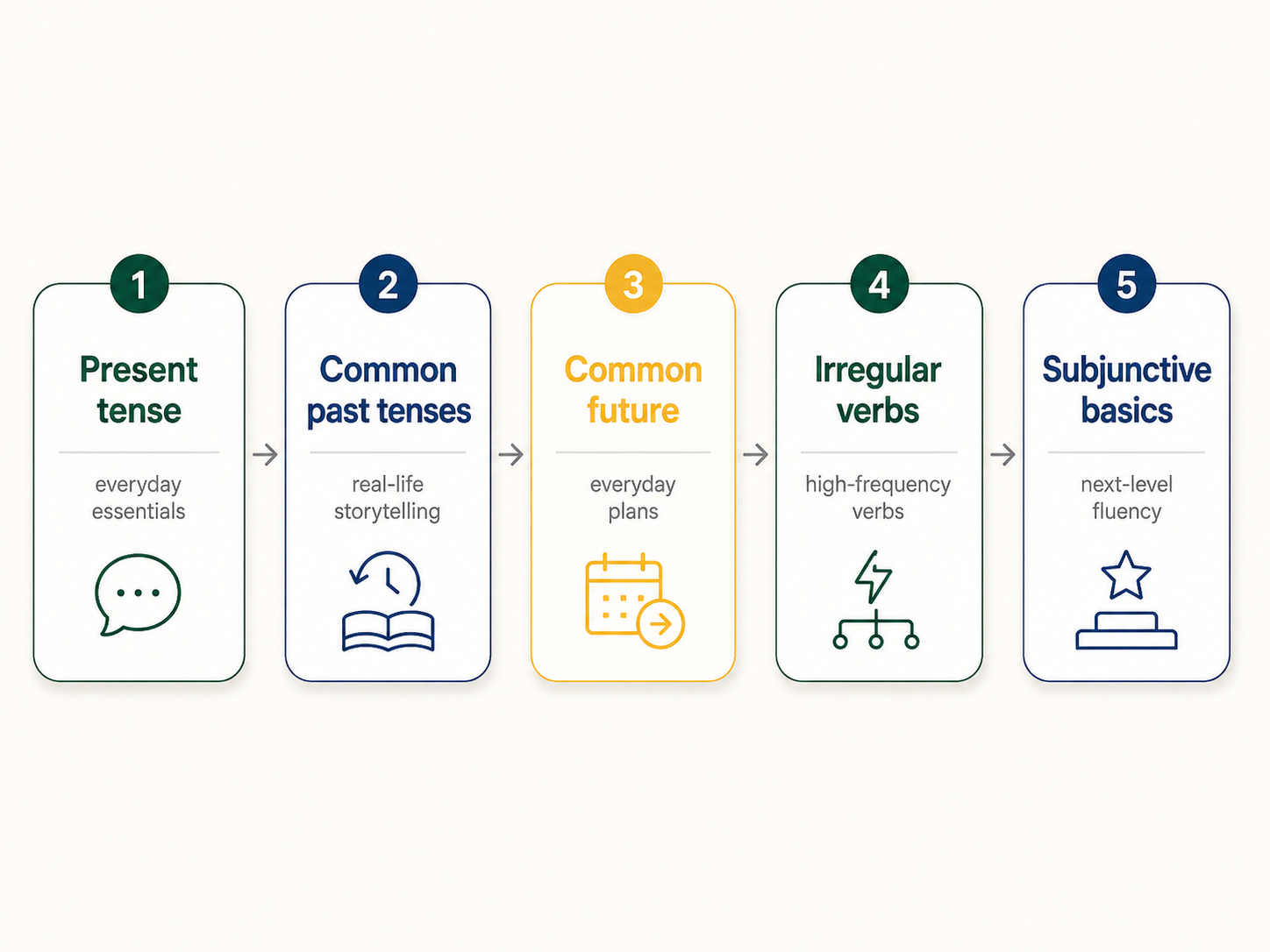
Important: do not wait until a separate later stage to meet irregular verbs. Begin high-frequency forms such as sou, estou, tenho, vou, and faço while learning the present tense, then expand their past and subjunctive forms gradually.
| Level | Priorities | Typical examples |
|---|---|---|
| A1 | Present indicative, infinitive after another verb, estar + gerund, ir + infinitive | Eu quero falar. / A gente está estudando. / Vou ligar amanhã. |
| A2 | Simple past, imperfect past, core irregular verbs, practical commands | Ontem eu falei. / Quando era criança, eu falava muito. |
| B1 | Present subjunctive, future subjunctive, conditional | Espero que você venha. / Quando eu tiver tempo, vou estudar. |
| B2+ | Imperfect subjunctive, compound tenses, personal infinitive, finer register choices | Se eu soubesse, teria contado. / É melhor esperarmos. |
Practice
How to practice verb conjugation effectively
- Choose one communicative goal. Practice describing your routine, telling what happened yesterday, or making plans—not a random tense in isolation.
- Use five high-frequency verbs at a time. Build sentences with ser, estar, ter, ir, and fazer before moving to less common verbs.
- Transform the same sentence. Compare eu falo, eu falei, eu falava, and eu vou falar.
- Practice retrieval, not copying. Cover the answer and produce the form from a situation or question.
- Tell short personal stories. Real memories naturally force you to contrast completed events and background information.
- Learn pronunciation with the conjugation. Endings such as -am, -ão, and -em need to become recognizable in speech. Use our Brazilian Portuguese pronunciation guide.
- Get feedback in conversation. A correct chart does not automatically become a form you can retrieve at normal speaking speed.
A five-minute daily drill
Minute 1: choose one subject and five verbs.
Minute 2: say five present-tense sentences.
Minute 3: turn them into completed past actions.
Minute 4: turn them into future plans with ir + infinitive.
Minute 5: speak freely about your real day using the same verbs.
Continue learning Brazilian Portuguese
Frequently asked questions about Portuguese verb conjugation
How many verb tenses are there in Portuguese?
Portuguese has several simple and compound verb forms across the indicative, subjunctive, and imperative systems. The exact total depends on how a grammar classifies compound constructions and nonfinite forms. For conversation, begin with a much smaller core: the present, progressive structures, the simple past, the imperfect past, and the future with ir + infinitive.
What are the three Portuguese verb endings?
The three main infinitive endings are -ar, -er, and -ir. They identify the regular conjugation group. The verb pôr and its derivatives form an important additional irregular family.
Should I learn tu or você first?
For broad communication across Brazil, você provides a consistent starting point. Learn to recognize tu early because it is common in several regions, then adapt your own use to the Brazilian community you interact with.
Why does a gente use the same verb as ele and ela?
Although a gente usually means “we,” it is grammatically third-person singular. Therefore, standard agreement uses forms such as a gente fala, a gente foi, and a gente vai.
What is the most common way to express the future in Brazilian Portuguese?
For everyday speech, ir in the present followed by an infinitive is the most immediately useful pattern: vou falar, vai chegar, vamos estudar, vão sair. The synthetic future remains important for recognition, writing, and particular styles or meanings.
What is the difference between falei and falava?
Falei normally presents the act as completed. Falava normally presents it as habitual, descriptive, background, or in progress in the past.
Do Brazilians always say the subject pronoun?
No. A subject can be omitted when the verb form and context identify it clearly. Speakers keep the pronoun when it helps with clarity, contrast, emphasis, or natural discourse flow.
What is the fastest way to remember irregular verbs?
Group them by frequency and communicative function, practice them inside complete sentences, and compare related forms. Retrieval from personal situations is more effective than repeatedly copying a full table.
Prefer to keep learning by email?
The Brazilian Ways newsletter brings Brazilian Portuguese explanations, cultural content, free resources, and occasional news about upcoming programs to your inbox.