

Brazilian Portuguese Filler Words: Né, Tipo, Então, Aí, Sabe
Spoken Brazilian Portuguese
Né, tipo, então, aí, sabe: the small words that hold real conversations together
Brazilian Portuguese filler words are not merely meaningless sounds. Expressions such as né, tipo, então, aí, and sabe can help speakers gain time, organize a story, soften an opinion, check understanding, or keep the listener involved.
Their English translations change with context. The goal is not to replace every né with “right?” or every tipo with “like.” The goal is to hear what each expression is doing in that specific conversation.
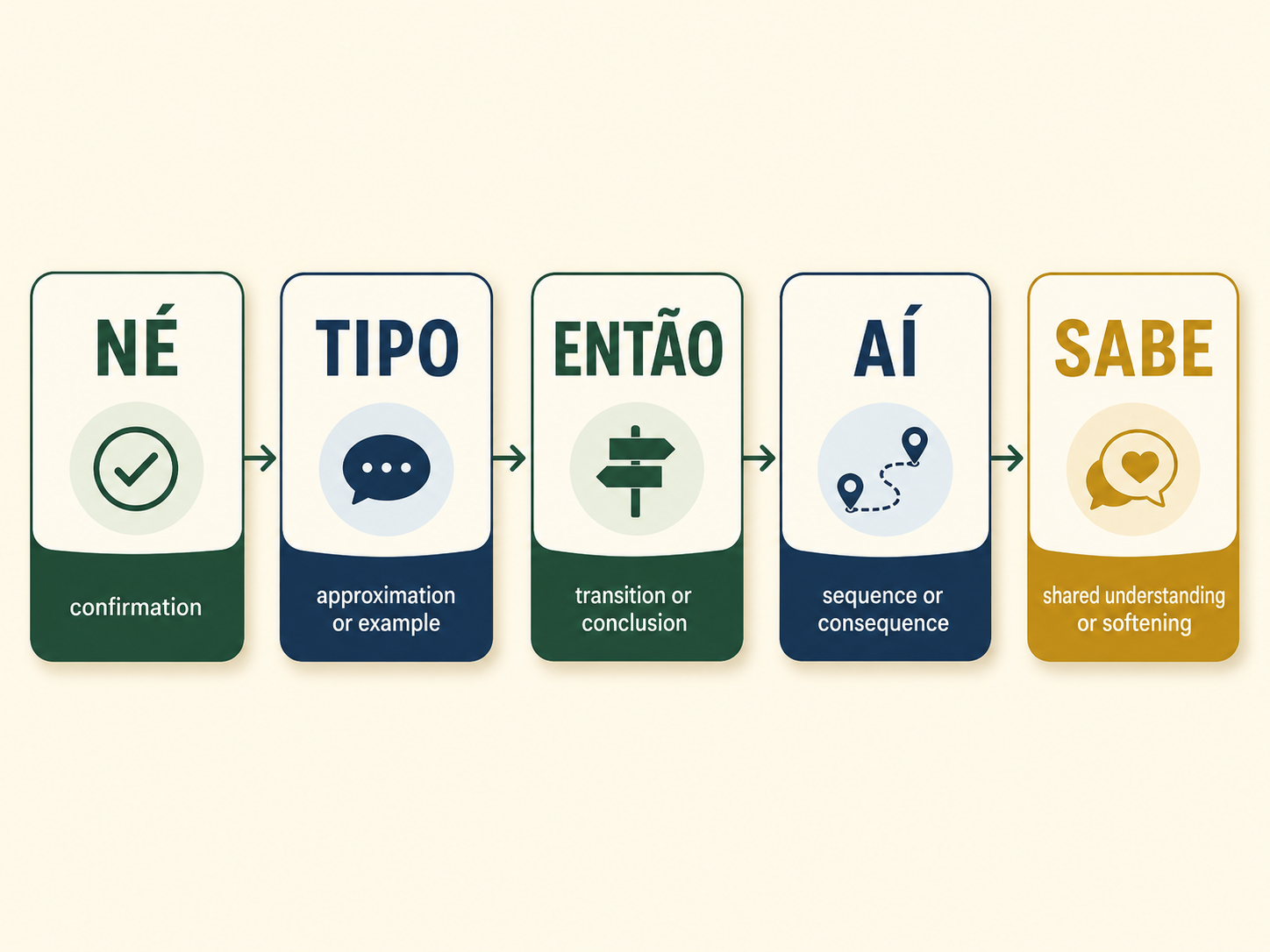
More than verbal clutter
What Brazilian Portuguese filler words actually do
In spontaneous speech, people plan and speak at the same time. Small expressions help them manage that process and manage the relationship with the listener.
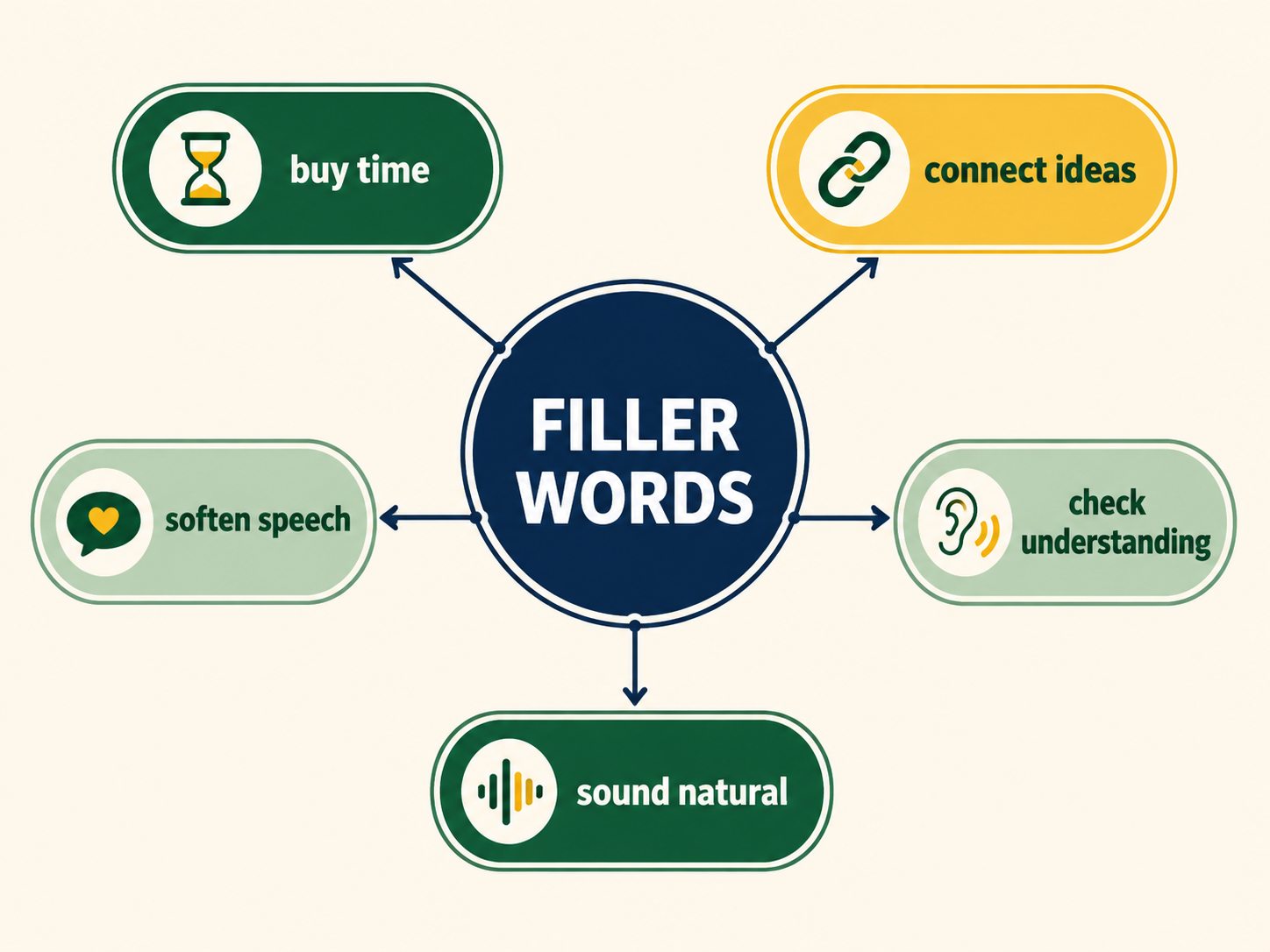
The map before the details
Brazilian Portuguese filler words: quick-reference table
These English equivalents are only orientation. Context and intonation determine the natural translation.
| Expression | What it commonly does | Approximate English—not a fixed translation |
|---|---|---|
| né? | Checks agreement, keeps the listener involved, or treats an idea as shared | right? / you know? / isn’t it? |
| tipo | Introduces an approximation, example, comparison, or formulation | like / kind of / for example |
| tipo assim | Signals that an explanation or reformulation is coming | like / it’s like / sort of |
| então | Starts, resumes, connects, concludes, or reacts to a topic | so / then / well |
| aí | Moves a story forward or presents what happened next | then / so / and then |
| sabe? | Checks shared understanding or invites involvement | you know? |
| assim | Frames an approximation, description, reformulation, or softened evaluation | like / sort of / this way |
| é… | Holds the floor while the speaker plans | um / uh |
| bom | Introduces a response, transition, reservation, or conclusion | well |
| olha / ó | Directs attention and prepares the listener for what follows | look / listen |
| pois é | Reacts with agreement, recognition, resignation, or continuation | yeah / exactly / well |
| tá? / entendeu? / viu? | Checks attention, understanding, or alignment | okay? / got it? / you see? |
Listener involvement
1. Né: confirmation, shared ground, and conversational connection
From não é?—but not always a literal question
Approximate equivalents: right?, isn’t it?, you know?, or no explicit English word.
interactive
tone-sensitive
Historically and transparently, né? relates to não é?. In real conversation, however, it often stops functioning as a full request for factual confirmation. It can treat information as shared, invite empathy, keep contact with the listener, or soften a statement.
Actual confirmation
The class is tomorrow, right?
The speaker genuinely wants confirmation.
Shared understanding
It was really difficult, you know? I didn’t know what to do.
The speaker invites the listener into the emotional perspective.
Softening an opinion
I think it ended up being a little expensive.
English may omit a tag question entirely.
Maintaining contact
We got there, you know, and nobody was there.
The marker helps maintain involvement during a longer turn.
Approximation and formulation
2. Tipo and tipo assim: “like” is only the beginning
An example, comparison, approximation, reaction—or planning signal
Approximate equivalents: like, kind of, sort of, for example.
multifunctional
especially common in informal and younger speech
Introducing an example
We could do something different, like going to the beach.
Approximation
There were like fifty people.
The number is approximate, not carefully counted.
Describing a reaction
When he said that, I was like, “What do you mean?”
Holding the floor
I wanted to, like… explain what happened more clearly.
What does tipo assim mean?
Tipo assim often announces that the speaker is about to explain, approximate, demonstrate, or reformulate an idea. Sometimes both words carry meaning; sometimes the combination mainly buys planning time.
Like, I enjoyed the course, but it wasn’t exactly what I expected.
Opening, connecting, and concluding
3. Então: so, then, well—and a complete response by itself
A highly flexible organizer
Approximate equivalents: so, then, well, in that case.
topic management
consequence
Opening a topic
So, I wanted to talk to you about the trip.
Returning to the main point
So, as I was saying, the meeting time changed.
Expressing a consequence
It rained a lot, so we stayed home.
Prompting the next step
So? What did you decide?
Então… can also be a complete hesitant response. The speaker may be preparing an answer, signaling that the answer is complicated, or gently resisting what was proposed.
A: Você vai aceitar o trabalho?
B: Então… eu ainda preciso pensar.
“Well… I still need to think about it.”
Narrative movement
4. Aí: not only “there”
A place word that also organizes spoken stories
Approximate equivalents in narratives: then, so, and then.
narrative sequence
context-dependent
Literal location
Your phone is there on the table.
Next event in a story
I got to the restaurant. Then he called me.
Result or development
The card didn’t go through, so I paid with Pix.
Prompting continuation
So? What happened next?
In an informal story, several occurrences of aí may build a chain: event, reaction, next event, consequence. English may use then, and, so, or simply sentence order.
Shared understanding
5. Sabe?: “you know?” without necessarily asking what you know
A verb that can become an interactional check
Approximate equivalent: you know?
alignment-seeking
empathetic
As a full verb, sabe refers to knowledge: Você sabe o endereço? As a discourse marker, sabe? may invite the listener to recognize an experience, imagine a quality, follow an explanation, or confirm that the point is understood.
Shared experience
You know when you wake up and you’re already tired?
Describing a quality
I wanted somewhere simpler, you know? More peaceful.
Emotional involvement
I was kind of disappointed, you know?
Checking that the explanation lands
It’s not that I don’t want to go. I just need more time, you know?
A flexible framing word
6. Assim: this way, like, sort of, or a softened formulation
One form with several ordinary and discourse functions
Possible equivalents: like this, like that, sort of, well.
reformulation
softening
Literal manner
Do it like this: first press this button.
Softened evaluation
I didn’t really like it, to be honest / I didn’t like it that much, really.
The translation depends heavily on tone and context.
Searching for a description
It was this really small, dark place.
Reframing
Well, it wasn’t exactly a problem.
Planning while speaking
7. É…, ah…, hum…, deixa eu pensar
These signals show that the speaker is processing, hesitating, remembering, or choosing words.
É…
I live in… um… Montes Claros.
Do not confuse this hesitation sound with the verb é meaning “is.”
Ah…
Uh… I think it was on Tuesday.
It may signal remembering, recognition, reaction, or a shift in thought.
Hum…
Hmm… I’m not sure.
It may show thought, doubt, or evaluation.
Deixa eu pensar
Let me think… about three years.
A useful explicit strategy when you need more time.
Como é que eu posso dizer?
It was… how can I put it? Kind of disappointing.
Quer dizer…
He’s my friend. I mean, we used to work together.
It repairs or refines what was just said.
Turn and attention management
8. Bom, olha, ó, and pois é
Bom…
Introduces an answer, transition, reservation, or conclusion.
Well, I understand your point, but I disagree.
Olha…
Directs attention and may introduce an explanation, warning, honest opinion, or disagreement.
Look, I wouldn’t do that now.
Ó…
A reduced attention-getter often used before showing, explaining, or emphasizing something.
Look, it’s very simple: you come in here and click this button.
Pois é…
Can signal agreement, recognition, resignation, irony, or that more explanation is coming.
“The price went up again.” “Yeah… / I know…”
Checking alignment
9. Tá?, entendeu?, and viu?
Tá?
Checks agreement, acceptance, or whether an instruction is understood.
Send me a message when you arrive, okay?
Entendeu?
May genuinely check comprehension or emphasize the speaker’s intended point.
It’s not that I don’t want to. I just can’t right now, you understand?
Viu?
Can draw attention, reinforce advice, underline a conclusion, or add warmth.
Don’t forget the document, okay?
Certo?
A relatively neutral confirmation check, common in explanations and professional contexts.
First you fill out the form, correct?
Real speech uses clusters
Common combinations you will hear
| Combination | What it signals | Natural example |
|---|---|---|
| Então, né… | The speaker resumes or concludes while seeking alignment. | Então, né… acho que a gente vai ter que mudar o plano. |
| Tipo assim… | The speaker prepares an explanation or rough description. | Tipo assim, não foi uma briga, mas ficou um clima estranho. |
| Aí, tipo… | The story advances and the speaker searches for the best formulation. | Aí, tipo, todo mundo ficou olhando pra mim. |
| Sabe, assim…? | The speaker asks the listener to imagine a quality while searching for the best description. | Sabe, assim, um lugar bem tranquilo, sem muita gente? |
| Pois é, né? | The speaker confirms a shared conclusion, often with resignation. | Pois é, né? Agora não tem muito o que fazer. |
| É que… | Introduces an explanation, justification, or gentle disagreement. | É que eu já tinha marcado outra coisa. |
| Assim, ó… | Organizes an explanation and directs attention. | Assim, ó: primeiro você abre o aplicativo. |
A frequent learner question
What is the difference between aí and então?
Aí often advances the event sequence
It is especially common when narrating what happened next.
I missed the bus. Then I called a car.
Então often expresses logic or organizes the topic
It can show consequence, start a conclusion, resume a point, or prompt a response.
I missed the bus, so I called a car.
The difference is not absolute. In informal Brazilian Portuguese, both can connect a cause with what happened next. A useful starting point is: aí tells the story forward; então makes the connection more explicitly logical or organizational.
Context controls the effect
Are filler words informal?
Some are clearly associated with relaxed conversation; others appear across many spoken settings. Frequency and delivery often matter more than the item alone.
| Register | Typical items | Where they fit |
|---|---|---|
| Neutral and widely usable | então, bom, olha, é…, sabe? | Conversation, classes, meetings, interviews—depending on tone and frequency |
| Usually conversational | né?, aí, assim, pois é | Everyday speech; some uses also appear in relatively formal conversation |
| Clearly informal when used as fillers | tipo, tipo assim, sei lá, cara, mano | Friends, relaxed classes, casual work conversations, social media |
| Regional or identity-marked | daí, uai, mano, meu | Meaning and frequency vary by region, age, group, and speaker |
| Avoid these conversational uses in formal writing unless quoting speech | né, tipo, aí, sabe, é… | Academic papers, contracts, formal reports, polished business writing; the same forms may still appear with their ordinary grammatical meanings |
Spoken professional Portuguese is not marker-free. A teacher may say então, a manager may begin with bom, and a speaker may use é… while planning. The difference is usually density, selection, and control—not total absence.
Recognition before performance
How to use filler words without sounding artificial
- Learn the function, not only the translation. Ask whether the marker is sequencing, softening, checking, reacting, or buying time.
- Listen for position. Notice whether it appears at the beginning, inside, or end of a sentence.
- Copy complete chunks. Learn Então, como eu estava dizendo… or Sabe quando…?, not an isolated word.
- Start with one or two markers. Então, bom, and deixa eu pensar are easier to control than scattering tipo and né everywhere.
- Match the speaker and setting. A marker strongly associated with a region, age group, or social style may not fit your own voice.
- Record yourself. Check whether the expression supports your message or merely repeats automatically.
- Keep formal writing separate. Natural speech and polished writing follow different conventions.
Correct but rigid
Eu cheguei ao restaurante. Ele não estava lá. Eu liguei para ele. Ele disse que estava em outro restaurante.
I arrived at the restaurant. He was not there. I called him. He said he was at another restaurant.
More conversational
Eu cheguei no restaurante, né, e ele não estava lá. Aí eu liguei pra ele e ele falou que estava em outro restaurante.
I got to the restaurant, you know, and he wasn’t there. So I called him, and he said he was at another restaurant.
See the system working together
An annotated Brazilian Portuguese dialogue
Lia: Então, você falou com a Júlia?
Rafa: Falei. Aí ela disse que, tipo, não sabia se ia conseguir viajar.
Lia: Ah, mas ela já tinha comprado a passagem, né?
Rafa: Pois é. É que apareceu um problema no trabalho, sabe?
Lia: Entendi. Então ela vai decidir quando?
Rafa: Acho que amanhã. Tipo assim, ela quer ir, mas depende do chefe.
opens the topic and later asks for the next conclusion.
moves the reported sequence forward.
signals that Rafa is giving an approximate version of Júlia’s position.
treats the ticket purchase as shared information and seeks confirmation.
acknowledges the contradiction: she bought the ticket, but may not travel.
introduces the explanation.
invites Lia to understand the situation rather than asking a factual question.
prepares a simplified reformulation of the dilemma.
Active practice
Choose the most natural discourse marker
More than one answer may be possible in real conversation. The proposed answer matches the intended function.
1. ___, eu queria falar sobre a reunião de ontem.
Show answer
então — A neutral way to open or return to a topic.
2. Ela ficou, ___, muito surpresa com a notícia.
Show answer
tipo — It approximates or dramatizes the description.
3. Eu saí de casa e ___ começou a chover.
Show answer
aí — It moves the sequence of events forward.
4. Foi uma situação bem desconfortável, ___?
Show answer
né — It invites recognition or agreement.
5. Eu não gostei muito. ___, não foi horrível, mas eu não voltaria.
Show answer
assim — It softens and frames the evaluation.
6. Eu queria um lugar mais tranquilo, ___? Sem muita gente.
Show answer
sabe — It invites the listener to understand the kind of place meant.
Speaking challenge
Record a 45-second story about a small problem. Use:
- então to open the topic;
- aí to move to the next event;
- né? or sabe? once to involve the listener;
- bom or pois é to conclude or react.
Listen again. Remove any marker that does not have a clear function.
Continue learning real Brazilian Portuguese
Related guides
Frequently asked questions
What are the most common Brazilian Portuguese filler words?
Common items include né, tipo, então, aí, sabe, assim, é, ah, bom, olha, pois é, tá, entendeu, and viu. Their frequency varies by speaker, region, age, context, and conversational style.
What does né mean in Brazilian Portuguese?
Né is related to não é? It may request confirmation, seek agreement, present information as shared, soften a statement, or keep the listener involved. It does not always translate literally as “isn’t it?”
Is tipo the same as “like” in English?
Sometimes. Tipo can introduce an example, approximation, comparison, reaction, or formulation. In other contexts, it keeps the speaker’s turn while they plan. “Like” is a useful clue, not a universal translation.
What is the difference between aí and então?
Aí often advances a spoken narrative—what happened next—while então often makes a consequence, transition, resumption, or conclusion more explicit. In informal speech, their functions can overlap.
Why do Brazilians say então so much?
Então performs several jobs: it can open a topic, resume an earlier point, connect a consequence, introduce a conclusion, or prompt the other person to continue. Its frequency comes from this flexibility, not from one fixed translation.
Why do Brazilians say sabe if they are not asking a question?
Sabe? can function as an interactional marker. The speaker may be inviting shared understanding, checking that the listener follows, or asking the listener to imagine an experience or quality.
Are filler words bad Portuguese?
No. They are normal features of spontaneous interaction. Excessive repetition can distract from a message, and many conversational markers do not belong in formal writing, but their presence in speech is not automatically an error.
Should Portuguese learners use né and tipo?
Learners should understand them early because they are common in listening. Production should develop gradually through complete chunks and real contexts. Forced repetition of né or tipo can sound unnatural.
Can I use filler words in a job interview or presentation?
Neutral markers such as então, bom, olha, and brief hesitation sounds may occur naturally. Highly repetitive tipo, né, or aí can make speech sound less controlled. The appropriate amount depends on the setting and desired tone.
Is uai a Brazilian Portuguese filler word?
Uai can work as a reaction or discourse particle, especially associated with Minas Gerais, but it carries regional identity. It should not be treated as a universal neutral filler for every speaker.