

Pão vs. Pau in Brazilian Portuguese: How to Pronounce ão Without the Awkward Mistake
One tiny sound. Two very different words.
If your pão sounds like pau, the problem is not the spelling. It is nasalization.
For English speakers, pão and pau can look almost identical and initially sound surprisingly close. To a Brazilian ear, however, the contrast is clear.
And yes, it is worth learning: pão means bread. Pau normally means stick/wood and also has a vulgar slang meaning: penis.
Start with the contrast
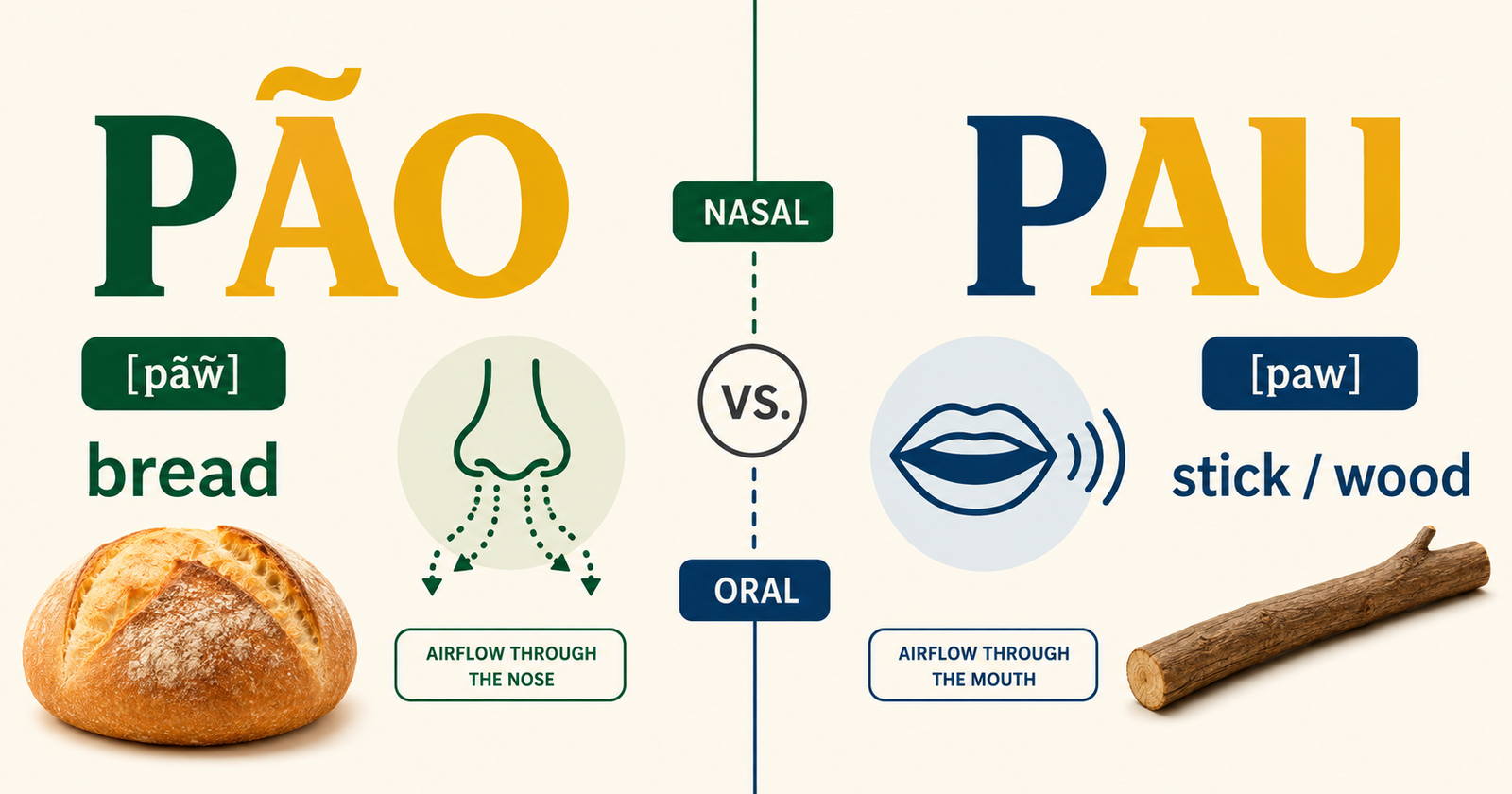
Pão vs. pau: same first consonant, different vowel system
/ˈpɐ̃w̃/
bread
The diphthong is nasal. The tilde tells you immediately that the vowel carries nasalization.
Eu quero um pão.I want a bread roll / some bread.
/ˈpaw/
stick / wood; vulgar slang: penis
The diphthong is oral. There is no nasalization.
Peguei um pau no chão.I picked up a stick from the ground.
The two words are not distinguished by adding an n sound to pão. In Brazilian Portuguese, nasal vowels are a property of the vowel itself: resonance is shared between the mouth and nasal cavity rather than ending with a clear English-style n or ng.
The famous café mistake, explained accurately
Why Brazilians laugh at pau com manteiga
The classic learner example is:
What you mean
Quero um pão com manteiga, por favor.
I’d like bread with butter, please.
What you accidentally say
Quero um pau com manteiga, por favor.
I’d like a stick with butter, please — with an obvious possible dirty-joke reading because pau is also vulgar slang for penis.
The old version of this article translated pau directly as “penis.” That makes the joke memorable, but it hides the ordinary meaning of the word. The basic noun means stick or piece of wood. Brazilian dictionaries also record the vulgar slang meaning “penis.”
The physical difference
What is a nasal vowel in Brazilian Portuguese?
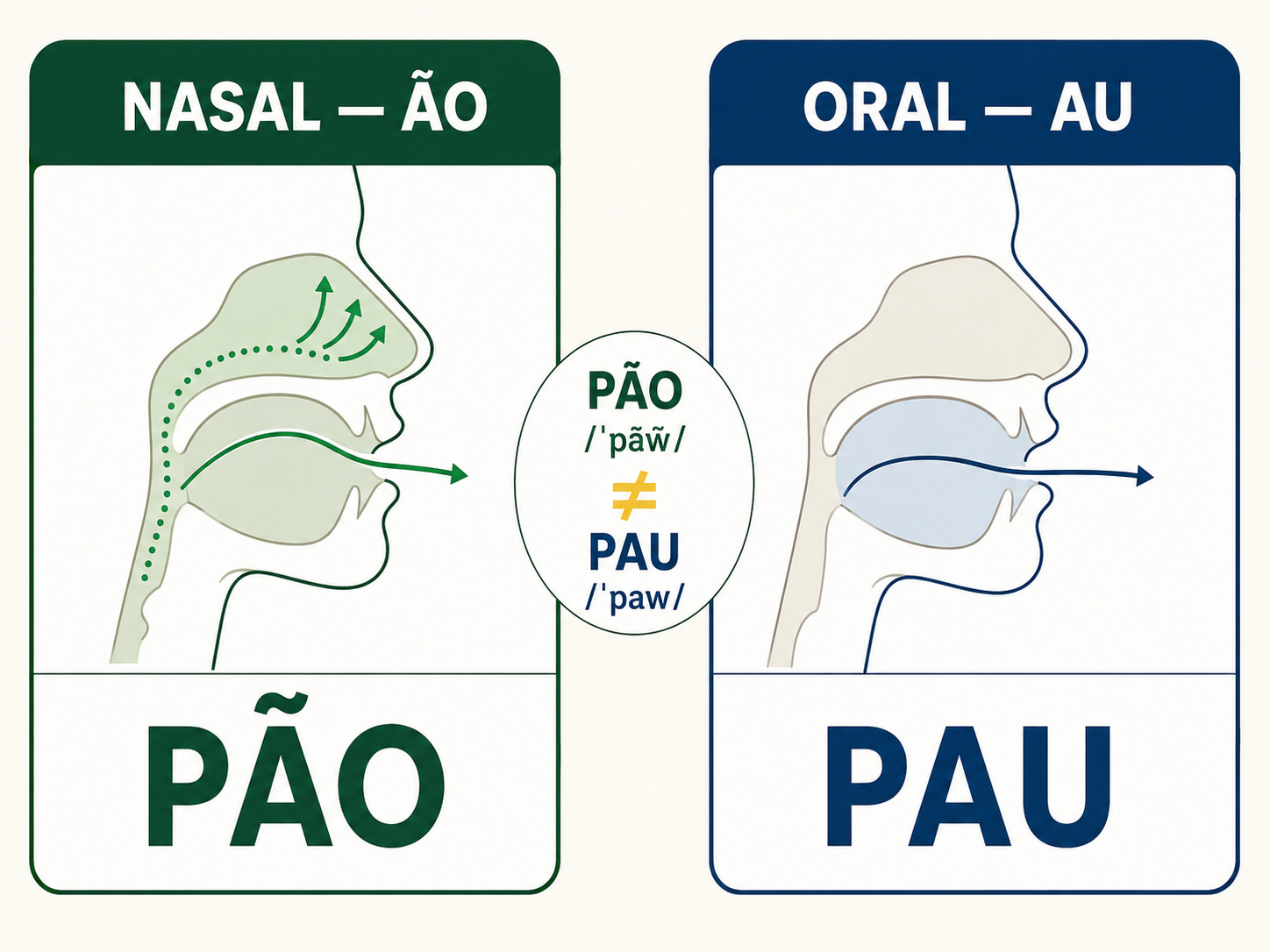
With an oral vowel, the soft palate is raised and the sound resonates mainly through the mouth. With a nasal vowel, the soft palate lowers enough for part of the acoustic energy and airflow to involve the nasal cavity as well.
Say the vowel normally with no deliberate nasal resonance. This is the type of vowel contrast you need in pau.
Allow the vowel to resonate through both the oral and nasal cavities. This is what distinguishes pão.
A simple awareness test is to say a nasal word slowly and briefly pinch your nose. The resonance should be noticeably disrupted. Try the same with a clearly oral vowel and the effect should be much smaller.
Build the sound in stages
How to pronounce Brazilian Portuguese ão
Start relaxed
Begin with an open central vowel rather than a strong English “ah” or “ow.” Do not exaggerate the jaw movement.
Add nasal resonance
Keep voicing while allowing the sound to resonate through the nose. Do not add an audible n.
Glide toward u
Round the lips toward a brief w-like glide at the end.
Keep it nasal
The nasal quality should continue through the glide. Do not switch back to a fully oral ending too early.
Practice the ending alone first:
Then move immediately into short phrases so the sound does not become an isolated pronunciation trick:
Now remove the nasal contrast
How to pronounce au in pau
Pau is much simpler for many English speakers: begin with an oral a and glide toward a brief w-like ending. Keep the entire diphthong oral.
nasal /ˈpɐ̃w̃/
Do not lose the nasal quality during the glide.
oral /ˈpaw/
No nasal resonance. This is much closer to an ordinary oral diphthong.
Do not fix one problem by creating another
Four common mistakes English speakers make with ão
If the sound stays fully oral, pão can move toward pau.
Pão should not end like English pan. The nasality belongs to the vowel/diphthong.
An ng-like cue may help some learners discover nasal resonance, but a full final /ŋ/ is not the target.
If you can say pão only in isolation, the sound may disappear when you start speaking faster.
Train the contrast, not just the word
Minimal and near-minimal pairs for nasal ão vs. oral endings
In many Brazilian accents, syllable-final l is pronounced with a w-like sound. That creates several excellent practice contrasts where nasalization carries much of the perceptual difference.
| Nasal | Meaning | Oral contrast | Meaning |
|---|---|---|---|
| pão | bread | pau | stick / wood |
| mão | hand | mal | badly / evil |
| cão | dog | cal | lime |
| são | are / healthy / saint | sal | salt |
Read each pair in alternating order:
Pão is one member of a larger system
Other nasal sounds you will hear constantly in Brazilian Portuguese
The tilde appears on ã and õ, but nasalization is not limited to words with a tilde. Vowels followed by m or n in the same syllable can also be nasal.
| Pattern | Examples | Meaning |
|---|---|---|
| ão | pão, mão, não, irmão, coração | bread, hand, no, brother, heart |
| ãe | mãe, pães | mother, breads |
| õe | põe, limões | puts, lemons |
| vowel + m | bom, bem, sim, um | good, well, yes, one/a |
| vowel + n | antes, canta | before, sings |
This broader system is one reason nasal pronunciation affects listening as well as speaking. If you are waiting for a strong final m in bom or a clear English-style n in a nasal syllable, you may fail to recognize a word you already know.
For the full sound system, continue with our Brazilian Portuguese Pronunciation Guide.
Your ear usually improves before your mouth
How to train yourself to hear pão and pau
Listen without reading
If you see the spelling first, your brain can “hear” what it expects. Start with audio-only contrast when possible.
Identify, don’t repeat
Listen to two words and decide which one you heard before trying to imitate either one.
Record both
Say the nasal word and oral word back-to-back. A contrast is easier to evaluate than one isolated recording.
Put them in phrases
Once you can distinguish the words, practice them at normal conversational speed.
This is also why pronunciation and listening belong together. Our guide Why You Understand Your Portuguese Teacher but Not Brazilians explains what happens when familiar words change shape in natural speech.
Use the sound in something you might actually say
Brazilian café phrases with pão
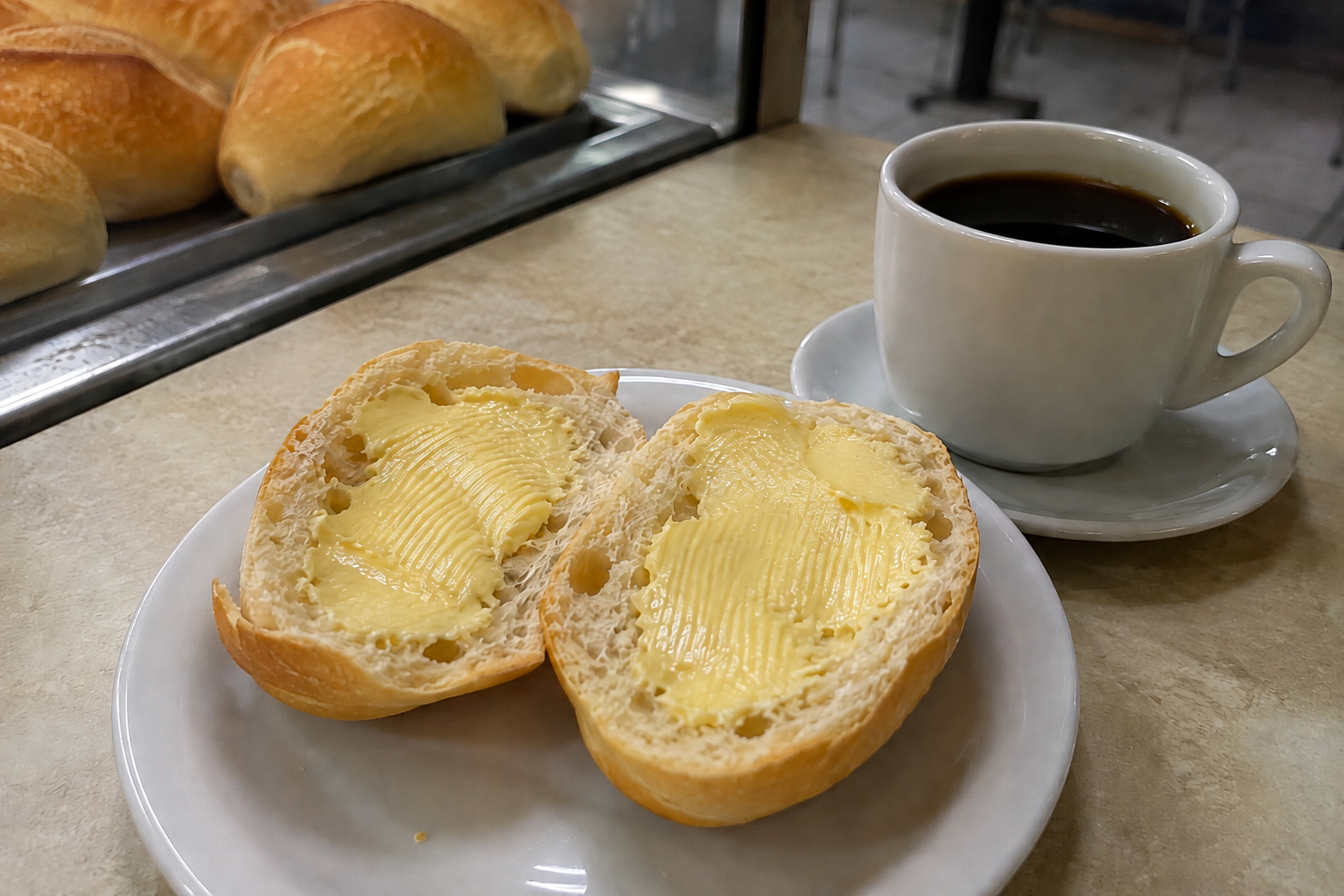
I’d like bread with butter, please.
Practice the whole phrase rather than stopping after pão.
Do you have pão de queijo?
The same nasal contrast appears in one of Brazil’s most famous foods.
I’ll have two bread rolls.
Notice that the plural changes to pães, introducing another nasal diphthong.
Is this bread from today?
Repeated phrase practice helps carry the nasal sound into connected speech.
One more reason the contrast matters
Pau has several meanings in Brazilian Portuguese
um pau de madeira — a piece/stick of wood
It can refer to the penis, which is why the pronunciation mistake is so memorable.
Custou 500 paus. — It cost 500 bucks.
It appears in expressions such as pau a pau, o pau comeu, and many others.
So even after you master the pronunciation contrast, context still matters. One Brazilian word can participate in several completely different meanings and expressions.
Keep building your ear
Related Brazilian Portuguese guides
Frequently asked questions
FAQ about pão, pau and Portuguese nasal vowels
What is the difference between pão and pau?
Pão means bread and contains a nasal diphthong. Pau usually means stick or wood and contains an oral diphthong. Pau also has a vulgar slang meaning referring to the penis.
How do you pronounce pão?
In Brazilian Portuguese it is commonly represented approximately as /ˈpɐ̃w̃/. Start with a nasalized central vowel and glide toward a w-like ending while keeping the nasal quality through the glide.
How do you pronounce pau?
Pau is approximately /ˈpaw/ in Brazilian Portuguese. The vowel sequence is oral, not nasal.
Does pau mean penis?
It can. The ordinary meanings include stick and wood, while Brazilian dictionaries also record a vulgar slang use meaning penis. Context determines which sense is intended.
Is Portuguese ão pronounced like English “own”?
Not exactly. “Own” is sometimes used as a rough learning approximation, but Brazilian ão is nasal and does not end with an English n. Treating “own” as the target pronunciation can create an inaccurate final consonant.
Why is ão difficult for English speakers?
Most English varieties do not use vowel nasality as the same kind of meaning-changing contrast. Learners therefore tend to substitute a familiar oral diphthong or add an n/ng consonant instead.
Does the tilde always mean the vowel is nasal?
In Portuguese, the tilde on ã and õ explicitly marks nasalization. Portuguese also has nasal vowels in many syllables written with m or n rather than a tilde.
What other words use ão?
Very common examples include não (no), mão (hand), cão (dog), irmão (brother), coração (heart), and many nouns ending in -ção.
Should I exaggerate the nasal sound when practicing?
Temporarily, a slightly exaggerated contrast can help you perceive and produce the difference. The goal is then to reduce that exaggeration until the nasalization fits naturally into normal speech.
Will Brazilians understand me if I pronounce pão incorrectly?
Usually context will help, especially in a bakery or café. But nasal vowels occur throughout Brazilian Portuguese, so learning the contrast improves much more than one breakfast order.