

Brazilian Portuguese vs. European Portuguese: The Complete Guide to the Differences
One language, two major national varieties, many regional voices
Brazilian and European Portuguese share a language—but they do not organize sound, grammar, vocabulary, and social distance in exactly the same way
A Brazilian and a Portuguese person can communicate without changing languages. They share most basic grammar, a large common vocabulary, and a largely shared writing system. But a learner who studies only one variety may initially struggle with the other—especially in fast conversation.
The largest listening difference is often pronunciation. The most visible everyday differences involve vowel reduction, rhythm, object pronouns, tu and você, the progressive tense, forms of address, vocabulary, and locally preferred spellings. None of this makes one variety more correct than the other.
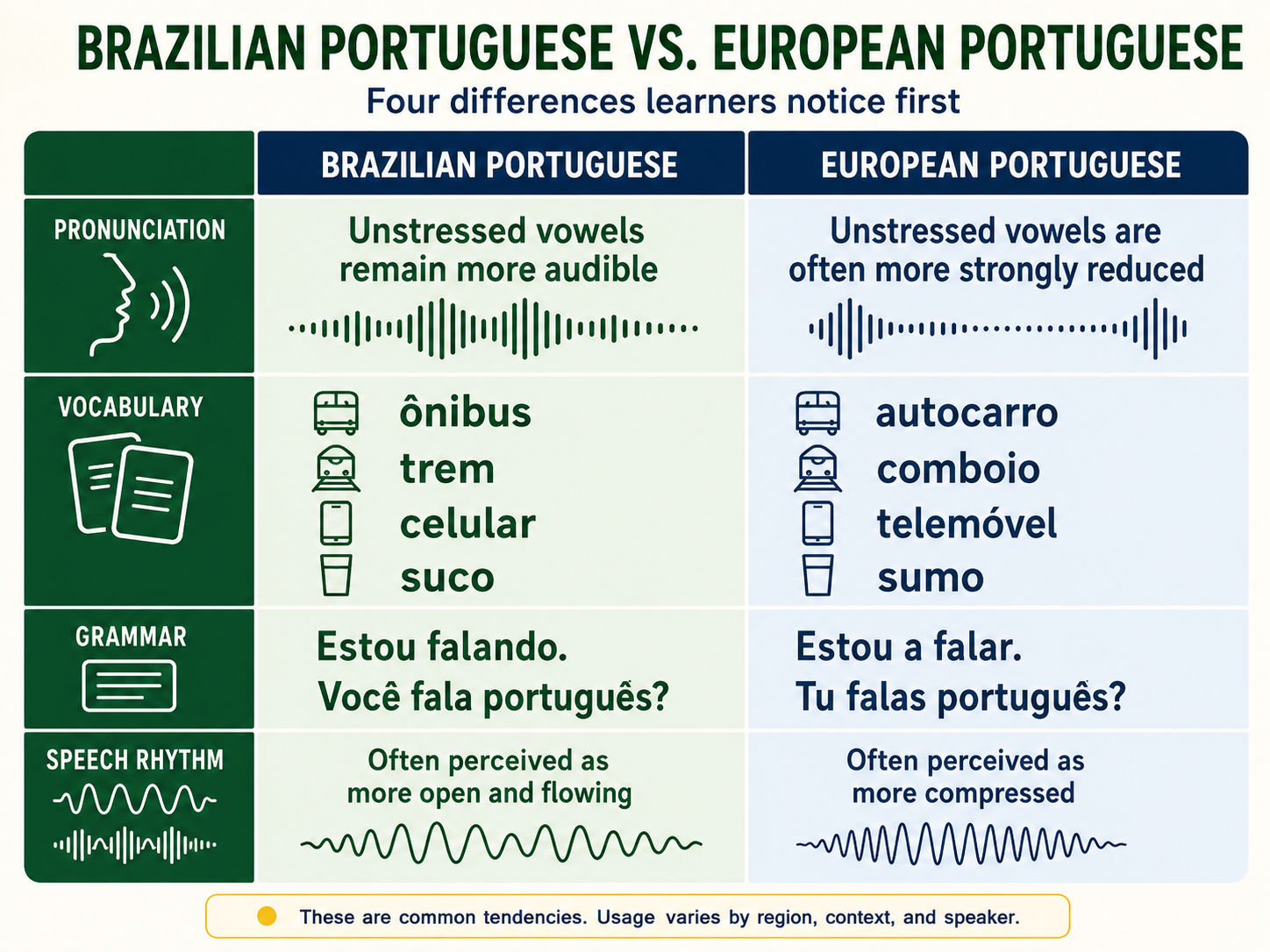
The differences learners notice first
Brazilian Portuguese vs. European Portuguese at a glance
| Area | Brazilian Portuguese | European Portuguese |
|---|---|---|
| Pronunciation | Unstressed vowels are often more audible; many varieties palatalize t and d before an i-type sound | Stronger unstressed-vowel reduction; words can sound more compressed to an unfamiliar listener |
| Progressive action | Estou estudando. | Estou a estudar. |
| Informal “you” | Você is widespread; tu is also common in several regions, with regional verb patterns | Tu is the regular intimate form; speakers often avoid an explicit você in many situations |
| Object pronouns | Spoken language strongly favors pronouns before the verb: Me ajuda. | After the verb is common in affirmative clauses: Ajuda-me. |
| Subject pronouns | Subjects are expressed more often: Eu acho que ele vem. | Subjects are omitted more freely when the verb identifies them: Acho que vem. |
| Vocabulary | ônibus, trem, celular, banheiro, suco | autocarro, comboio, telemóvel, casa de banho, sumo |
| Spelling | fato, recepção, bebê, econômico | facto, receção, bebé, económico |
| Best learning target | Brazil, Brazilian family, Brazilian media, Celpe-Bras, work or study in Brazil | Portugal and daily interaction with people and institutions in Portugal |
Different does not mean separate
Are Brazilian and European Portuguese the same language?
Yes. They are major national varieties of Portuguese. Speakers share fundamental grammar, a large core vocabulary, literary and historical traditions, and most formal written communication.
What remains shared
Basic sentence structure, most high-frequency vocabulary, verb categories, gender and number agreement, the writing system, and a broad common standard.
What has diverged
Pronunciation, rhythm, regional vocabulary, frequency of grammatical constructions, pronoun systems, forms of address, cultural references, and localization choices.
A 2025 parallel-corpus study found the greatest measured divergence at the lexical level, while also identifying recurring grammatical differences involving the gerund, subject expression, clitic pronouns, and word-order preferences. That finding fits the learner experience: the language remains structurally related, but ordinary sentences can be built differently.
Separation, contact, and different national histories
Why did Portuguese develop differently in Brazil and Portugal?
Portuguese arrived in colonial Brazil through settlement, administration, religion, and coercive political expansion. It developed in contact with many Indigenous and African languages and later with immigration languages. The social history of slavery, territorial expansion, urbanization, schooling, national media, and internal migration shaped Brazilian varieties.
Portugal also continued to change. European Portuguese developed through its own regional patterns, social movements, urban centers, educational norms, and contact with other languages and Portuguese-speaking societies.
The same spelling can produce very different listening experiences
Pronunciation is usually the biggest initial barrier
| Feature | Brazilian Portuguese | European Portuguese | Learner note |
|---|---|---|---|
| Unstressed vowels | Usually more audible, although reduction still exists and varies by region and position | Frequently reduced or centralized, especially in unstressed syllables | telefone may sound as if it has fewer clear vowels in European Portuguese |
| Rhythm and phrasing | Often perceived as more syllable-forward, with more audible vowel transitions | Often perceived as more compressed because reduction and phrasing make consonant groups more prominent | The difference is not simply “slow Brazil, fast Portugal”; both countries contain many speaking rates and accents |
| T and D before an I-type sound | In many—but not all—Brazilian varieties, tia and dia begin with sounds similar to “chee” and “jee” | Usually remain closer to plain t and d | This is regional in Brazil, not a universal national rule |
| S at the end of a syllable | Can sound like s, z, sh, or zh, depending on region and the following sound | A sh-like or zh-like coda is frequent | Rio de Janeiro also has prominent sh-like pronunciations, so the difference cannot be reduced to country alone |
| R | Several realizations coexist: an h-like sound, tap, trill, or other regional forms | Several realizations also coexist, including taps, trills, and stronger back-of-the-mouth forms | There is no single Brazilian R or Portuguese R |
| Final L | Often vocalized, so Brasil may end with a sound close to English w | Usually remains a dark or velarized L | This difference is very audible in words such as Portugal, papel, and final |
| Final unstressed E and O | Frequently approach i and u in many accents | Often become weak central vowels or may be barely audible | The written ending is the same, but the acoustic result can be very different |
| Intonation | Questions, statements, calls, and emphasis follow Brazilian regional patterns | Uses its own inventory of intonational contours and phrasing | Intonation contributes strongly to the perception that the varieties have different rhythms |
These descriptions compare broad tendencies, not two single accents. A person from Recife, Rio de Janeiro, São Paulo, Porto Alegre, Lisbon, Porto, Madeira, or the Azores may sound very different from another speaker in the same country.
For a deeper explanation of nasal vowels, stress, R, S, T, D, and regional variation, use our Brazilian Portuguese Pronunciation Guide.
Listeners do not hear spelling; they hear prominence and reduction
Why can European Portuguese sound as if vowels disappear?
European Portuguese frequently reduces unstressed vowels. A written e or o may become centralized, extremely weak, or difficult for an untrained learner to identify. Consonants then feel closer together, and familiar written words can become hard to segment.
Brazilian Portuguese also reduces vowels, but many unstressed vowels remain more audible. This can make word boundaries easier for beginners, although Brazilian connected speech still includes contractions, assimilation, sound changes, and regional reduction.
A complete written sequence of vowels and consonants.
Every written vowel to have the strength it has in a careful dictionary pronunciation.
Redistributes duration and prominence, weakens unstressed material, and groups words into phrases.
National labels hide regional variation
T, D, S, R, and L do not follow one simple Brazil–Portugal rule
T and D
Many Brazilians pronounce tia and dia with palatalized sounds similar to “chee” and “jee.” Other Brazilian regions retain plainer T and D sounds. Portugal generally does not use the same widespread palatalization.
S
Portugal frequently has sh-like or zh-like syllable-final S. Brazil varies greatly: many regions use s/z-like forms, while Rio de Janeiro and other varieties also use sh-like forms.
R
Both countries have several R realizations. Position in the word, region, age, and social variety all matter. “Brazilian R sounds like H” is an incomplete learner shortcut.
Final L
Brazil commonly vocalizes final L, producing a w-like ending. Portugal typically retains a dark L. This creates a strong contrast in Brasil, Portugal, papel, and final.
Shared grammatical resources, different everyday preferences
Major grammar differences between Brazil and Portugal
| Feature | Brazil | Portugal | Important nuance |
|---|---|---|---|
| Action in progress | Estou trabalhando. | Estou a trabalhar. | The meaning is normally the same |
| Informal request | Você pode me ajudar? / Tu pode(s) me ajudar? depending on region | Podes ajudar-me? | Brazilian tu does not follow one national conjugation pattern |
| Affirmative object pronoun | Ela me chamou. | Ela chamou-me. | Both varieties also have grammatical contexts that attract the pronoun before the verb |
| Negative object pronoun | Ela não me chamou. | Ela não me chamou. | Negation triggers pre-verbal placement in standard European Portuguese |
| Starting a spoken sentence with a pronoun | Me manda a foto. | Manda-me a fotografia. | The Brazilian form is natural in conversation but may be edited in highly formal writing |
| Subject expression | Eu não sei se ele vai. | Não sei se vai. | Context determines whether the omitted subjects remain clear |
| First-person plural | A gente vai amanhã. / Nós vamos amanhã. | Nós vamos amanhã.; a gente exists but has a different frequency and distribution | A gente takes a third-person singular verb in standard Brazilian usage |
| Direct-object person in informal speech | Eu vi ele ontem. | Vi-o ontem. | Formal Brazilian writing often prefers Eu o vi; actual speech and formal norms are not identical |
| Possessive clarity | O carro dele / dela is very common to avoid ambiguity | O carro dele / dela also exists, while possessive choices and article use differ by context | Seu can refer to more than one person in Brazilian Portuguese |
| Demonstratives | Esse commonly covers much of the everyday territory of “this,” while este remains available | The three-way distinction este / esse / aquele is often maintained more productively | Actual usage varies by speaker and setting |
One of the most socially important differences
Tu, você, o senhor, and a senhora
Simplified learner charts sometimes describe Brazil as a você country and Portugal as a simple tu informal / você formal country. Real usage is more complex.
| Situation | Brazil | Portugal | Advice |
|---|---|---|---|
| Close friend | você or regional tu | tu | Listen to the local pattern before changing forms |
| Older stranger or formal service | o senhor / a senhora, sometimes você depending on region and situation | o senhor / a senhora, professional title, name, or a third-person verb without an explicit pronoun | An explicit você can sound distancing or uncomfortable to some Portuguese speakers |
| Group of people | vocês | vocês | Vós is not the normal everyday plural form in either country |
| Workplace | First names and você are common, but hierarchy and region matter | First name, title, third-person forms, or tu depending on workplace culture | Neither country has one universal rule for formality |
Brazil
Você is widespread and can be friendly, neutral, or contextually formal. Tu remains common in several regions. Some communities use traditional second-person forms such as tu vais; others combine tu with third-person verb forms such as tu vai in natural speech.
Portugal
Tu is the ordinary intimate singular form. Formality is not created by automatically replacing it with an explicit você. Depending on the speaker and relationship, você may sound distant, marked, uncomfortable, or normal. Speakers may instead use a name, title, o senhor / a senhora, or a third-person verb without saying the pronoun.
A visible difference in everyday sentences
Why Brazil says me ajuda and Portugal says ajuda-me
Brazilian spoken preference
Me ajuda.
Ela me ligou.
Eu te mandei a mensagem.
European spoken preference
Ajuda-me.
Ela ligou-me.
Eu mandei-te a mensagem.
European Portuguese strongly favors enclisis—placing an unstressed object pronoun after the verb—in many affirmative main clauses. Brazilian conversation strongly favors proclisis—placing the pronoun before the verb.
But neither rule is absolute. Negative words, subordinate structures, interrogatives, and other grammatical triggers can place the pronoun before the verb in European Portuguese:
Comparative syntax research treats clitic placement as one of the major structural differences between the varieties, not merely a stylistic preference.
The same action, two highly recognizable constructions
Estou estudando vs. estou a estudar
Brazil
Estou estudando português.
I am studying Portuguese.
Portugal
Estou a estudar português.
I am studying Portuguese.
Brazilian Portuguese normally uses estar + gerund for an action in progress. European Portuguese normally uses estar a + infinitive. Both constructions exist within the history and wider geography of Portuguese, but their everyday national distributions differ sharply.
Pronouns reveal deeper grammatical preferences
Subject pronouns, a gente, and informal direct objects
More explicit subjects in Brazil
Brazilian Portuguese often expresses eu, você, ele, and ela even when the verb and context could identify the subject.
More subject omission in Portugal
European Portuguese more robustly omits a recoverable subject because its verbal and discourse system supports that interpretation.
A gente
Brazilian conversation frequently uses a gente + third-person singular verb for “we”: a gente vai.
Ele and ela as objects
Informal Brazilian speech may use vi ele. European Portuguese prefers clitic forms such as vi-o; formal Brazilian writing may prefer eu o vi.
A familiar object may have a completely different everyday name
30 Brazilian and European Portuguese vocabulary differences
| Meaning | Brazil | Portugal |
|---|---|---|
| Bus | ônibus | autocarro |
| Train | trem | comboio |
| Cellphone | celular | telemóvel |
| Bathroom | banheiro | casa de banho |
| Juice | suco | sumo |
| Ice cream | sorvete | gelado |
| Breakfast | café da manhã | pequeno-almoço |
| Cup | xícara | chávena |
| Refrigerator | geladeira | frigorífico |
| Suit | terno | fato |
| ID card | carteira de identidade / RG | cartão de cidadão |
| Driver’s license | carteira de motorista / CNH | carta de condução |
| Crosswalk | faixa de pedestres | passadeira |
| Pedestrian | pedestre | peão |
| Sidewalk | calçada | passeio |
| Line / queue | fila | fila / bicha in informal usage |
| Screen | tela | ecrã |
| Mouse | mouse | rato |
| File | arquivo | ficheiro |
| Website | site | site / sítio depending on context |
| Download | baixar / fazer download | descarregar / fazer download |
| Stapler | grampeador | agrafador |
| Adhesive tape | fita adesiva / durex as a trademark-based term | fita-cola |
| Sneakers | tênis | sapatilhas |
| Socks | meias | meias / peúgas |
| Sweater | suéter / blusa | camisola |
| Kid | criança / menino / garoto | criança / miúdo |
| Cool / nice | legal / bacana | giro / fixe |
| Takeaway food | comida para viagem | comida para levar |
| Receipt | recibo / nota fiscal depending on the document | recibo / fatura depending on the document |
The most memorable differences are not always the most frequent
Words that can sound normal in one country and offensive or confusing in the other
| Word | Portugal | Brazil | Practical warning |
|---|---|---|---|
| rapariga | Can be understood as a neutral word for a girl or young woman | In much of Brazil, it can be insulting or associated with a sex worker | Use menina, garota, or moça in Brazil unless you understand the local context |
| propina | Tuition or a fee paid to an educational institution | A bribe | This can completely reverse the interpretation of a university conversation |
| bicha | Can informally mean a queue | Commonly understood as a homophobic slur or insult | Use fila when speaking in Brazil |
| puto | Can mean a boy or young person in informal speech | Can mean angry in expressions such as ficar puto, and can also be offensive | Do not transfer the Portuguese meaning automatically |
| camisola | Often a sweater, jersey, or shirt depending on context | Often a nightgown | Ask or use a more specific clothing word |
| fato | A suit; facto is “fact” | A fact; a suit is terno | Spelling and meaning work together here |
These examples are useful because the consequences can be immediate, but learners should not reduce the entire comparison to humorous “dangerous words.” Pronunciation, pronouns, and high-frequency grammar affect far more conversations.
A common agreement did not eliminate national pronunciation
Why do Brazil and Portugal still spell some words differently?
The 1990 Orthographic Agreement reduced certain differences and created a common framework, but it explicitly allows variation connected to established pronunciation. It did not make every word identical, and some forms have accepted double spellings when pronunciation varies.
| Reason for difference | Brazil | Portugal | Explanation |
|---|---|---|---|
| Common national pattern when a consonant is pronounced differently | fato, contato are the usual Brazilian forms | facto, contacto are common Portuguese forms | Pronunciation guides the spelling, and accepted variants may exist when educated pronunciation varies |
| Reverse consonant pattern | recepção is the usual Brazilian form | receção is common in Portugal | This is a common national contrast, but the agreement permits double forms when the consonant is pronounced |
| Different stressed-vowel quality | bebê, Antônio, econômico, acadêmico | bebé, António, económico, académico | Acute and circumflex accents can legitimately differ because pronunciation differs |
| Vocabulary-based spelling difference | arquivo, tela, celular | ficheiro, ecrã, telemóvel | An orthographic agreement does not replace different words with one common word |
The agreement also cannot unify different vocabulary. No spelling reform turns Brazilian ônibus into Portuguese autocarro because those are different lexical choices, not two spellings of one word.
Different social grammar is not the same as more or less polite
Is European Portuguese more formal than Brazilian Portuguese?
That statement is too broad. Brazilian communication may use first names and você more readily in some environments, while Portuguese communication may mark distance through pronouns, titles, or omission of an explicit form of address. But both societies have casual, intimate, professional, ceremonial, regional, and highly formal registers.
Brazilian warmth is not grammatical simplicity
Diminutives, indirect requests, titles, tone, greetings, and relationship-building can carry complex politeness.
Portuguese distance is not automatic coldness
A speaker may avoid você or use a title because that is the locally appropriate way to manage respect.
For a broader explanation of greetings, first names, titles, and social distance in Brazil, read Brazilian Portuguese Greetings and Introductions.
The differences become clearer in complete sentences
Four side-by-side conversations
Asking what someone is doing
Brazil: O que você está fazendo?
Portugal: O que estás a fazer?
Meaning: What are you doing?
Asking for help
Brazil: Você pode me ajudar?
Portugal: Podes ajudar-me?
Meaning: Can you help me?
Taking public transportation
Brazil: A gente pega o ônibus perto da estação.
Portugal: Apanhamos o autocarro perto da estação.
Meaning: We take the bus near the station.
Talking about a phone file
Brazil: Baixa o arquivo no celular.
Portugal: Descarrega o ficheiro no telemóvel.
Meaning: Download the file on the cellphone.
Mutual intelligibility is real, but it is not automatic in every situation
Can Brazilians and Portuguese people understand each other easily?
Reading
Usually relatively accessible because spelling and formal grammar remain closely connected.
Careful conversation
Generally successful when speakers adapt speed, vocabulary, and pronunciation.
Fast informal speech
Can be difficult because of reduction, slang, regional accents, references, and word boundaries.
Exposure
A person familiar with the other country’s media usually adapts much faster.
Comprehension can also be asymmetrical. Brazilian music, television, online content, and migration give some Portuguese speakers substantial exposure to Brazilian Portuguese. Many Brazilians have less routine exposure to European Portuguese and may initially find its vowel reduction difficult. This is a pattern, not a rule about every individual.
The best variety is the one connected to your real life
Which Portuguese should you learn?
Choose Brazilian Portuguese when
You plan to live, travel, work, study, date, build family relationships, consume media, or take Celpe-Bras in connection with Brazil.
Choose European Portuguese when
Your daily life, work, studies, immigration, family, or travel centers on Portugal.
For another Portuguese-speaking country
Seek materials and speakers from that country. Angolan, Mozambican, Cape Verdean, Guinean, São Toméan, Timorese, and other varieties have their own norms and histories.
When your interests are broad
Choose one productive base first, then intentionally add listening and vocabulary from other varieties.
Comprehensible does not always mean locally natural
Is it a problem to mix Brazilian and European Portuguese?
Mixing is normally understandable. A sentence does not become meaningless because it contains Brazilian vocabulary with a Portuguese pronoun pattern. However, uncontrolled mixing can create practical problems:
The useful goal is not purity. It is consistency, communicative control, and awareness of what your choices signal.
You do not need to relearn the entire language
How to adapt from one variety to the other
- Train listening before changing your speech. Learn to segment the other variety’s rhythm and reduced vowels.
- Build a high-frequency conversion list. Start with transport, food, technology, housing, healthcare, and work.
- Learn the local form-of-address system. Pronouns affect relationships more than a vocabulary mistake does.
- Practice the progressive construction. Move between estou fazendo and estou a fazer.
- Notice clitic placement. Recognize me disse / disse-me even if you initially produce only one.
- Change device and streaming settings. Select pt-BR or pt-PT intentionally rather than generic “Portuguese.”
- Use complete audio sentences. Isolated word lists cannot teach reduction, phrasing, or social tone.
- Ask for local feedback. “Is this understandable?” and “Is this what people here normally say?” are different questions.
Localization is more than changing ônibus to autocarro
Why software, films, subtitles, and customer service use pt-BR and pt-PT
Interface vocabulary
Arquivo versus ficheiro, tela versus ecrã, and baixar versus descarregar.
Forms of address
A button, notification, or customer-service message needs locally appropriate distance and politeness.
Voice and dubbing
Pronunciation, acting conventions, humor, and cultural references influence whether audio feels native.
Grammar and sentence flow
Localization may change pronouns, gerund constructions, clitic placement, and complete phrasing—not only nouns.
Computational research now treats Brazilian-to-European Portuguese localization as a distinct task because automatic translation trained on generic Portuguese can reproduce the wrong national variety.
Continue learning about Portuguese and Brazil
Related guides
Frequently asked questions about Brazilian and European Portuguese
Are Brazilian Portuguese and European Portuguese the same language?
Yes. They are major national varieties of Portuguese. They share most grammar and a large core vocabulary, but differ enough in pronunciation, everyday grammar, vocabulary, spelling preferences, and social usage to require deliberate adaptation.
Can Brazilians and Portuguese people understand each other?
Generally yes, especially with context and accommodation. Reading is often easier than first-time listening. Fast European Portuguese can be difficult for Brazilians and Brazilian Portuguese learners because unstressed vowels are strongly reduced; unfamiliar Brazilian regional accents can also challenge Portuguese listeners.
Which variety is easier?
Neither is objectively easier in every respect. Learners often find Brazilian vowels easier to hear at the beginning, while their actual goal, teacher, exposure, first language, and learning materials matter more than a universal ranking.
Which Portuguese should I learn?
Learn the variety used where you plan to live, travel, work, study, or build relationships. Choose Brazilian Portuguese for Brazil and European Portuguese for Portugal. Angola, Mozambique, Cape Verde, and other countries have their own national and regional varieties.
Will Brazilians understand me if I learn European Portuguese?
Usually, yes. You may need to slow down, adapt certain vocabulary, and become familiar with Brazilian listening patterns. The reverse is also true.
Is it wrong to mix Brazilian and European Portuguese?
It is normally understandable, not morally or linguistically wrong. However, inconsistent pronouns, verb forms, vocabulary, and pronunciation can sound unusual and make learning harder. Build one productive base first and develop passive comprehension of the other.
Does the Orthographic Agreement make writing identical?
No. It reduced some differences but preserved legitimate national spellings connected to pronunciation, such as facto/fato, receção/recepção, and bebé/bebê. Vocabulary and many stylistic preferences also remain different.
Is European Portuguese more correct or closer to Latin?
No national variety is a more correct version of modern Portuguese. Both changed historically. Claims that one remained pure while the other became simplified ignore normal language change in both societies.
Do people in Portugal use você?
Yes, but its social value is not the same as in Brazil. Some speakers use it, while others avoid the explicit pronoun and prefer a name, title, o senhor/a senhora, or a third-person verb form.
Can I use European Portuguese materials if I want to learn Brazilian Portuguese?
Yes, especially for shared grammar, reading, and core vocabulary. However, use Brazilian-focused audio and speaking materials for pronunciation, pronouns, progressive forms, everyday vocabulary, and natural conversation. Otherwise, you may understand the lesson while developing an inconsistent productive model.
Why do streaming services separate Portuguese (Brazil) and Portuguese (Portugal)?
Localization must adapt voice, vocabulary, grammar, humor, forms of address, and cultural expectations. A grammatically possible sentence can still sound foreign to the target market.