

Brazilian Portuguese Swear Words: 30+ Curses, Meanings & Real-Life Context
Brazilian Portuguese beyond the textbook
Brazilian swear words are not difficult because of the vocabulary. They are difficult because the same word can sound funny, friendly, furious, impressed—or genuinely insulting.
If you watch Brazilian movies, listen to informal conversations, read comments online, or spend time with Brazilians, you will eventually hear palavrões. Learning to recognize them is useful even if you never plan to swear yourself.
This guide focuses on what Brazilian Portuguese learners actually need: meaning, intensity, context, safer alternatives, and the difference between understanding a word and having permission to use it.
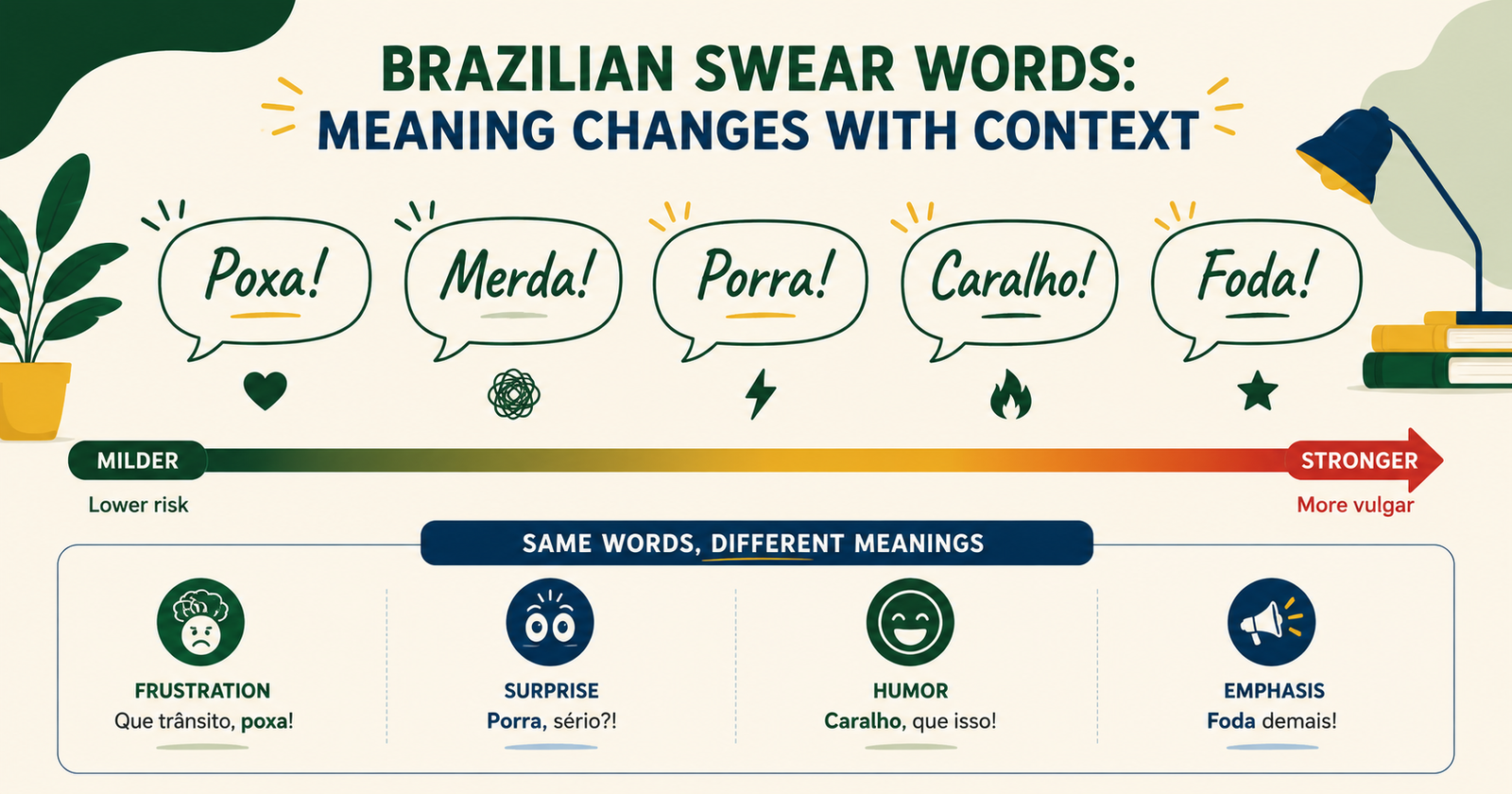
First, one useful distinction
What does palavrão mean in Brazilian Portuguese?
Palavrão is the ordinary Brazilian Portuguese word for a swear word, curse word, profanity, or “bad word.” But not every palavrão is an insult.
A taboo or vulgar word/expression. You can shout one because you dropped your phone without insulting anyone.
An insult directed at someone. Babaca or idiota can function as xingamentos.
A more formal expression for vulgar, obscene, or coarse language.
This matters because Merda! after spilling coffee and Seu filho da puta! shouted at a person are not socially equivalent. One is an emotional outburst; the other directly attacks someone.
A learner-oriented reference
Common Brazilian swear words and what they usually do
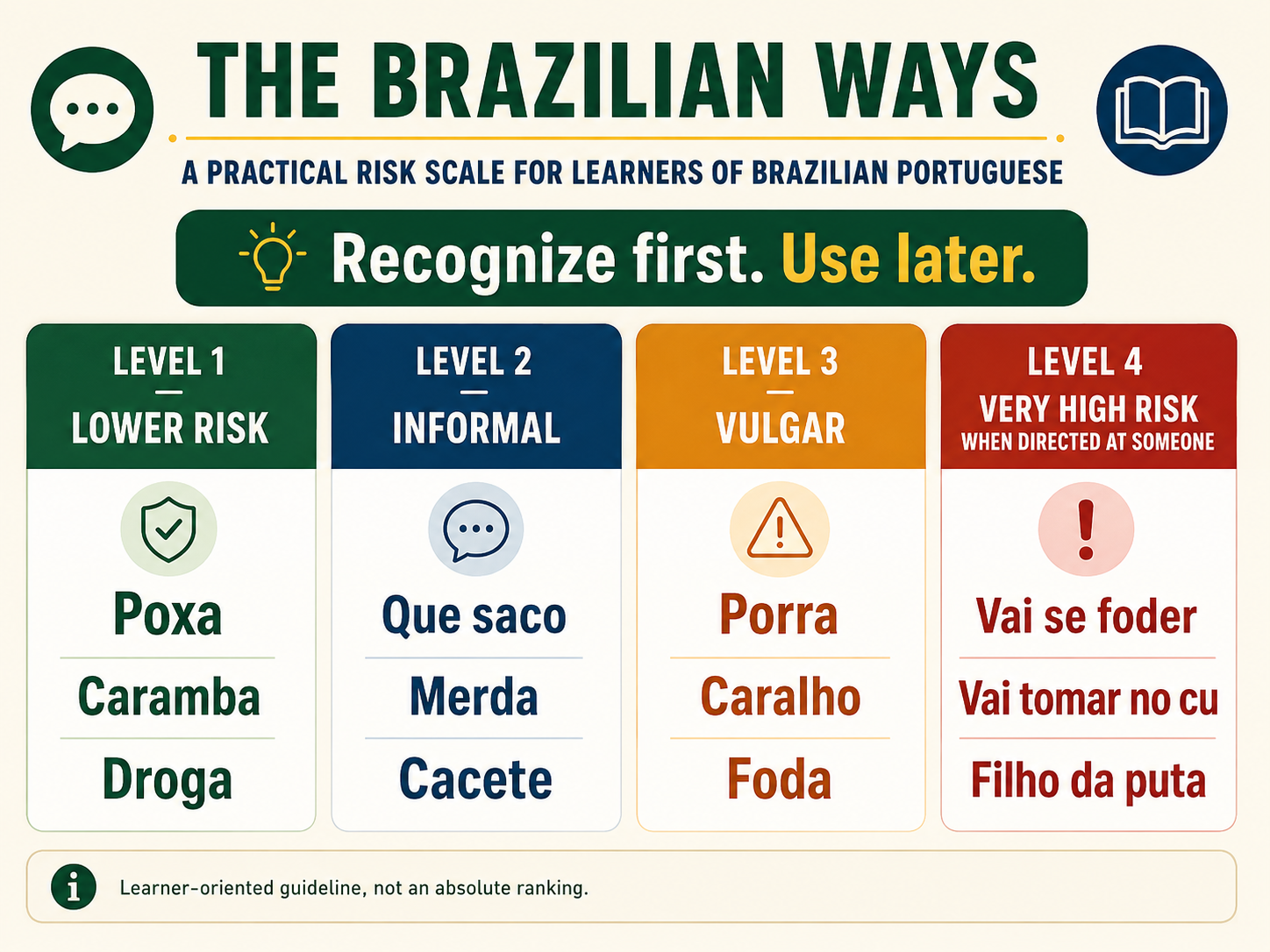
The levels below are only a rough guide. Tone, region, relationship, and situation can make the same expression sound lighter or much harsher.
| Portuguese | Approximate English | Common function | Learner risk |
|---|---|---|---|
| droga! | damn! | frustration | low |
| poxa! | oh man / geez | disappointment, surprise | low |
| caramba! | wow / darn | surprise, emphasis | low |
| que saco! | what a pain / so annoying | annoyance | low |
| cacete! | damn / fuck | surprise, frustration | medium |
| merda! | shit! | frustration, mistake | medium |
| bosta! | shit / crap | disgust, negative evaluation | medium |
| porra! | fuck / damn / come on | surprise, anger, emphasis | high |
| caralho! | fuck / holy shit | surprise, anger, admiration | high |
| puta merda! | holy shit / fuck | strong surprise or frustration | high |
| puta que pariu! | holy fuck / for fuck’s sake | shock, anger, frustration | high |
| foda | fucking great / tough / fucked up | positive or negative evaluation | high |
| foda-se! | fuck it / fuck off | dismissal, anger, giving up | high |
| vai se foder! | fuck off / go fuck yourself | directed aggression; sometimes joking | very high |
| vai tomar no cu! | go fuck yourself | strong direct insult | very high |
| vai pro caralho! | fuck off | strong rejection | very high |
| filho da puta | son of a bitch | direct insult; sometimes playful among intimates | very high |
| babaca | jerk / asshole | direct insult | medium |
| otário | sucker / idiot | insulting someone’s judgment | medium |
| arrombado | asshole / scumbag | strong direct insult | very high |
| corno | cuckold / cheated-on partner | culturally loaded insult | high |
| escroto | asshole / disgusting person | negative character judgment | high |
| cuzão | asshole | very vulgar direct insult | very high |
| desgraçado | bastard / miserable bastard | anger, condemnation | high |
Useful before you reach for profanity
Mild alternatives Brazilians use instead of stronger swear words
Poxa!
Disappointment, sympathy, or mild frustration. Often close to “oh man,” “geez,” or “come on.”
Caramba!
Surprise or emphasis. Depending on tone: “wow,” “darn,” or “damn.”
Droga!
A common frustrated “damn!” The noun also literally means “drug,” but the interjection is contextually obvious.
Que saco!
“What a pain,” “how annoying,” or “this sucks.” Informal, but far safer than directing a strong curse at someone.
You may also hear pô, caraca, and vai se ferrar as less harsh alternatives in contexts where a stronger expression could otherwise appear.
One word, several jobs
Porra: much more than one English translation
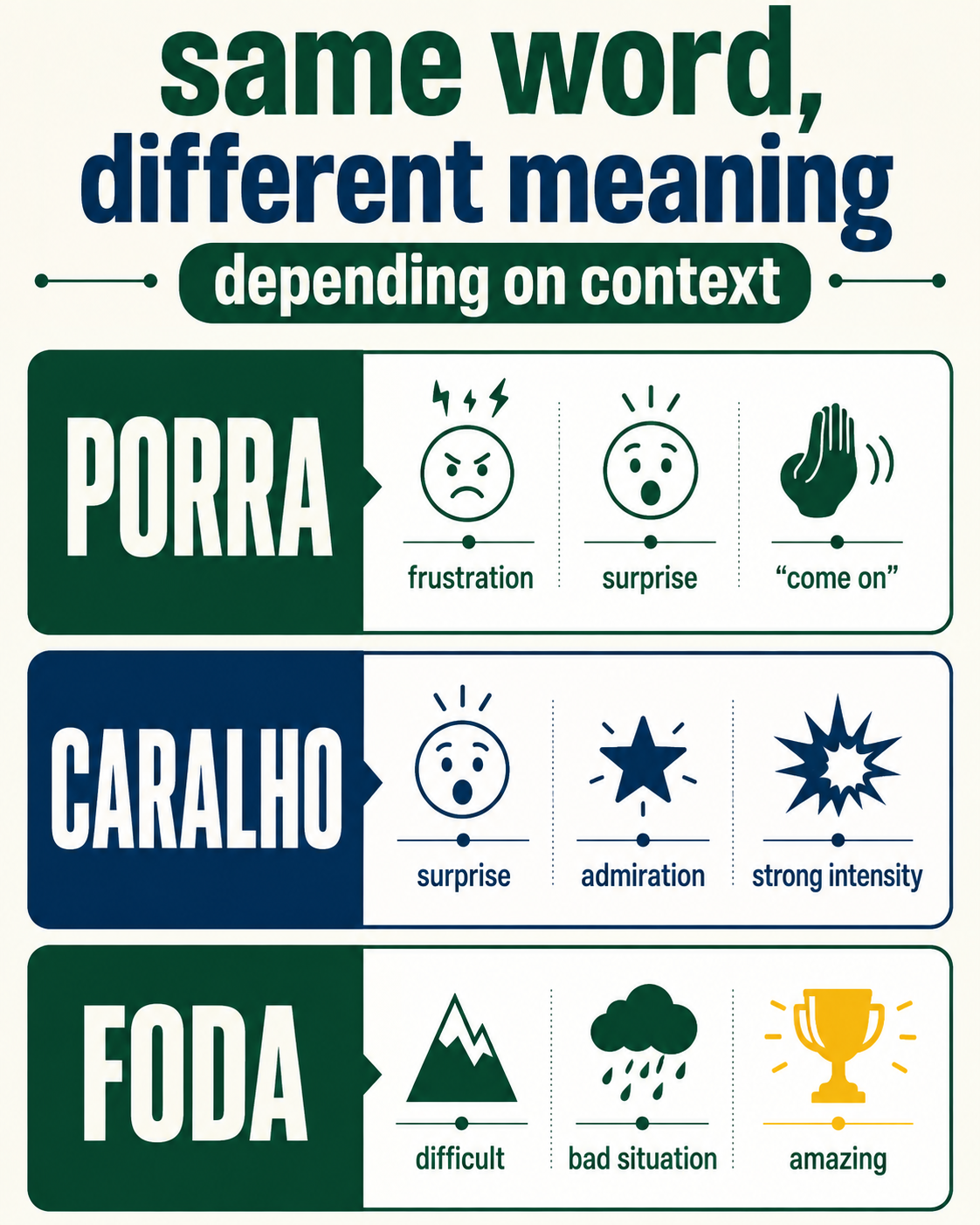
Porra is vulgar. Its literal meaning refers to semen, but in everyday speech it very often functions as an interjection, a negative noun, or part of a larger expression. Brazilian dictionaries also record its interjectional use for reactions such as surprise, annoyance, anger, and admiration.
Porra! Esqueci a chave.
Fuck! / Damn! I forgot the key.
A frustrated reaction. No one is being directly insulted.
Porra, cara, você não avisou.
Come on, man / Damn, man, you didn’t tell me.
Can communicate frustration with another person without functioning as a literal translation of “fuck.”
Que porra é essa?
What the fuck is this?
A strong reaction to something surprising, confusing, or unacceptable.
Essa porra não funciona.
This fucking thing doesn’t work.
The word can refer dismissively to a thing or situation.
Literal meaning is not the conversational meaning
Caralho: surprise, anger, admiration and intensity
The literal vulgar meaning of caralho is “penis,” but that is often not what a Brazilian is communicating when the word appears in conversation. Dictionaries also record its use as an interjection for indignation, admiration, and surprise, as well as the expression pra caralho for large quantity or intensity.
Surprise
Caralho! Você já chegou?
Holy shit! You’re already here?
Positive evaluation
Esse show foi do caralho.
That concert was fucking amazing.
Intensity
Tá frio pra caralho.
It’s fucking cold. / It’s really damn cold.
Distance
Isso fica lá na casa do caralho.
That’s in the middle of fucking nowhere.
The key lesson is not “caralho means X.” It is that the construction tells you what job the word is doing.
A classic learner trap
Foda, foder and foda-se can move from sex to difficulty, praise, damage or dismissal
Foder is a vulgar verb whose literal meaning is “to fuck,” but Brazilian Portuguese also uses it figuratively for harming, ruining, getting into trouble, or being in a bad situation. Foda can describe something difficult or unpleasant—and, in other contexts, something impressive or excellent.
| Expression | Likely meaning | Example |
|---|---|---|
| Isso é foda. | That’s tough / That sucks / That’s intense. | Meaning depends heavily on context and tone. |
| Esse cara é foda. | This guy is amazing / badass. | Can be strong praise. |
| Eu me fodi. | I’m fucked / I got screwed / I’m in trouble. | Speaker is describing their own bad situation. |
| Ele me fodeu. | He screwed me over. | Figurative harm or damage. |
| Foda-se. | Fuck it / fuck off / whatever. | Can express dismissal, irritation, or giving up. |
| Vai se foder. | Go fuck yourself / fuck off. | Very risky when directed at someone. |
Literal “shit,” many figurative uses
Merda and bosta
Merda!
Merda! Perdi o ônibus.Shit! I missed the bus.
A frustrated outburst.
Fazer merda
Eu fiz merda.I screwed up / I fucked up.
A very common figurative construction for making a serious mistake or doing something stupid.
Ser uma bosta
O filme foi uma bosta.The movie was shit / terrible.
A strongly negative evaluation.
You may also hear que merda, essa merda de…, um bosta, and puta merda. The grammatical pattern often matters as much as the vocabulary itself.
A word that requires extra caution
Puta, puta merda and puta que pariu
Puta literally refers vulgarly to a prostitute and can be used as a misogynistic insult when directed at a woman. Learners should be very cautious about reproducing that use.
But puta also appears inside fixed expressions and as a vulgar intensifier:
Holy shit! / Fuck!
A reaction to surprise, frustration, shock, or admiration depending on tone.
Holy fuck! / For fuck’s sake!
A very common strong exclamation. It does not need to be directed at a person.
incredible / huge luck
Here puta intensifies the noun rather than referring to a person.
son of a bitch
When aimed at someone, this is a strong insult even though close friends may sometimes use it jokingly.
Directed language is usually riskier
Common Brazilian Portuguese insults
Some of the expressions learners search as “Brazilian bad words” are not really general expletives; they are xingamentos aimed at a person.
| Insult | Approximate meaning | Nuance |
|---|---|---|
| babaca | jerk / asshole | Common direct insult; often less extreme than the strongest profanity. |
| otário | sucker / idiot | Suggests someone was foolish, gullible, or easily taken advantage of. |
| idiota | idiot | Direct and insulting, but not necessarily obscene. |
| imbecil | imbecile / idiot | Direct contempt; can sound harsh and deliberate. |
| escroto | asshole / disgusting person | Often criticizes someone’s behavior or character. |
| arrombado | asshole / scumbag | Very vulgar and potentially aggressive. |
| cuzão | asshole | Very vulgar; directly derived from cu. |
| desgraçado | bastard / miserable bastard | Strong condemnation; tone can range from dramatic to genuinely hostile. |
| corno | cuckold / cheated-on partner | Culturally loaded and frequently used as an insult or teasing label. |
| safado | shameless / naughty / bastard | Can be insulting, joking, flirtatious, or playful depending on context. |
Why literal translation fails
The exact same swear phrase can be playful or hostile
Genuinely aggressive
Vai se foder, seu idiota.
Go fuck yourself, you idiot.
Angry tone, direct confrontation, hostile relationship: there is little ambiguity here.
Playful between close friends
Vai se foder, você ganhou de novo!
Fuck you, you won again!
Laughter, shared history, and a joking interaction can radically change the social meaning.
Admiration
Caralho, ficou muito bom!
Holy shit, that turned out really good!
The speaker is not angry at all.
Frustration with a situation
Porra, perdi o voo.
Fuck / Damn, I missed my flight.
No person is being attacked; the profanity expresses the speaker’s emotion.
This is one reason non-native speakers can sound much harsher than they intend: they learn the word but not the relationship, prosody, timing, and shared assumptions that make a playful use possible.
Profanity can behave like grammar
Brazilian swear words are often used as intensifiers
pra caralho
Tem gente pra caralho aqui.There are a fuckton of people here. / There are so many people here.
Expresses large quantity or strong degree.
do caralho
Foi uma festa do caralho.It was a fucking amazing party.
Can be strongly positive despite the vulgar vocabulary.
de merda
Que dia de merda.What a shitty day.
Strongly negative evaluation.
These patterns are useful for listening because a swear word may be modifying the intensity of another idea rather than carrying its literal meaning.
You may recognize the abbreviation before the full phrase
Brazilian swear words in texts and social media
| Abbreviation | Usually expands to | Rough meaning |
|---|---|---|
| pqp | puta que pariu | holy shit / for fuck’s sake |
| vsf | vai se foder | fuck off / go fuck yourself |
| vtnc | vai tomar no cu | go fuck yourself |
Abbreviating a phrase does not automatically make it polite. The social meaning still depends on who is speaking to whom and why. For more everyday texting language—not only profanity—see our guide to Brazilian Portuguese text abbreviations.
Brazil is too large for one universal intensity chart
Regional, generational and social variation matters
The older versions of this article divided some expressions into rigid regional categories. That is too simple. Brazil has enormous variation, and swear words move through music, television, social media, migration, friendship networks, and local speech.
You may hear expressions such as arrombado, peste, cabra safado, caraca, pô or many other local and socially marked forms with different frequencies across regions and groups. But a label like “Rio word” or “Northeast word” does not guarantee that a word is exclusive to that place—or that every person there uses it the same way.
Vocabulary and frequency can shift across states and cities.
Some expressions feel dated, youthful, online, or associated with a particular age group.
Close friends can license language that would be aggressive between strangers.
A football match, family dinner, workplace, classroom, and customer-service interaction have different expectations.
If you are interested specifically in Rio vocabulary, see our guide to Carioca slang and expressions.
Recognition first, production second
Should foreigners use Brazilian swear words?
You can, but there is no reason to make strong profanity a fluency milestone. For most learners, the useful progression is:
Recognize
Understand what you heard in a movie, group chat, class, game, or conversation.
Interpret
Decide whether it expressed anger, affection, surprise, emphasis, humor, or an actual insult.
Use safer reactions
Build confidence with poxa, caramba, droga, que saco and other lower-risk informal language.
Use stronger language only if you understand the relationship
Copying the vocabulary without the social context is where problems begin.
| Situation | Safer learner choice | Higher-risk choice |
|---|---|---|
| You make a small mistake | Droga! / Poxa! | Merda! |
| You are impressed | Caramba! / Nossa! | Caralho! |
| Something is annoying | Que saco! | Que merda! |
| You disagree with a friend | Ah, para! / Tá de brincadeira? | Vai se foder! |
| You do not know the person well | Avoid directed profanity | Do not imitate strong insults just because you heard Brazilians use them with friends |
Keep learning real Brazilian Portuguese
Related guides
Frequently asked questions
FAQ about Brazilian swear words
What are the most common Brazilian swear words?
Common words and expressions include merda, porra, caralho, foda, foda-se, puta merda, puta que pariu, filho da puta, vai se foder and vai tomar no cu. Their meaning and intensity change with context.
What is the Brazilian Portuguese word for “swear word”?
The most common word is palavrão. Xingamento is closer to “insult” and usually refers to language directed at another person.
What does porra mean?
Literally it is a vulgar word for semen, but conversationally it can work like “fuck,” “damn,” “come on,” or a strongly negative reference to a thing. Context determines the closest English equivalent.
What does caralho mean?
Its literal vulgar meaning is “penis,” but as an interjection it can express surprise, anger, or admiration. In pra caralho, it works as a vulgar intensifier meaning “a lot” or “very.”
What does foda mean in Brazilian Portuguese?
Depending on context, foda can describe something difficult, unpleasant, impressive, excellent, or intense. That flexibility is why a one-word English translation is often misleading.
How do you say “fuck off” in Brazilian Portuguese?
Vai se foder, vai tomar no cu, and vai pro caralho can all function as strong dismissive or aggressive expressions. They are high-risk phrases for learners to direct at another person.
Are Brazilian curse words always offensive?
No. A swear word can express frustration, surprise, admiration, humor, solidarity, or aggression. But the fact that a word can be playful in one relationship does not make it safe in another.
What are some mild Brazilian bad words or alternatives?
Poxa, caramba, droga, caraca, and que saco are useful informal reactions that generally carry less risk than stronger profanity.
What do pqp, vsf and vtnc mean?
They commonly abbreviate puta que pariu, vai se foder, and vai tomar no cu. The shortened spelling does not remove the vulgar or aggressive meaning.
Should I use Brazilian cuss words if I am learning Portuguese?
Understanding them is useful. Using them is optional. Start by recognizing meaning and tone; use lower-risk informal reactions first, and only use stronger profanity when you understand the relationship and social setting well.