

Brazilian Portuguese Family Vocabulary: Family Members & Relatives
Brazilian Portuguese for real conversations
Learn the family words you actually need—and the ones that commonly confuse English speakers.
Family vocabulary looks simple until you meet words such as parentes, pais, cunhado, enteada, or the tiny accent difference between avó and avô.
This guide gives you the essential vocabulary for immediate family, extended relatives, in-laws, blended families, partners, godparents, affectionate forms, and real conversation—plus the grammar patterns that help you use the words correctly.
Start here
Twenty Brazilian Portuguese family words to learn first
If you are a beginner, start with the people you are most likely to mention in everyday conversation. You can add the more specific terms later.
| Portuguese | English | Example |
|---|---|---|
| família | family | Minha família mora no Brasil. My family lives in Brazil. |
| parente | relative | Tenho parentes em Minas Gerais. I have relatives in Minas Gerais. |
| mãe | mother / mom | Minha mãe trabalha em casa. My mom works from home. |
| pai | father / dad | Meu pai gosta de cozinhar. My dad likes to cook. |
| pais | parents | Meus pais moram perto. My parents live nearby. |
| filho | son | Ele tem um filho. He has a son. |
| filha | daughter | Ela tem duas filhas. She has two daughters. |
| irmão | brother | Meu irmão é mais velho. My brother is older. |
| irmã | sister | Minha irmã mora em Recife. My sister lives in Recife. |
| irmãos | siblings / brothers | Você tem irmãos? Do you have siblings? |
| avó | grandmother | Minha avó tem 82 anos. My grandmother is 82. |
| avô | grandfather | Meu avô nasceu na Bahia. My grandfather was born in Bahia. |
| tio | uncle | Meu tio vem amanhã. My uncle is coming tomorrow. |
| tia | aunt | Minha tia mora em Salvador. My aunt lives in Salvador. |
| primo | male cousin | Meu primo estuda medicina. My cousin studies medicine. |
| prima | female cousin | Minha prima está viajando. My cousin is traveling. |
| sobrinho | nephew | Meu sobrinho tem cinco anos. My nephew is five. |
| sobrinha | niece | Minha sobrinha nasceu ontem. My niece was born yesterday. |
| marido | husband | Meu marido é brasileiro. My husband is Brazilian. |
| esposa | wife | Minha esposa fala português. My wife speaks Portuguese. |
Parents, children, and siblings
Immediate family vocabulary
Parents
Pais has no accent. País, with an accent, means “country.”
Children
In a mixed group, the masculine plural traditionally functions as the general plural.
Siblings
Tenho dois irmãos can mean “I have two brothers” or “I have two siblings,” depending on context.
Useful question:
This is much more natural than trying to invent a separate everyday noun corresponding exactly to English “siblings.”
The accent changes the person
Grandparents, grandchildren, and generations
The pair avó and avô is worth learning visually and by sound. The accent marks are different because the vowel quality is different.
avó = grandmother
The final vowel is open: ó.
avô = grandfather
The final vowel is closed: ô.
| Portuguese | English | Usage note |
|---|---|---|
| os avós | the grandparents | Used for a mixed group of grandmothers and grandfathers. |
| as avós | the grandmothers | Feminine article makes the meaning clear. |
| os avôs | the grandfathers | Used when the group is exclusively male. |
| avó materna | maternal grandmother | Your mother’s mother. |
| avô materno | maternal grandfather | Your mother’s father. |
| avó paterna | paternal grandmother | Your father’s mother. |
| avô paterno | paternal grandfather | Your father’s father. |
| bisavó | great-grandmother | One generation above a grandparent. |
| bisavô | great-grandfather | One generation above a grandparent. |
| neto | grandson | Male grandchild. |
| neta | granddaughter | Female grandchild. |
| netos | grandchildren / grandsons | Mixed group or male-only group, depending on context. |
| bisneto | great-grandson | Male great-grandchild. |
| bisneta | great-granddaughter | Female great-grandchild. |
Aunts, uncles, cousins, nieces, and nephews
Extended family vocabulary
| Portuguese | English | Example |
|---|---|---|
| tio | uncle | Meu tio é irmão da minha mãe. My uncle is my mother’s brother. |
| tia | aunt | Minha tia é irmã do meu pai. My aunt is my father’s sister. |
| tios | aunts and uncles / uncles | Meus tios vêm no domingo. My aunt(s) and uncle(s) are coming Sunday. |
| primo | male cousin | Ele é meu primo por parte de mãe. He is my cousin on my mother’s side. |
| prima | female cousin | Ela é minha prima por parte de pai. She is my cousin on my father’s side. |
| sobrinho | nephew | O filho da minha irmã é meu sobrinho. My sister’s son is my nephew. |
| sobrinha | niece | A filha do meu irmão é minha sobrinha. My brother’s daughter is my niece. |
| tio-avô | great-uncle | The brother of one of your grandparents. |
| tia-avó | great-aunt | The sister of one of your grandparents. |
| parente distante | distant relative | Useful when the exact relationship is not important. |
Relationship words matter too
Partners, spouses, dating, and engagement
Everyday relationship words
Neutral or formal alternatives
Cônjuge is especially useful in forms, legal language, and administrative contexts; it is less conversational than marido, esposa, or companheiro(a).
Family by marriage or partnership
In-law vocabulary in Brazilian Portuguese
English repeats “in-law.” Portuguese normally uses a different word for each relationship.
| Portuguese | English | Example |
|---|---|---|
| sogro | father-in-law | Meu sogro mora em Brasília. My father-in-law lives in Brasília. |
| sogra | mother-in-law | Minha sogra cozinha muito bem. My mother-in-law cooks very well. |
| cunhado | brother-in-law | Meu cunhado é irmão do meu marido. My brother-in-law is my husband’s brother. |
| cunhada | sister-in-law | Minha cunhada é irmã da minha esposa. My sister-in-law is my wife’s sister. |
| genro | son-in-law | Ele é meu genro. He is my son-in-law. |
| nora | daughter-in-law | Ela é minha nora. She is my daughter-in-law. |
Modern families need more than one model
Blended, adoptive, biological, and other family relationships
| Portuguese | English | Usage note |
|---|---|---|
| padrasto | stepfather | Your parent’s male spouse or partner in relation to you. |
| madrasta | stepmother | Your parent’s female spouse or partner in relation to you. |
| enteado | stepson | Your spouse or partner’s son in relation to you. |
| enteada | stepdaughter | Your spouse or partner’s daughter in relation to you. |
| meio-irmão | half-brother | A brother who shares one parent with you. |
| meia-irmã | half-sister | A sister who shares one parent with you. |
| pai biológico | biological father | Use when the distinction is relevant. |
| mãe biológica | biological mother | Use when the distinction is relevant. |
| pai adotivo / mãe adotiva | adoptive father / mother | Describes an adoptive parent. |
| filho adotivo / filha adotiva | adopted son / daughter | Describes an adopted child when the distinction matters. |
| família adotiva | adoptive family | A family formed through adoption. |
| família de criação | family that raised someone | Colloquial/social concept; not necessarily the same as legal adoption. |
Relationships beyond the family tree
Godparents, godchildren, and chosen-family language
Godparents
Godchildren
Between the adults
In Brazilian Portuguese, padrinho and madrinha are not limited to one single context: the words can be used for baptismal godparents and also for sponsors or witnesses in other ceremonies. The exact social relationship depends on the event and family.
What people call relatives at home
Affectionate and regional family words
Family terms often change in intimate speech. These forms can signal affection, childhood habits, region, or family style.
| Portuguese | Natural English | Usage note |
|---|---|---|
| mamãe | mom / mommy | Affectionate form of mãe; adults may also use it in their own families. |
| papai | dad / daddy | Affectionate form of pai. |
| vó | grandma | Very common shortened affectionate form of avó. |
| vô | grandpa | Very common shortened affectionate form of avô. |
| vovó | grandma / granny | Affectionate. |
| vovô | grandpa / granddad | Affectionate. |
| mainha | mom / mum | Affectionate regional form associated with parts of Brazil’s Northeast; not universal even within the region. |
| painho | dad | Affectionate regional form associated with parts of Brazil’s Northeast. |
| mano / mana | bro / sis; sometimes buddy | Can refer to a sibling, but also functions as informal address in some regions and social groups. |
| filhinho / filhinha | little son / daughter; sweetheart | Diminutive forms can sound affectionate, not merely physically “small.” |
Vocabulary becomes usable when the grammar is simple
Gender, plurals, articles, and possessives
Possessives agree with the family word
The possessive changes according to the noun, not according to the speaker.
Articles before possessives vary
Both patterns occur in Portuguese. In Brazilian speech, usage varies by region and speaker. Beginners can comfortably use minha mãe, meu pai, and similar forms.
Mixed groups often use the masculine plural
Grandparents have a useful special pattern
The article and accent together help identify the group.
These cause more mistakes than the long words
Family vocabulary false friends and confusing pairs
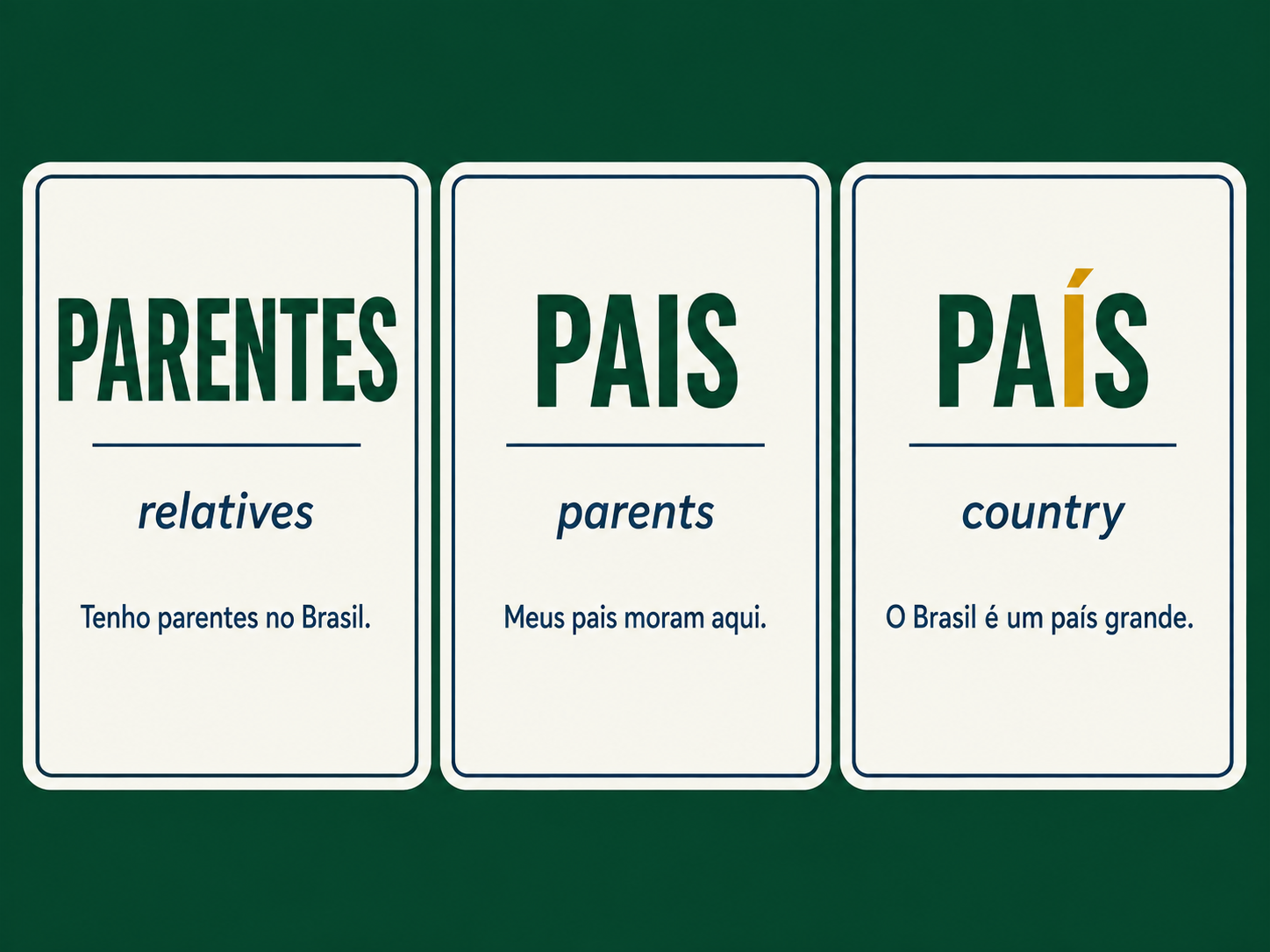
Parente means relative. “Parents” is pais.
Pais = parents. País = country. The accent changes pronunciation and meaning.
It can mean “woman” or “wife.” Context normally makes the intended meaning clear.
Noivo/noiva means fiancé/fiancée: the couple is engaged. Boyfriend/girlfriend is namorado/namorada.
Portuguese distinguishes the cousin’s gender, not “first cousin” versus every English relationship label in ordinary conversation.
Tenho três irmãos can mean three brothers or three siblings. Add detail if gender matters.
Move from vocabulary to conversation
How to ask about someone’s family in Brazilian Portuguese
| Portuguese | Natural English | Use |
|---|---|---|
| Você tem irmãos? | Do you have siblings? | Very common, neutral question. |
| Você tem filhos? | Do you have children? | Common, but personal; use context. |
| Sua família mora aqui? | Does your family live here? | Useful when talking about origin or relocation. |
| Como estão seus pais? | How are your parents? | Natural when you already know something about them. |
| Você é filho único? / filha única? | Are you an only child? | The adjective agrees with the person being described. |
| Você tem uma família grande? | Do you have a big family? | General conversation question. |
| Você é próximo da sua família? | Are you close to your family? | More personal; better after some rapport. |
| Quem é ela na foto? | Who is she in the photo? | Lets the person explain the relationship naturally. |
Build sentences instead of memorizing labels
How to describe your family naturally
Basic description
Where people live
Relationship
A male speaker would normally say Sou muito próximo….
Family size
Blended family
Partner and children
A useful beginner pattern: Tenho… (“I have…”) + family member + one extra detail.
Real conversation
Six bilingual dialogues about family
1. Siblings
Notice: the first question uses the mixed/general plural irmãos.
2. Parents
3. Grandparents
4. Partner
5. In-laws
6. Godmother
Check what you learned
Quick family-vocabulary practice
1. How do you say “my parents”?
Meus pais. Remember: pais without an accent means “parents.”
2. What does parente mean?
It means relative, not “parent.”
3. Your sister’s son is your…?
sobrinho — nephew.
4. Your spouse’s mother is your…?
sogra — mother-in-law.
5. What is the difference between avó and avô?
Avó is grandmother; avô is grandfather.
6. How do you ask “Do you have siblings?”
Você tem irmãos?
7. What is a madrinha?
A godmother, sponsor, or ceremonial female sponsor/witness depending on context.
8. What does noiva mean?
Fiancée or bride, depending on context—not simply “girlfriend.”
Continue learning
Related Brazilian Portuguese guides
Frequently asked questions
FAQ about family vocabulary in Brazilian Portuguese
How do you say “family” in Portuguese?
Família means “family.” A relative is parente, and relatives are parentes.
How do you say “parents” in Brazilian Portuguese?
Pais means “parents.” Do not confuse it with país, which means “country.”
How do you say “siblings” in Portuguese?
Irmãos is the usual word for a group of siblings that includes at least one male, and it can also mean “brothers.” Irmãs means sisters.
What is the difference between avó and avô?
Avó, with an open final vowel, means grandmother. Avô, with a closed final vowel, means grandfather.
How do you say “grandparents” in Portuguese?
Os avós means “the grandparents.” As avós means “the grandmothers,” while os avôs can refer specifically to grandfathers.
Does parente mean “parent”?
No. This is a major false friend for English speakers. Parente means “relative.” Parent is pai or mãe, and parents is pais.
Can mulher mean “wife”?
Yes. Mulher means “woman,” but in a possessive relationship context it can also mean “wife.” Esposa is the unambiguous noun for wife.
Can Brazilians call non-relatives tio or tia?
Yes, in some families and settings, especially when children address close family friends or familiar adults. It is a social usage, not a literal statement of biological kinship, and it varies across speakers and contexts.
What do mainha and painho mean?
They are affectionate regional forms for mom and dad associated with parts of Brazil’s Northeast. Usage varies considerably within the region, so learners should recognize them rather than assume everyone uses them.
What is the easiest way to practice family vocabulary?
Describe your actual family or a fictional family tree using complete sentences. Practice patterns such as Tenho…, Meu/minha…, Ele/ela é…, and mora em… instead of memorizing isolated translations.
Language references: Vocabulary and relationship terminology were checked against the Academia Brasileira de Letras’ official Vocabulário Ortográfico da Língua Portuguesa, the Brazilian Michaelis dictionary, and Brazilian government materials that define relationships such as sogro, genro, nora, enteado, padrasto, madrasta, and cunhado. Regional and affectionate usage varies across Brazil; examples are presented as usage patterns rather than rules for every speaker.