

Can You Learn Brazilian Portuguese With Apps Alone? What You Need for Real Conversation
From studying Portuguese to actually using it
A language app can teach you a lot of Portuguese. Conversation asks you to do something different with it.
You can keep a long streak, recognize hundreds of words, complete grammar exercises, and still freeze when a Brazilian asks you an unexpected question. That does not mean the app was useless. It means studying Brazilian Portuguese and interacting spontaneously in Brazilian Portuguese are related—but not identical—skills.
The goal of this guide is not to tell you to delete your favorite app. It is to show you what apps can do well, what real conversation adds, and how to build a study routine that turns knowledge into usable Portuguese.
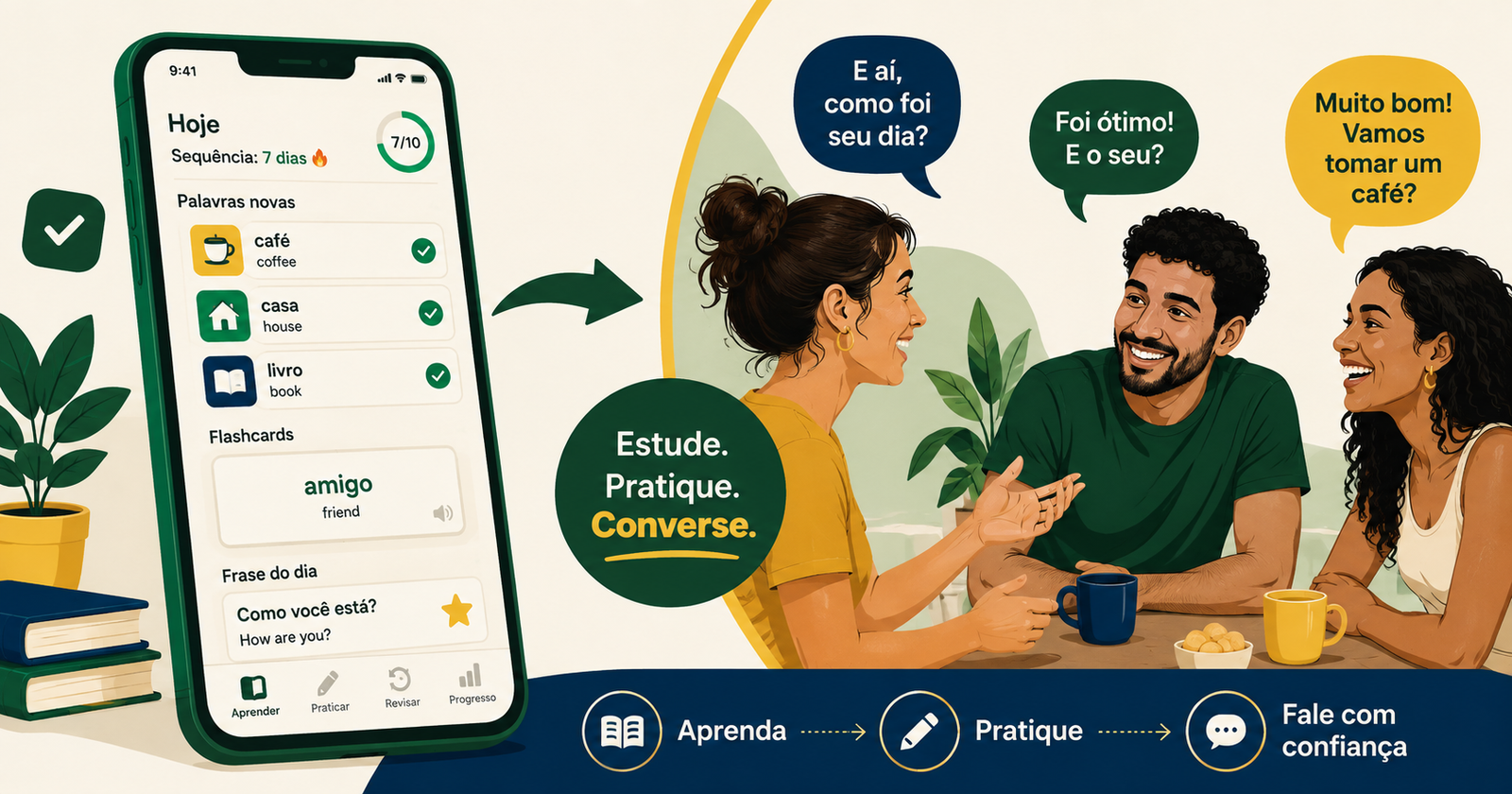
Start with what apps actually solve
Language apps can be genuinely useful for Brazilian Portuguese
The problem is not that apps are “bad.” The problem is expecting one tool to train every part of language proficiency equally well.
A short lesson on a busy day is still contact with Portuguese. Apps make it easy to create a repeatable study habit.
Repeated exposure helps you notice, review, and retain high-frequency words, phrases, and grammatical patterns.
Exercises reduce the number of things you must process at once, which is useful while a structure is still new.
You can repeat an item several times without worrying about another person waiting for you to answer.
Different app types also solve different problems. A flashcard app is not trying to do the same job as an audio course, a structured grammar app, a pronunciation tool, or an AI conversation app. “Can apps teach Portuguese?” is therefore too broad a question.
Performance under different conditions
Why finishing Portuguese lessons is not the same as holding a conversation
Most exercises make the task smaller and more predictable. A conversation does the opposite: several language processes happen at once.
| A controlled exercise may give you… | A conversation may require… | The hidden difference |
|---|---|---|
| Four possible answers | No answer choices | You must retrieve the language yourself. |
| A sentence you can reread | Speech that disappears immediately | You must process meaning while the interaction continues. |
| One expected grammar point | Several structures mixed together | You cannot prepare for exactly what comes next. |
| One clean recorded voice | Different voices, accents, speeds, and reductions | Your listening must generalize beyond one sound model. |
| A correct/incorrect signal | A person who may look confused or respond unexpectedly | You must notice whether communication actually worked. |
| Time to think | A turn in a live exchange | Retrieval speed becomes part of your speaking ability. |
Conversation is a bundle of abilities
You do not become conversational by training only one skill
Speaking with a Brazilian is not simply “knowing enough vocabulary.” You are listening, retrieving, producing, monitoring, interpreting tone, and managing the interaction at the same time.
Understand
Recognize enough of what the other person says to identify the message.
Retrieve
Find useful words and chunks in memory without being shown the answer.
Build
Combine those resources into a message that fits what you actually want to say.
React
Adjust when someone interrupts, laughs, asks a follow-up question, or changes direction.
Repair
Ask for repetition, clarify, rephrase, or keep going when communication breaks down.
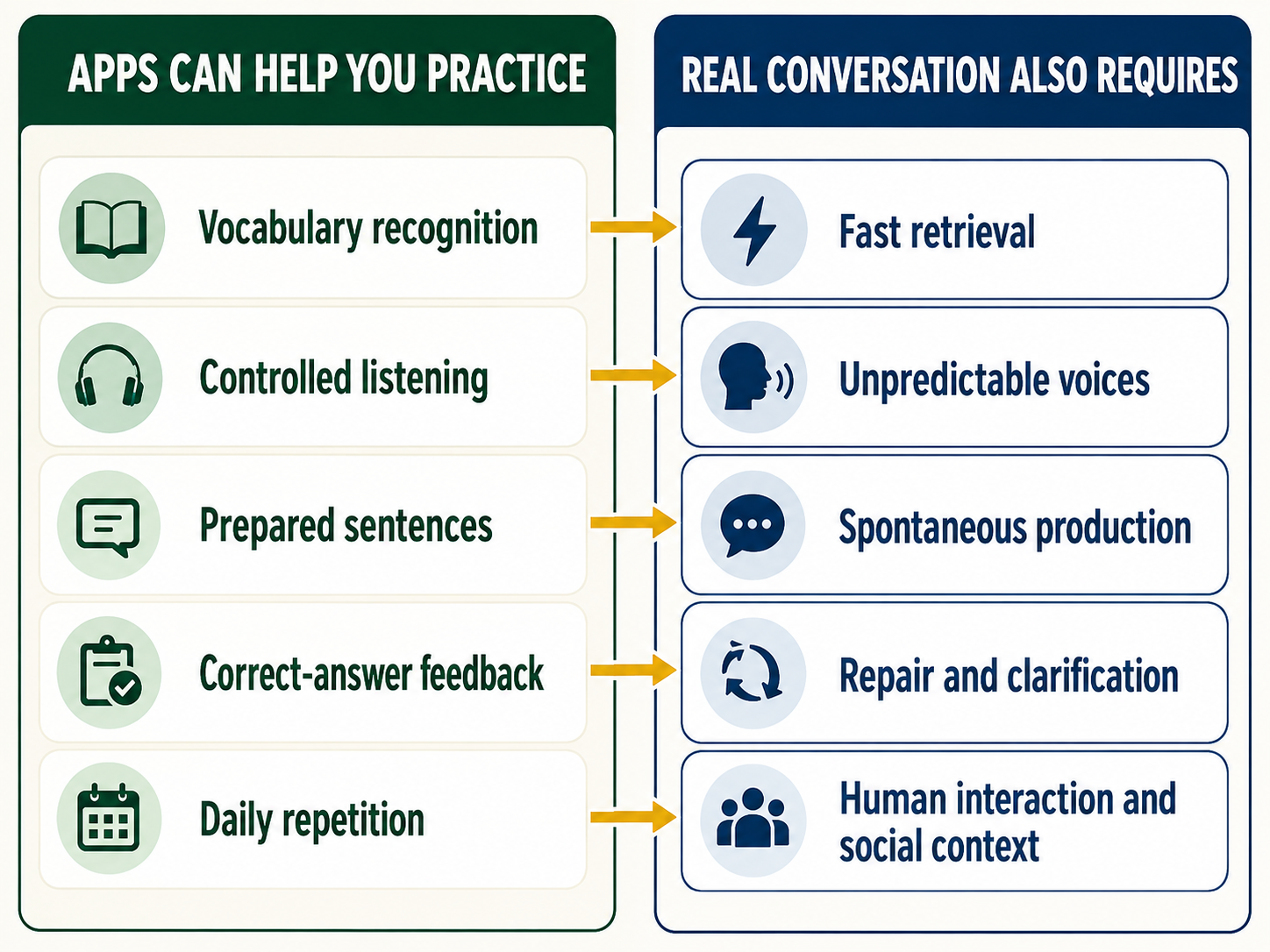
Second-language interaction research has long examined processes such as negotiation for meaning, feedback, and modified output. In other words, interaction is not only a place where you display Portuguese you already possess. It can also be part of how your Portuguese develops.
“I know this word. Why can’t I say it?”
Why you can know Portuguese and still freeze when someone talks to you
Imagine that you have studied the verb achar. You recognize it immediately in an exercise. Then a Brazilian asks:
Recognition task
Eu acho que…
I think that…
You see the phrase and recognize its meaning. The language is already in front of you.
Conversation task
O que você acha?
What do you think?
Now you must understand the question, decide what you think, retrieve vocabulary, choose a structure, pronounce it, and monitor the other person’s reaction.
The vocabulary did not disappear. The retrieval conditions changed.
Your attention is divided
You are listening while planning your answer. There is less mental space available for consciously searching grammar rules.
The clock is running
Conversation has timing. A word you can remember after thirty seconds may not yet be easily accessible after two seconds.
You are creating, not selecting
Multiple choice can test recognition. Conversation asks you to decide what message to create in the first place.
The listening problem often appears first
Why Brazilian Portuguese in an app can sound easier than Brazilians in real life
Many learning activities deliberately make audio understandable. That is useful. But everyday Brazilian Portuguese contains more variability: connected speech, informal reductions, filler words, overlapping turns, unfinished sentences, background noise, unfamiliar voices, and regional pronunciation.
| You may study | You may hear | Meaning |
|---|---|---|
| Você está bem? | Cê tá bem? | Are you okay? |
| Eu estou indo. | Tô indo. | I’m going / I’m on my way. |
| Para você. | Pra você. | For you. |
| Nós vamos depois. | A gente vai depois. | We’ll go later. |
| A complete, direct answer | Então… tipo… acho que… sei lá. | Well… like… I think… I don’t know. |
If this is your main difficulty, read our dedicated guide Why You Understand Your Portuguese Teacher but Not Brazilians. It explains connected speech, reductions, different voices, and a practical listening method in much more detail.
Apps are changing
What about apps with voice chat and AI conversation?
Modern language tools increasingly include speaking prompts, voice interaction, pronunciation feedback, and open-ended conversation. That makes “apps versus speaking” a false binary.
What AI conversation can add
- More opportunities to produce sentences instead of only recognizing them.
- Low-pressure repetition when you want to try the same structure several times.
- Practice at almost any hour without scheduling another person.
- A useful bridge between controlled exercises and less predictable speaking.
What human interaction still adds
- A real person with their own history, attention, humor, preferences, and speaking habits.
- Natural interruptions, misunderstandings, side comments, and topic changes.
- Sociocultural feedback: whether your wording fits the relationship and situation.
- The need to communicate when the other person is not designed around your learning level.
An AI speaking tool can therefore be valuable. It simply should not make you believe that all forms of speaking practice are interchangeable. If your real goal is to talk with Brazilian family, colleagues, friends, or people while traveling, some of your practice should eventually involve actual humans.
The question learners ask most often
Is Duolingo enough to learn Brazilian Portuguese?
It depends on what you mean by learn.
If your goal is…
build a daily habit, learn vocabulary, notice sentence patterns, and get regular exposure to Portuguese, an app can contribute a lot.
If your goal is…
understand different Brazilians and respond spontaneously in real time, you should also train natural listening and unscripted production.
If your goal is…
participate comfortably in real relationships, you also need interaction, repair strategies, and cultural context.
The same principle applies beyond any single brand. App features change, and different products emphasize different skills. Instead of asking whether one app is “good” or “bad,” ask whether your complete routine covers the abilities your real-life goal demands.
Turn passive success into active access
Seven ways to use a Portuguese app if your real goal is speaking
- Answer before looking at the choices. Give yourself a few seconds to retrieve the word or sentence first.
- Say every useful sentence aloud. Do not let Portuguese remain only visual.
- Personalize the example. Change Eu moro em São Paulo into a sentence that is true for you.
- Create one follow-up question. If the lesson teaches Eu gosto de música, ask yourself Que tipo de música você gosta?
- Change the time or person. Turn a present-tense sentence into yesterday, tomorrow, eu, você, or a gente.
- Save mistakes from real conversations. Let your app or review system reinforce language you actually needed and could not access.
- Connect the lesson to Brazilian input. Listen for the same word or structure in a short video, podcast, dialogue, or conversation.
App sentence
Eu quero café.
I want coffee.
You understand and repeat one correct sentence.
Turn it into conversation
Você quer café?
Do you want coffee?
Quero, mas sem açúcar.
Yes, but without sugar.
Eu prefiro chá de manhã.
I prefer tea in the morning.
One lesson can become several acts of retrieval, listening, pronunciation, personalization, and interaction. You are no longer only completing the app; you are using it as raw material.
Do not search for one magical resource
A four-part system for learning Brazilian Portuguese
You do not need twenty resources. You need your regular study to cover four jobs.
Grammar, vocabulary, pronunciation patterns, review, and clear explanations. An app can fit very well here.
Brazilian voices, natural rhythm, reductions, informal language, and material that is challenging but still workable.
Answering questions, retelling, describing, voice notes, sentence transformations, and saying what you genuinely mean.
Another person reacts. You clarify, ask questions, misunderstand, recover, change direction, and continue.
A routine you can actually repeat
A realistic weekly plan if you already use a language app
This is an example, not a universal prescription. The point is to add missing skills without turning language learning into a second full-time job.
15–25 minutes on four or five days. Focus on useful vocabulary, grammar, and review.
10–15 minutes on three days. Work deeply with a short Brazilian clip instead of only playing long audio in the background.
5–10 minutes on several days. Answer aloud, record voice notes, summarize, or retell without reading a script.
At least one regular opportunity to speak with another person at a level where you can participate and receive support.
One live conversation does not replace all self-study, and self-study does not replace all interaction. Each part makes the others more useful.
Do not wait for a mythical “ready” point
When should you start speaking Brazilian Portuguese?
You can begin speaking from the start, but the task should match your level. A complete beginner does not need to debate politics for forty minutes. They can greet someone, answer a personal question, choose between two options, ask E você?, describe a routine with support, or complete a guided exchange.
| Stage | Useful speaking goal | Example |
|---|---|---|
| Very early beginner | Short predictable exchanges | Oi! Tudo bem? / Tudo. E você? |
| Beginner | Personal information and simple preferences | Eu moro em… Eu gosto de… Eu trabalho com… |
| Developing speaker | Connect sentences and ask follow-up questions | Eu fui no sábado porque… E você, já foi? |
| Intermediate | Explain, compare, narrate, and repair | Não sei explicar direito. O que eu quero dizer é… |
A skill every speaker needs
Practice what to do when you do not understand
Fluent conversation is not a world in which misunderstanding disappears. Stronger speakers simply have more ways to manage it.
Ask for repetition
Desculpa, pode repetir?Sorry, can you repeat that?
Pode falar mais devagar?Can you speak more slowly?
Ask for clarification
O que você quer dizer?What do you mean?
Como assim?What do you mean? / How so?
Buy time
Deixa eu pensar…Let me think…
Como é que eu posso explicar?How can I explain it?
Rephrase
Não sei a palavra, mas é uma coisa que…I don’t know the word, but it’s something that…
O que eu quero dizer é…What I mean is…
These phrases are not evidence that your Portuguese failed. They are part of conversational competence.
Measure the right thing
How to know you are becoming more conversational
A streak tells you that you returned to an app. It does not tell you everything about what you can now do with Portuguese.
- You answer familiar questions with less silent planning.
- You can create a sentence that you have never memorized exactly.
- You understand the main idea even when you miss individual words.
- You recover after a misunderstanding instead of abandoning the conversation.
- You ask natural follow-up questions rather than only answering.
- You understand more than one Brazilian voice.
- You can tell a short story across several connected sentences.
- You rely less on mental translation for familiar topics.
- You notice that phrases you studied are starting to appear automatically.
- You can communicate an idea even when your grammar is not perfect.
Build the From Studying to Speaking cluster
Related Brazilian Portuguese guides
Frequently asked questions
FAQ about learning Brazilian Portuguese with apps
Can I learn Brazilian Portuguese with an app?
Yes. Apps can help you build vocabulary, grammar awareness, pronunciation practice, listening familiarity, and a consistent study habit. If your goal includes spontaneous conversation, add activities that require you to produce language and interact without predetermined answers.
Can an app make me fluent in Brazilian Portuguese?
No single tool can guarantee fluency. What matters is whether your overall learning process develops the abilities you need: comprehension, production, interaction, pronunciation, vocabulary, grammar, and sociocultural competence across the situations that matter to you.
Is Duolingo enough to learn Brazilian Portuguese?
It can be one useful part of a learning routine. If your goal is real conversation, supplement app study with natural Brazilian listening, active sentence production, and regular opportunities to interact with people.
What is the best app for learning Brazilian Portuguese?
There is no universal best app because different tools emphasize different skills. Choose one that matches the job you need it to do, then check whether your wider routine also includes listening, active speaking, and interaction.
Are AI conversation apps enough for speaking practice?
They can provide useful additional speaking time and make open-ended practice easier to access. Human interaction still adds real social context, unpredictable reactions, natural conversational repair, and exposure to people who are not adapting every turn to a learning system.
Why can I understand Portuguese in an app but not Brazilians?
Learning audio is often clearer and more predictable. Natural Brazilian conversation includes reductions, connected speech, informal vocabulary, filler words, regional pronunciation, different voices, interruptions, and background noise. Our dedicated listening guide explains this gap in detail.
When should I start speaking Portuguese?
You can start at the beginning if the task matches your level. Early speaking can be highly supported and predictable. As your language grows, gradually increase the length, unpredictability, and independence of the interaction.
How often should I practice speaking Brazilian Portuguese?
Consistency matters more than waiting for one long perfect session. Short active speaking during the week plus a regular opportunity for live interaction can work well. The exact frequency depends on your level, schedule, and goals.
Should I stop using language apps?
No, not if the app is helping you. Keep the tools that make your learning clearer and more consistent. The goal is to identify what they are not training enough and deliberately add that missing practice.
What should I use besides a Portuguese app?
A balanced system can include structured study, short natural Brazilian listening, active speaking or voice-note practice, and real interaction with teachers, tutors, exchange partners, friends, family, or conversation groups.