

How Brazilians Pay for Things: Pix, Boleto, Credit Cards, and Installments
Money, shopping, and everyday life in Brazil
Pix, boleto, credit, debit, cash, or twelve installments: paying in Brazil has its own language
A Brazilian cashier may ask Débito ou crédito?, Vai parcelar?, CPF na nota?, and Quer pagar no Pix? within the same minute. None of these questions is unusual. They reflect a payment culture in which instant transfers, cards, installments, fiscal receipts, and older billing systems coexist.
This guide explains what each payment method does, why Brazilians choose it, what foreigners often misunderstand, and the Portuguese you need at a store, restaurant, website, pharmacy, or service provider.
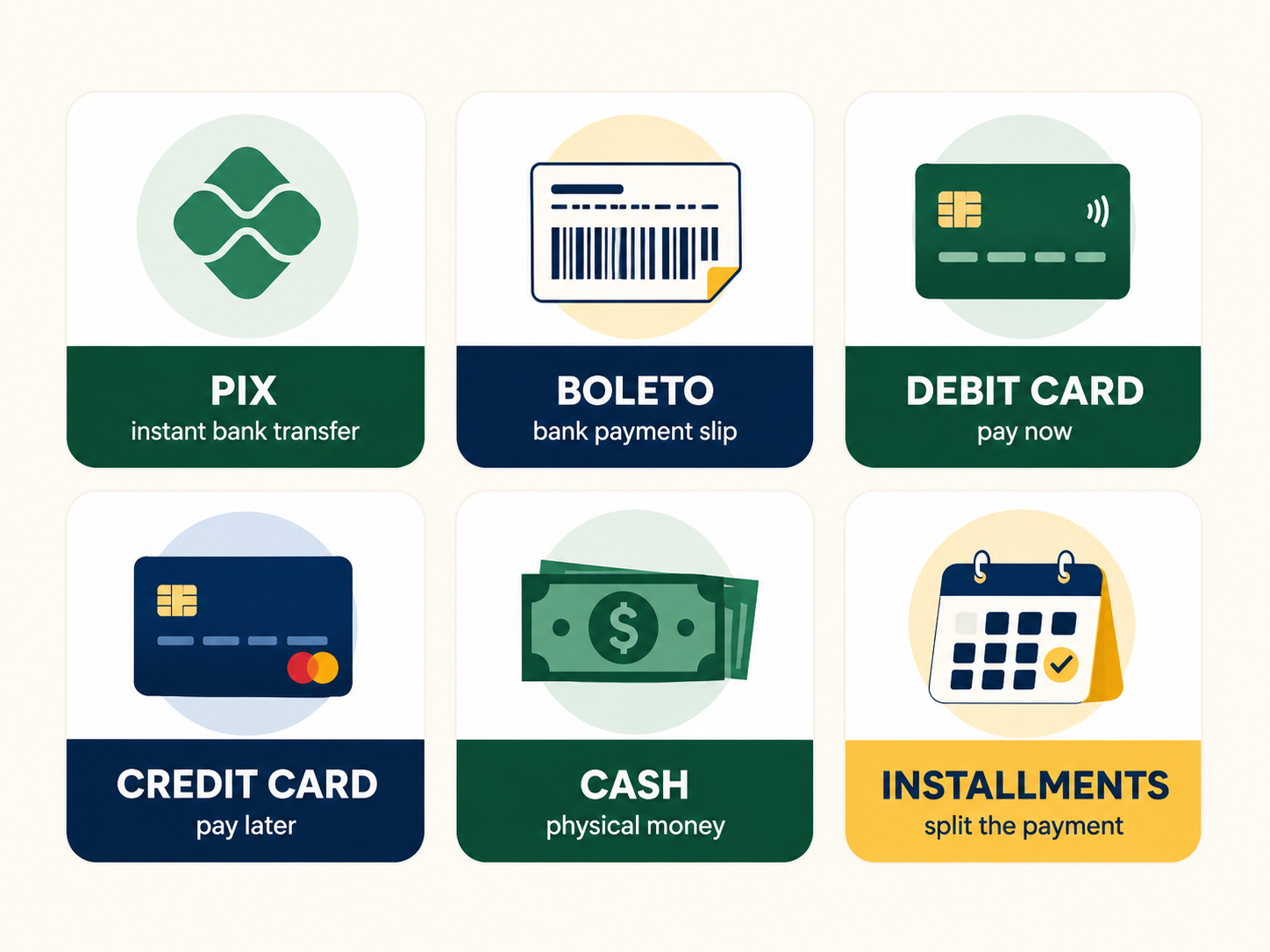
A rapid digital shift without a single winner
How Brazilians pay: the current landscape
Different statistics answer different questions. One source may count how many people use a method; another counts transactions; another measures the total value moved.
Pix share of payment transactions by count in the second half of 2025.
Share of the population reporting Pix use in the Central Bank’s 2024 survey.
Value moved through credit, debit, and prepaid cards in the first quarter of 2026.
Share of in-person card transactions made contactlessly in the first quarter of 2026.
In the second half of 2025, the Central Bank recorded 78.4 billion payment transactions totaling R$68.2 trillion across the reported instruments. Pix alone represented 54.7% of the transaction count. A separate population survey found that 76.4% of respondents used Pix, followed by debit cards at 69.1% and cash at 68.9%.
Cards remain extremely important. In the first quarter of 2026, credit, debit, and prepaid cards moved R$1.1 trillion across 11.7 billion transactions. Credit cards accounted for R$810.2 billion of that value.
One country, several payment logics
Brazilian payment methods compared
| Method | What it is | Common uses | What surprises foreigners |
|---|---|---|---|
| Pix | Instant account-to-account payment | Transfers, shops, professionals, bills, online checkout, splitting costs | Fast and usually immediate; no installment by default |
| Debit card | Money leaves the linked account | Supermarkets, pharmacies, restaurants, everyday purchases | The cashier may ask débito ou crédito? |
| Credit card | Purchase goes to a monthly statement | Everyday spending, online shopping, subscriptions, expensive goods | Can be one payment or installments |
| Boleto | A payment order with barcode and numeric line | Bills, invoices, tuition, services, selected online purchases | Has a due date and is not the same as a bank transfer |
| Cash | Physical reais | Small shops, markets, tips, emergencies, places with weak connectivity | Still relevant even after rapid digitalization |
| Automatic debit / Pix Automático | Authorized recurring payment | Utilities, school, gym, condominium, subscriptions, insurance | Useful for recurring bills; authorization and cancellation rules matter |
A five-second conversation with several cultural clues
What happens at a Brazilian checkout?
Pix, dinheiro, débito, or crédito.
One charge, installments, or payment on a later due date.
The cashier may ask for CPF or loyalty information.
Receipt, card slip, Pix confirmation, or boleto.
A very common exchange is:
Debit or credit?
The same physical card may support both functions, so the cashier needs to select the correct transaction. If you answer crédito, the next question may be uma vez ou parcelado?—one charge or installments?
The infrastructure that changed everyday money movement
What is Pix and how do Brazilians use it?
Instant payment between accounts
Pix is Brazil’s instant-payment system, created by the Central Bank. Funds move between participating accounts in a few seconds, at any hour or day. It can be used between individuals, companies, and public institutions.
Common ways to start a Pix payment
CPF, CNPJ, phone number, email, or a random key linked to an account.
Common at stores, restaurants, invoices, websites, and service providers.
A long code copied into the bank or payment app.
Why people choose Pix
- The money normally reaches the receiver immediately.
- Individuals generally do not pay a fee, except in specified commercial-use situations.
- Small businesses and independent professionals can receive without a traditional card terminal.
- Stores may offer a lower price because receipt is immediate or acceptance costs are different.
- Friends can split restaurant bills, tickets, rent, gifts, or travel expenses quickly.
- It works outside banking hours, including weekends and holidays.
Gente, ficou R$ 68 para cada um. Minha chave Pix é o meu telefone.
Everyone, it came to R$68 per person. My Pix key is my phone number.
Immediate payment from the account
Debit cards in Brazil
No monthly card statement for the purchase
In a debit transaction, the amount is taken from the linked account rather than added to a later credit-card statement. Debit remains common in supermarkets, pharmacies, restaurants, fuel stations, and everyday retail.
The natural answer at checkout is:
Debit, please.
Debit does not normally create a consumer installment plan. If a Brazilian wants to divide the purchase into future monthly charges, the expected route is usually credit rather than debit.
A payment method and a short-term credit system
Credit cards: one purchase now, a statement later
Credit can mean one charge or many monthly installments
The purchase enters the card statement. The customer may choose one charge—crédito em uma vez—or a merchant installment plan when available.
Crédito em uma vez
The full purchase appears as a single charge on the relevant statement.
Crédito parcelado
The store divides the purchase into monthly charges, often advertised as 3x, 6x, 10x, or 12x.
Pagamento recorrente
Subscriptions or services charge the card repeatedly under an ongoing authorization.
Parcelamento da fatura
The cardholder finances an unpaid statement balance. This is different from the original merchant installment purchase and normally involves interest.
The cultural feature that deserves its own complete guide
Why do Brazilian stores show 10x or 12x?
Brazilian retail frequently presents an expensive item through its monthly installment:
R$ 3,000
10x de R$ 300 sem juros
R$ 2,850 no Pix
The installment offer makes the monthly commitment visible, while the Pix offer may reveal that “without interest” does not necessarily mean every payment method has the same effective price. A careful buyer compares the total, the discount, the timing, and the effect on available credit.
In everyday Brazilian Portuguese:
- 3x means three installments.
- 10x de R$ 300 means ten monthly charges of R$300.
- sem juros means no separately stated interest to the buyer under that offer.
- com juros means the installment plan increases the total through interest.
- parcela mínima may limit how many times a smaller purchase can be divided.
A normal part of everyday payment
Contactless cards, digital wallets, and Pix por aproximação
Contactless cards and wallets
Contactless card payments are called pagamento por aproximação. The customer brings the physical card, phone, or compatible device close to the terminal rather than inserting the chip.
In the first quarter of 2026, contactless represented 74.8% of in-person card transactions reported by the card industry association Abecs. That helps explain why a cashier may simply turn the terminal toward you without asking you to insert the card.
Pix por aproximação
Brazil also supports Pix por aproximação. With a compatible account, app or digital wallet, NFC-enabled phone, and participating payment terminal, the customer can initiate a Pix payment by bringing the phone close to the machine instead of scanning a QR Code. The user still reviews the payment information and confirms the transaction.
Availability, authentication, and limits depend on the financial institution, wallet, device, merchant setup, and the customer’s settings. Pix keys, QR Codes, copy-and-paste codes, and the other initiation methods continue to exist.
Can I pay contactlessly?
A payment order with a due date
What is a boleto bancário?
A structured billing instrument
The Central Bank describes boleto as an order of payment that gathers transaction data and the elements required for payment, including a barcode and a numeric representation known as the linha digitável.
A boleto may contain:
- the beneficiary or receiving company;
- the payer’s identification;
- the amount;
- the due date;
- a barcode;
- a numeric line that can be copied or typed;
- instructions about late payment, interest, or penalties;
- in some systems, an additional QR Code or Pix payment option.
Where boleto remains common
Invoices and services
Schools, condominiums, professional services, insurance, and business collections.
Online checkout
Some stores generate a boleto for customers who do not want or cannot use a card.
Recurring obligations
Monthly bills may still be issued as boleto even when the customer later pays through a banking app.
Formal identification
The document creates a clear billing reference with beneficiary, amount, and due date.
Declining does not mean irrelevant
Does Brazil still use cash?
Yes. Cash use has fallen sharply as Pix and cards expanded, but Central Bank research still found physical money used by 68.9% of the surveyed population in 2024. It was the most frequently used method for 22% of respondents, behind Pix.
Cash may remain useful for:
- small markets, street vendors, tips, and informal sales;
- locations with unstable connectivity;
- people without convenient digital access;
- backup when a card terminal or app fails;
- situations where the seller offers a cash price.
Do you have change for one hundred?
Paying every month without repeating the entire process
Automatic debit, recurring card charges, and Pix Automático
Débito automático
The customer authorizes recurring debits from an account. It has long been used for utilities and other regular bills.
Cartão recorrente
A subscription or service charges the card periodically under continuing authorization.
Pix Agendado recorrente
The payer schedules repeated Pix transfers, commonly with a fixed pattern and payer control.
Pix Automático
Launched nationally in June 2025 for recurring payments initiated under authorization to participating businesses.
The Central Bank lists energy, telephone, schools, gyms, condominiums, subscriptions, and insurance among the intended uses of Pix Automático. The customer authorizes the recurring arrangement and can review the terms in the financial institution’s app.
A question that can surprise visitors
What does CPF na nota mean?
Would you like your CPF on the receipt?
CPF is Brazil’s individual taxpayer identification number. The specific question CPF na nota? asks whether your CPF should be included on the fiscal receipt. Depending on the state, this may connect to a tax-receipt program or help identify the transaction.
A cashier may also request CPF separately for loyalty points, warranty registration, a customer profile, or purchase history. Those uses are related to identification, but they are not necessarily the same as adding CPF to the fiscal receipt.
You can answer:
- Sim. — Yes.
- Não, obrigado / obrigada. — No, thank you.
- Para que vocês precisam do CPF? — What do you need the CPF for?
The checkout may be more local than the website looks
Paying for online shopping and subscriptions in Brazil
A Brazilian online checkout may offer several combinations:
- Pix QR Code or copy-and-paste code, often with a short payment window;
- credit card in one charge;
- credit-card installments;
- boleto with a due date;
- recurring card payment for subscriptions;
- Pix Automático or another authorized recurring method;
- store credit, marketplace balance, or partner financing.
Some websites request CPF before showing all payment options. A foreign-issued card may be accepted for one charge while local installments are unavailable. Authentication, billing address, fraud screening, and issuer authorization can also affect approval.
Do not assume your home-country setup will map perfectly
What foreigners should know before paying in Brazil
| Situation | What to expect |
|---|---|
| You have a Brazilian bank or payment account | You may be able to use Pix directly through the institution’s app, subject to its onboarding and account rules. |
| You only have a foreign card | Card acceptance may be available, but do not assume that a foreign-issued card will support local installment checkout. |
| A website requests CPF | The merchant may use CPF for identification, fraud checks, invoice issuance, delivery, loyalty, or generation of a local payment method. |
| The merchant offers only Pix or boleto | You may need a local account, a trusted local payer, or another payment arrangement accepted by the merchant. |
| You are booking travel | Use the exact name and card details required by the platform; payment rules may differ from an in-person store. |
| The purchase is important or expensive | Confirm the total price, installment count, interest, refund policy, delivery terms, and the name of the legal seller. |
A practical payment backup plan
- Carry more than one card. Issuer or terminal approval can fail even when the merchant accepts the card brand.
- Keep a small amount of cash. It is useful when connectivity, terminals, or apps fail.
- Ask the total before choosing installments. Compare the total with the Pix or one-payment price.
- Confirm whether the price includes interest. Ask É sem juros?
- Save addresses and seller information. This matters for online orders and service deposits.
- Do not borrow a stranger’s payment identity. CPF, account ownership, receipts, refunds, and warranties can become complicated.
- For a long stay, research local account options. Access to Pix can make rent, professionals, classes, and daily transfers easier.
Portuguese for paying, billing, and shopping
Essential Brazilian payment vocabulary
| Portuguese | Natural English | Brazilian usage note |
|---|---|---|
| à vista | in one payment / upfront | Pode ser no Pix ou em uma única cobrança no cartão, dependendo da loja. |
| parcelado | in installments | Quero pagar parcelado. |
| sem juros | without stated interest | Em dez vezes sem juros. |
| com juros | with interest | Em doze vezes, mas com juros. |
| entrada | down payment | Uma entrada de R$ 2.000 e o restante parcelado. |
| parcela / prestação | installment payment | A primeira parcela cai nesta fatura. |
| fatura | credit-card statement / bill | Minha fatura fecha amanhã. |
| vencimento | due date | Qual é a data de vencimento? |
| limite | credit limit | Essa compra compromete o limite inteiro? |
| débito | debit | No débito, por favor. |
| crédito | credit | Crédito em uma vez. |
| passar o cartão | run / use the card | Pode passar este cartão. |
| aproximação | contactless payment | Pode ser por aproximação? |
| chave Pix | Pix key | Minha chave Pix é o meu e-mail. |
| QR Code | QR code | Vou escanear o QR Code. |
| Pix Copia e Cola | copy-and-paste Pix code | Me manda o Pix Copia e Cola. |
| boleto | Brazilian payment slip/order | Vou pagar o boleto pelo aplicativo do banco. |
| linha digitável | numeric boleto line | Copie a linha digitável. |
| comprovante | proof of payment / receipt | Pode me enviar o comprovante? |
| estorno | refund / reversal | O estorno pode aparecer na próxima fatura. |
| troco | change | Você tem troco para cem? |
| CPF na nota | CPF on the receipt | Dependendo do estado e da loja, a finalidade pode variar. |
The same words in real exchanges
Four Brazilian payment dialogues
At a physical store
Cashier: Débito ou crédito?
Customer: Crédito.
Cashier: Uma vez ou parcelado?
Customer: Em três vezes, por favor.
Cashier: CPF na nota?
Customer: Não, obrigado.
Asking about a Pix discount
Customer: Tem desconto no Pix?
Salesperson: Tem 5% de desconto.
Customer: E no cartão?
Salesperson: No cartão, dá para dividir em dez vezes sem juros.
Paying a professional
Client: Você aceita Pix?
Professional: Aceito. Vou te mandar a chave.
Client: Pode mandar o QR Code?
Professional: Claro. Confere o nome antes de pagar.
Paying a boleto
Customer: O boleto vence quando?
Company: Na próxima sexta-feira.
Customer: Posso pagar depois do vencimento?
Company: O aplicativo vai mostrar o valor atualizado, se houver multa ou juros.
Translate the system, not only the vocabulary
Common misunderstandings about paying in Brazil
Thinking Pix is a Brazilian version of Venmo
Pix is national payment infrastructure created by the Central Bank. It works across participating banks and payment institutions rather than belonging to one private app.
Assuming boleto means cash
A boleto is a payment order. It can be paid through a bank app and may include a barcode, numeric line, and sometimes a Pix option.
Treating every installment as unpaid credit-card debt
A merchant installment purchase that is paid normally on each monthly statement is different from failing to pay the statement and financing the balance.
Looking only at the monthly installment
Twelve small-looking payments can hide a high total price. Always calculate the total and compare it with the Pix or upfront price.
Assuming sem juros means the seller has no financing cost
The consumer may see no separately stated interest, while the commercial price and the merchant’s payment arrangement still reflect business costs.
Believing cash has disappeared
Cash use has declined, but it remains useful and widely recognized, especially for small purchases, emergencies, and people with different levels of digital access.
Sending Pix before checking the recipient
The app displays recipient information before confirmation. Stop if the name, institution, or amount is unexpected.
Assuming foreign cards work exactly like Brazilian cards
Installments, authentication, address checks, online acceptance, and issuer authorization can differ.
Fast payments require deliberate confirmation
Basic safety for Pix, boleto, cards, and online checkout
Money and Shopping in Brazil series
Continue with the cultural and economic context
Frequently asked questions about payments in Brazil
What is the most common payment method in Brazil?
Pix leads by transaction count and has become the most frequently used method in Central Bank research. Cards also remain central, especially for credit, installments, subscriptions, and contactless payments. The best answer depends on whether you are counting people, transactions, or value.
Is Pix free?
For individuals, Pix is generally free, although the rules allow charges in certain commercial-use situations. Businesses may face pricing set by their financial institution.
Can tourists use Pix?
Pix is accessed through an account at a participating bank or payment institution. A tourist without a compatible local account may not be able to initiate Pix directly, even though a merchant strongly prefers it.
What is a Pix key?
A key is a convenient identifier linked to an account, such as CPF, CNPJ, phone number, email, or a random key. Pix can also be initiated through QR Code, copy-and-paste code, or account details.
Why do stores offer a lower price for Pix?
The seller may value immediate receipt, lower acceptance costs, lower fraud exposure, or simpler cash flow. The reason and size of the discount vary by business.
What does crédito em uma vez mean?
Crédito em uma vez means the full purchase is charged once to the credit-card statement rather than divided into monthly installments.
Does sem juros really mean no interest?
It means no separate interest charge is stated to the buyer for that installment plan. You should still compare the total installment price with any Pix or upfront discount.
Is boleto still used in Brazil?
Yes. Pix reduced its role in some consumer situations, but boleto remains important for invoices, bills, tuition, services, business collections, and selected online purchases.
What is CPF na nota?
It means placing the customer’s CPF on the fiscal receipt. Depending on the state, this may connect to a tax-receipt program or help identify the transaction. A retailer may also request CPF separately for loyalty, warranty, a customer profile, or purchase history, but that is not necessarily the same request.
What should I say when the cashier asks débito ou crédito?
Answer débito for a debit-card transaction, crédito em uma vez for one credit charge, or crédito parcelado if you want to ask about installments.