

Brazilian Nicknames: 40+ Common, Funny & Affectionate Apelidos
Brazilian Portuguese names and social language
Bia, Dudu, Zé, Paulinho, Marcão: Brazilian nicknames follow patterns—but they also follow relationships.
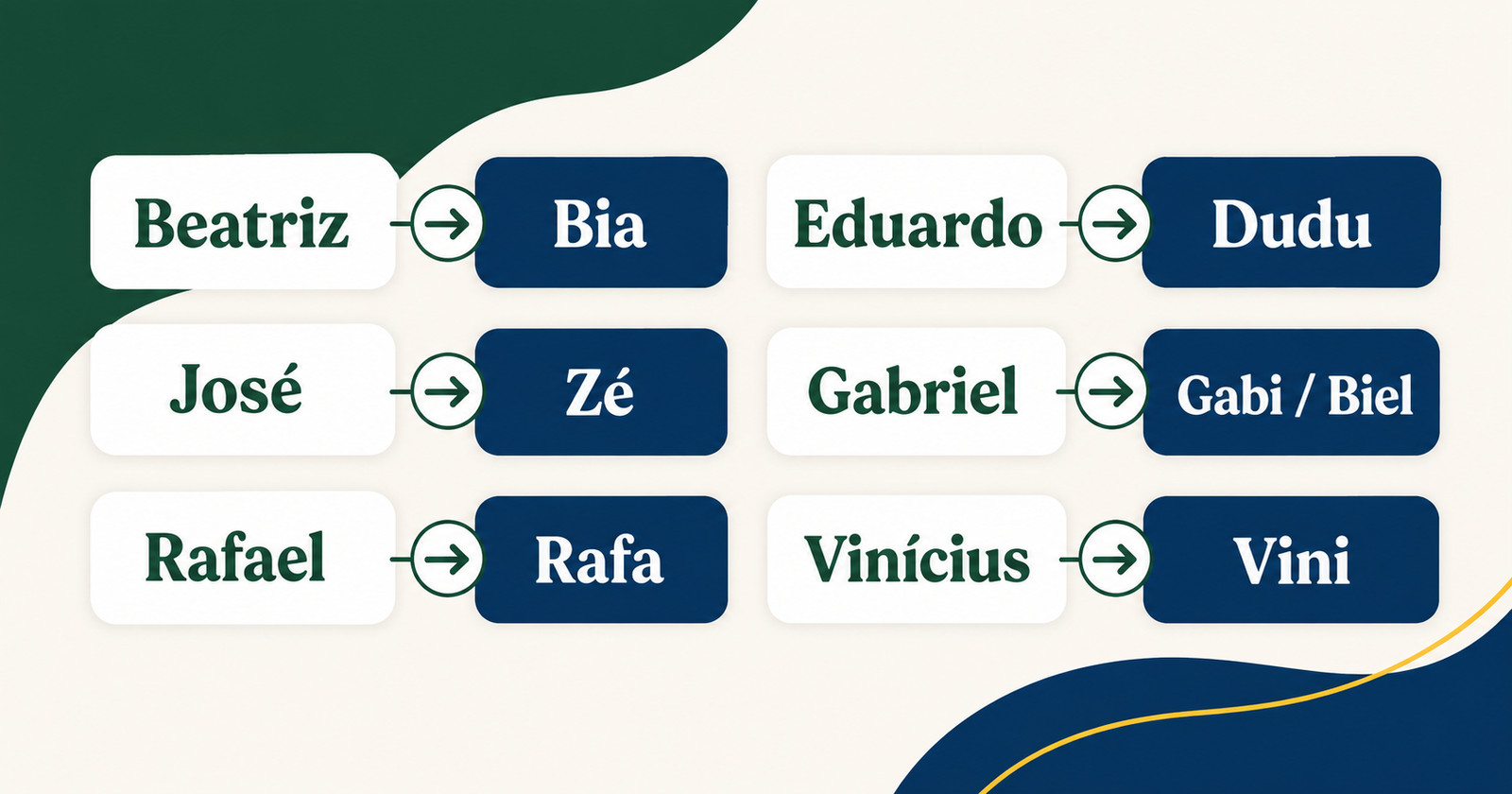
If you spend time with Brazilians, you may discover that the name everyone uses is not the name you first heard during an introduction. Beatriz becomes Bia, Eduardo becomes Dudu, José becomes Zé, and a person may be known by a nickname based on family history, personality, a place, or an old joke.
The important part is not memorizing a giant list. It is understanding how Brazilian nicknames are formed, what they communicate, and when you should—or should not—use one.
The first vocabulary trap
What does apelido mean in Brazil?
For Brazilian Portuguese learners, this distinction is worth learning early because the same word can create confusion across Portuguese varieties.
nickname in normal Brazilian usage.
Meu apelido é Bia.
My nickname is Bia.
surname / last name in Brazilian Portuguese.
Qual é o seu sobrenome?
What is your last name?
In European Portuguese, apelido commonly means surname. This is a genuine Brazil–Portugal vocabulary difference.
Recognition first, memorization second
Common Brazilian nicknames formed from first names
These are common patterns, not legal or mathematical rules. The same person may use different forms with family, childhood friends, coworkers, or online.
| Full name | Common nickname(s) | Example |
|---|---|---|
| Alexandre | Alex, Xande | Oi, Xande! |
| Ana | Aninha, Nana | A Aninha já chegou? |
| Antônio | Tonho, Toninho, Tonhão | Fala, Toninho! |
| Beatriz | Bia, Bê | A Bia trabalha comigo. |
| Bruna | Bru | Manda mensagem pra Bru. |
| Camila | Cami, Mila | A Mila vem hoje? |
| Carlos | Carlinhos, Carlão | O Carlão conhece todo mundo. |
| Carolina | Carol, Carolzinha | Fala com a Carol. |
| Daniel / Daniela | Dani | Você viu o Dani? / Você viu a Dani? |
| Eduardo | Dudu | O Dudu é meu primo. |
| Felipe | Fê, Lipe | O Lipe vai com a gente. |
| Fernanda | Fê, Nanda | A Nanda mora em Recife. |
| Fernando | Fê, Nando | O Nando está chegando. |
| Francisco | Chico, Chiquinho | O Chico é amigo do meu pai. |
| Gabriel | Gabi, Biel | O Biel joga comigo. |
| Gabriela | Gabi | A Gabi já respondeu. |
| Guilherme | Gui | O Gui está aqui. |
| Gustavo | Guto, Gu | Pergunta pro Guto. |
| Isabela / Isabella | Isa, Bela | A Isa é minha colega. |
| João | Joãozinho, Jão, Joca | O Joca chega mais tarde. |
| José | Zé, Zezinho | Seu Zé mora aqui perto. |
| Juliana | Ju, Juli | A Ju me ligou. |
| Leonardo | Léo | O Léo é professor. |
| Letícia | Lê | A Lê vai também. |
| Lucas | Lu, Luquinhas | O Luquinhas é filho dela. |
| Luísa / Luiza | Lu, Lulu | A Lulu dormiu cedo. |
| Marcos | Marquinhos, Marcão | O Marcão trouxe o carro. |
| Maria / Mariana | Mari | A Mari é minha vizinha. |
| Paulo | Paulinho | O Paulinho joga futebol. |
| Pedro | Pedrinho | O Pedrinho está na escola. |
| Rafael / Rafaela | Rafa, Rafinha | Fala com a Rafa. |
| Roberto / Alberto | Beto, Betinho | O Beto é meu tio. |
| Rodrigo | Rô, Digo | O Rô já sabe. |
| Tatiana / Tatiane | Tati | A Tati trabalha aqui. |
| Tiago / Thiago | Ti, Tiaguinho | O Tiaguinho é o mais novo. |
| Vinícius | Vini | O Vini mandou o endereço. |
| Vitória | Vi, Vivi | A Vivi vem amanhã. |
The patterns behind the list
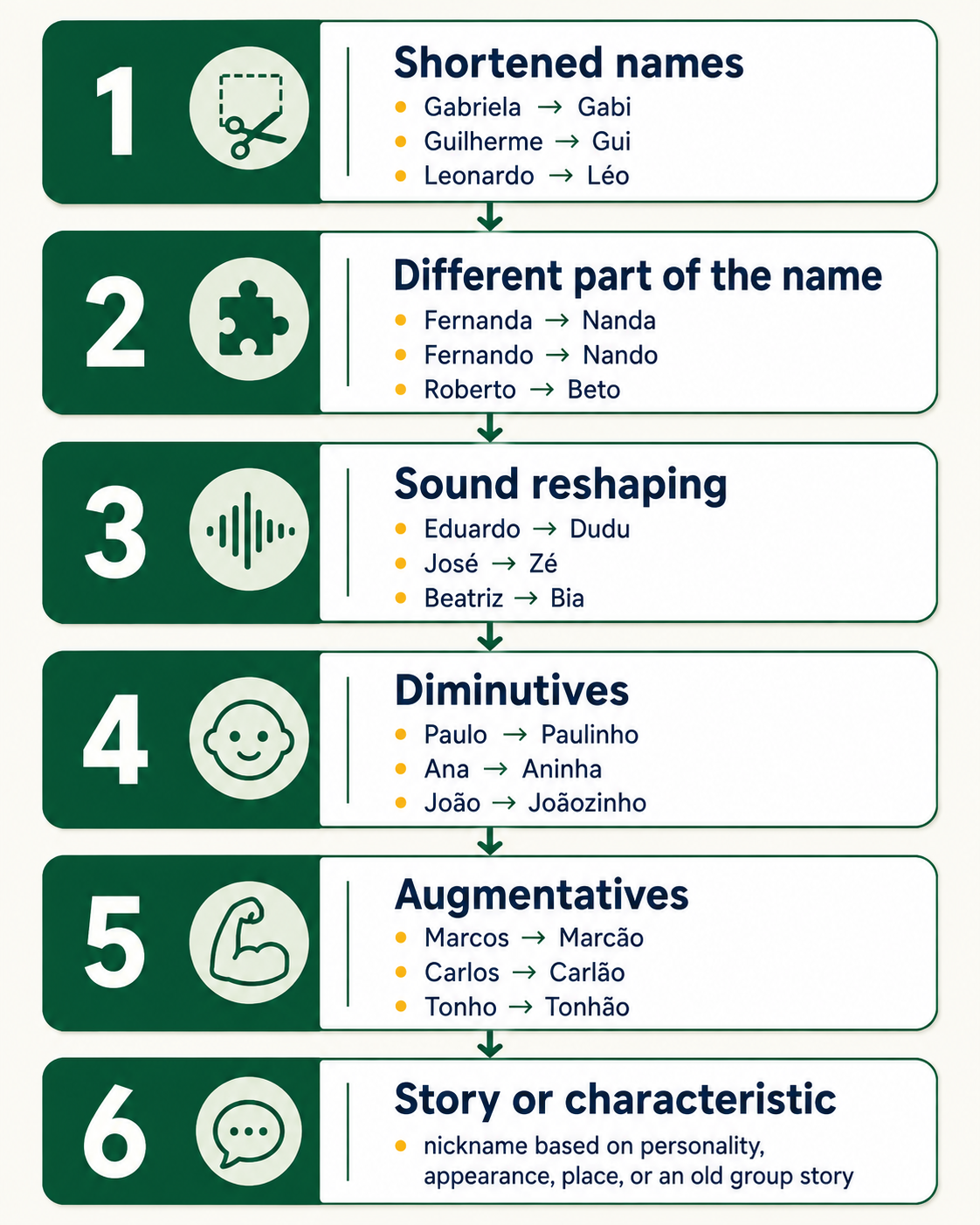
How do Brazilians create nicknames?
Gabriela → Gabi
Guilherme → Gui
Leonardo → Léo
Fernanda → Nanda
Fernando → Nando
Roberto → Beto
Eduardo → Dudu
José → Zé
Beatriz → Bia
Paulo → Paulinho
Ana → Aninha
João → Joãozinho
Marcos → Marcão
Carlos → Carlão
Tonho → Tonhão
A nickname may come from appearance, personality, hometown, a childhood event, a family joke, sport, work, or something outsiders could never guess.
This is why learning Brazilian nicknames is partly linguistic and partly social. You can learn the morphology, but you still need the relationship to understand why a particular nickname belongs to a particular person.
A small ending with several meanings
Why -inho and -inha do not simply mean “small”
Affection
Paulinho may simply be the affectionate form everyone has used since childhood.
Age or family distinction
A younger relative may receive a diminutive to distinguish them from an older person with a similar name.
Established identity
Some diminutives stop feeling “small” altogether and simply function as the person’s everyday name.
The most visible endings are -inho/-inha and -zinho/-zinha, but the exact form depends on the word or name. Learners should recognize the pattern instead of trying to attach the same ending mechanically to every name.
Bigger does not always mean physically bigger
Nicknames with -ão and -ona
Marcos → Marcão
The augmentative can suggest size or presence, but it may simply be an established friendly nickname.
Carlos → Carlão
A person called Carlão does not need to be physically large. The form may have become conventional inside a group.
Portuguese suffixes are expressive. Their literal grammatical meaning matters, but social use can become more important than the literal meaning.
Not every nickname is derived from a name
Affectionate pet names you may hear in Brazilian families and relationships
| Portuguese | Natural English idea | Important nuance |
|---|---|---|
| amor / meu amor | love / my love | Common between partners and sometimes family members. |
| meu bem | dear / honey | Warm and common; relationship and tone matter. |
| anjo / meu anjo | angel / my angel | Affectionate; may be romantic, familial, or simply warm. |
| lindo / linda | handsome / beautiful; gorgeous | Can function as affectionate address, not only description. |
| fofo / fofa | cutie / sweetie | Fofo can mean cute, sweet, or adorable depending on context. |
| neném / bebê | baby | Used with children and sometimes romantically. |
| filho / filha | son / daughter | Parents may use the family term itself as a form of address. |
| filhinho / filhinha | little son / daughter; sweetheart | The diminutive adds affection. |
These are forms of address, not always “nicknames” in the strictest sense. But learners hear them in the same social space: people calling one another something other than a full legal name.
Where literal translation becomes dangerous
Descriptive and teasing nicknames in Brazil
Brazilian groups can create nicknames from appearance, personality, habits, origin, work, sport, or old stories. Some can sound surprisingly direct to outsiders.
| Example you may hear | Literal idea | What a learner should know |
|---|---|---|
| Careca | bald | Can become an established nickname, but do not assume a stranger enjoys being called this. |
| Baixinho / Baixinha | short person / little one | May be affectionate inside a relationship; can also be unwanted. |
| Magrão | big skinny/tall guy | Often descriptive, but body-based nicknames are personal. |
| Gordo / Gordinho | fat / chubby | Can be affectionate among people who already use it, but can also be insulting. Never assume it is safe. |
| Gigante | giant | May refer to height, presence, or an old joke. |
| Foguinho | little fire | Could refer to red hair, energy, personality, or an unrelated story. |
| Formiguinha | little ant | Can refer to someone who loves sweets or to a completely different group story. |
| Cabeludo | hairy / long-haired | May be literal or ironic—for example, an established nickname for someone who later became bald. |
Recognition is not permission
Which Brazilian nicknames should learners avoid inventing themselves?
The safest rule is simple: use the name or nickname the person uses for themselves in that context.
Where are you from?
Nicknames based on places and regional identity
Literally someone from Bahia. It can become an identifying nickname when a person moves somewhere else.
Someone from Minas Gerais. In a group outside Minas, it may become the easiest way to identify one person.
Commonly identifies someone associated with Rio Grande do Sul and can become part of a public nickname.
This pattern is easier to understand if you think of a nickname as a social identifier. If there are three people named Carlos, one may become Carlão, another may be known by a surname, and another may become Baiano because he is the one from Bahia.
Why Brazilian football looks like a nickname lesson
Nicknames in Brazilian sport and public life
Brazilian public life offers unusually visible examples of people whose everyday public identity is shorter, more expressive, or completely different from a full civil name.
Name-derived public forms
Ronaldinho shows the diminutive pattern. Ronaldinho Gaúcho combines that form with a regional identifier.
Guga, widely associated with tennis player Gustavo Kuerten, is another familiar example of a public nickname.
Nicknames that do not reveal the full name
Pelé, Xuxa, and other public names show why you cannot always predict a person’s legal name from the name the public knows.
In everyday life the same thing happens on a smaller scale: the nickname may become the socially primary name.
Informal does not mean unprofessional
Can Brazilians use nicknames at work or in formal situations?
Yes—but there is no universal rule. A familiar shortened name such as Bia, Rafa, or Dudu may function almost like a normal first name and appear naturally at work. A teasing nickname based on someone’s body or an old joke belongs to a very different category.
Usually low-risk
A person introduces herself as Bia, signs messages as Bia, and coworkers call her Bia. Use Bia.
Higher-risk
You hear two close coworkers use a teasing private nickname once. Do not automatically assume you have been invited to use it too.
Instead of asking whether “Brazilian culture allows nicknames at work,” ask a more useful question: what does this particular person use in this particular relationship?
The easiest way to avoid guessing
How to ask a Brazilian what they want to be called
| Portuguese | Natural English | When to use it |
|---|---|---|
| Como você prefere que eu te chame? | What do you prefer I call you? | Clear and respectful when you are unsure. |
| Posso te chamar de Bia? | Can I call you Bia? | Useful when you have heard others use the nickname. |
| Todo mundo te chama de Dudu? | Does everyone call you Dudu? | Natural way to confirm whether a nickname is broadly used. |
| Você tem apelido? | Do you have a nickname? | Casual conversation question. |
| Meu nome é Rafael, mas pode me chamar de Rafa. | My name is Rafael, but you can call me Rafa. | A natural way to introduce your own preferred form. |
| Lá em casa todo mundo me chama de Ju. | At home everyone calls me Ju. | Signals that a nickname may be family-specific. |

Hear the relationship in the sentence
Six real-style dialogues with Brazilian nicknames
1. Meeting someone
A: Oi, meu nome é Beatriz.
Hi, my name is Beatriz.
B: Prazer, Beatriz.
Nice to meet you, Beatriz.
A: Pode me chamar de Bia.
You can call me Bia.
2. Confirming a nickname
A: Todo mundo te chama de Dudu?
Does everyone call you Dudu?
B: Quase todo mundo. Minha mãe me chama de Eduardo quando está brava.
Almost everyone. My mom calls me Eduardo when she’s mad.
3. A family-only form
A: Por que sua irmã te chamou de Lulu?
Why did your sister call you Lulu?
B: É apelido de infância. Só minha família me chama assim.
It’s a childhood nickname. Only my family calls me that.
4. At work
A: No e-mail está “Rafael”. Posso te chamar de Rafa?
The email says “Rafael.” Can I call you Rafa?
B: Claro. Todo mundo aqui me chama de Rafa.
Of course. Everyone here calls me Rafa.
5. A teasing nickname
A: Por que chamam ele de Careca?
Why do they call him Careca?
B: É um apelido antigo da turma. Melhor deixar eles usarem.
It’s an old nickname from the group. Better to let them use it.
6. Origin becomes identity
A: O Mineiro vem hoje?
Is Mineiro coming today?
B: Vem. Depois que ele mudou pra cá, o apelido pegou.
Yes. After he moved here, the nickname stuck.
A learner’s decision rule
Should you use the nickname you just heard?
- Did the person introduce themselves with it? Use it.
- Do they sign messages or public profiles with it? Usually safe.
- Does everyone in that context use it naturally? Probably safe, but personal nicknames may still be relationship-specific.
- Is it based on body, race, ethnicity, disability, sexuality, or an insult? Do not assume permission.
- Are you unsure? Ask: Como você prefere que eu te chame?
Continue the names and relationships cluster
Related Brazilian Portuguese guides
Frequently asked questions
FAQ about Brazilian nicknames
What does apelido mean in Brazilian Portuguese?
In everyday Brazilian Portuguese, apelido means “nickname.” The normal Brazilian word for surname or last name is sobrenome.
Why do Brazilians use so many nicknames?
Nicknames can make names shorter, distinguish people with similar names, preserve childhood or family forms, and express familiarity or identity. Some are name-based; others come from stories, characteristics, places, or group history.
What are common Brazilian nicknames?
Common examples include Bia for Beatriz, Dudu for Eduardo, Gabi for Gabriela, Gui for Guilherme, Rafa for Rafael or Rafaela, Zé for José, Vini for Vinícius, Beto for Roberto or Alberto, and diminutive forms such as Paulinho and Pedrinho.
Does -inho always mean someone is small?
No. The diminutive can express affection, age, familiarity, family distinction, or simply an established nickname. A person called Paulinho does not have to be physically small.
What does -ão mean in a nickname?
It is an augmentative pattern. In names such as Marcão or Carlão, it may suggest size or presence, but it can also simply function as a familiar established form.
Can I call a Brazilian by a nickname based on appearance?
Not automatically. You may hear body-based nicknames among close friends, but the same word can be hurtful from a different speaker. Use an established self-used nickname or ask what the person prefers.
Are nicknames used at work in Brazil?
Yes, especially familiar shortened names such as Bia, Rafa, Gabi, or Dudu. Whether a more personal or teasing nickname is appropriate depends on the workplace, relationship, and the person’s preference.
Is apelido the same word in Portugal?
The word exists in both varieties, but the everyday meaning differs. In Brazil, apelido normally means nickname; in European Portuguese, apelido commonly refers to a surname or family name.
How can I ask someone what they prefer to be called?
Say Como você prefere que eu te chame? You can also ask Posso te chamar de Rafa? if you already know the nickname.
If a Brazilian gives me a nickname, does it mean they like me?
It can signal familiarity or playful inclusion, but there is no universal rule. A nickname can also be practical, inherited from another group, neutral, or unwanted. The relationship matters more than the existence of the nickname itself.